
The purpose of this Strategic Planning Policy is to establish a clear and systematic approach for the development, implementation, review, and updating of Alfaisal university's Strategic Plan. This policy ensures that our strategic planning processes are aligned with our mission, vision, and core values, and that they effectively address the current and future challenges and opportunities facing the university.
This policy applies to all colleges, faculties, departments, and units within Alfaisal university encompassing academic, research, administrative, and support functions. It outlines the responsibilities of all members of the university community in contributing to the strategic planning process.
This policy will be reviewed and revised as necessary to reflect changes in the strategic direction or operational needs of Alfaisal university. Any modifications will be approved by the University Council.
Policy Statement
Alfaisal University is committed to excellence in education, research, and community engagement. Our strategic planning process is designed to be inclusive, transparent, and dynamic, providing a roadmap for the university's future growth and development. It will guide decision-making, resource allocation, and performance measurements across all levels of the university.
Key Principle
The strategic planning process at Alfaisal University is guided by the following principles:
- Inclusivity: Engaging a broad range of stakeholders in the planning process.
- Transparency: Ensuring that information about the strategic planning process is openly shared.
- Accountability: Holding individuals and units responsible for achieving strategic objectives.
- Adaptability: Remaining flexible to adjust to changing internal and external environments.
- Alignment: Ensuring that the Strategic Plan aligns with the university's mission, vision, and values.
Strategic Planning Process
The Steering Committee at Alfaisal University oversees the strategic planning process and ensures alignment with the university’s mission, vision, and long-term priorities. Reporting directly to the University Council, the committee provides high-level oversight and submits periodic updates, including progress, key challenges, and recommendations.
The main responsibilities of the Steering Committee include:
- Strategic Oversight: The committee ensures that the development and implementation of the strategic plan align with the university's core priorities, such as enhancing global ranking, research, teaching and learning excellence, and community engagement.
- Monitoring and Evaluation: The committee regularly reviews progress toward key strategic goals, assesses performance indicators, and recommends adjustments to keep the university on track to achieve its targets, including alignment with initiatives like Saudi Vision 2030.
- Resource Allocation: The Steering Committee advises on the optimal allocation of financial and human resources to support strategic initiatives, ensuring sustainability and proper use of university assets.
- Risk Management: It identifies potential risks and develops mitigation strategies to minimize disruptions in the implementation of the strategic plan.
- Reporting to University Council: The committee reports directly to the University Council, ensuring the council is well-informed to make critical decisions regarding institutional priorities and resources.
The comprehensive framework for developing, implementing, reviewing, and updating the university’s strategic plan is essential for aligning the university’s goals with its actions. This framework is tailored to the specific needs of Alfaisal University and is structured around five major consecutive phases. These phases guide the strategic planning process from conception to execution, ensuring that institutional efforts remain aligned with internal priorities and external opportunities.
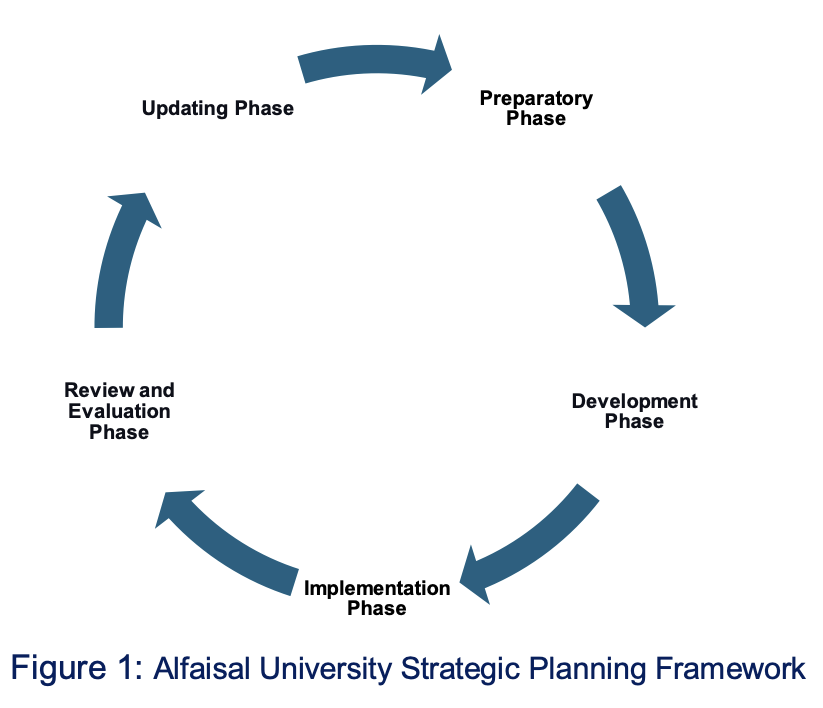
Phase One: Preparatory Phase
The objective of the Preparatory Phase is to establish a solid foundation for Alfaisal University's strategic planning process by ensuring all key elements are in place before moving forward. This phase focuses on setting clear parameters for the strategic plan and conducting a thorough analysis of both internal and external factors.
- Define the Scope and Timeline: Establish clear boundaries for the strategic plan's coverage and set a realistic timeline for its development and implementation.
- Conduct an Environmental Scan: Perform a SWOT analysis to assess internal strengths and weaknesses, along with external opportunities and threats, helping the university understand its current standing and future possibilities.
- Incorporate National Goals: Summarize key national initiatives, such as Saudi Vision 2030, the Ministry of Education's goals, and the Human Capital Development Program, to ensure that the strategic plan aligns with these broader objectives and uses them as key drivers for shaping the university’s future direction.
Phase Two: Development Phase
The objective of the Development Phase is to create a strategic plan through a collaborative and inclusive process that engages stakeholders across the university.
This phase ensures that the strategic plan is aligned with the university’s core values and aspirations and sets a clear path forward.
- Vision and Mission Review: Review and, if necessary, revise the university’s vision and mission statements to ensure they accurately reflect current values and long-term aspirations.
- Goal Setting: Establish strategic goals that are SMART (specific, measurable, achievable, relevant, and time-bound), ensuring they align with the university’s vision and mission.
- Strategy Development: Develop detailed strategies and actions to achieve each goal. This process involves wide consultation with faculty, staff, students, and other stakeholders to ensure collective ownership, buy-in, and the feasibility of the plan.
Phase Three: Implementation Phase
The objective of the Implementation Phase is to put the strategic plan into action while maintaining flexibility and responsiveness to emerging needs and challenges. This phase translates strategic goals into concrete actions and ensures all stakeholders are aligned and engaged throughout the process.
- Action Plans: Create detailed action plans for each strategic goal, outlining specific tasks, timelines, responsible parties, and the resources required to ensure successful execution.
- Communication Plan: Develop and implement a communication strategy to share the strategic plan with all stakeholders, fostering transparency, engagement, and collective ownership.
- Resource Allocation: Allocate the necessary resources, such as budget and personnel, to support the effective implementation of the strategic plan and ensure that each initiative has the support it needs.
Phase Four: Review and Evaluation Phase
The objective of the Review and Evaluation Phase is to regularly assess the progress of the strategic plan and make necessary adjustments to ensure ongoing relevance and effectiveness. This phase focuses on continuous improvement and responsiveness to emerging challenges and opportunities.
- Monitoring and Reporting: Develop a system for tracking progress toward strategic goals using key performance indicators (KPIs) and establish regular reporting mechanisms to maintain transparency and accountability.
- Review Meetings: Conduct regular review meetings with the Steering Committee and other key stakeholders to evaluate progress, address challenges, and identify new opportunities.
- Feedback Loops: Implement feedback mechanisms that allow the university community and stakeholders to provide input on the plan's implementation and its impact, ensuring continuous alignment with institutional needs and priorities.
Phase Five: Updating Phase
The objective of the Updating Phase is to refresh the strategic plan based on the outcomes of evaluations and any changing circumstances. This phase ensures the plan remains dynamic and adaptable, continuously aligned with the university’s evolving goals and external factors.
- Assessment of Outcomes: Evaluate how well the strategic goals have been achieved and identify areas of success as well as those requiring further attention.
- Adjustment and Adaptation: Revise strategies and action plans to address any unmet goals or to respond to new challenges, opportunities, or shifts in the university’s environment.
- Renewal Process: Every 2-3 years, initiate a comprehensive review and renewal of the strategic plan to ensure it remains relevant and aligned with the university’s long-term aspirations and the changing external landscape
By following this framework, Alfaisal university can ensure that its strategic planning process is dynamic, inclusive, and practical, leading to a plan that is both aspirational and achievable.
Roles and Responsibilities
- Governing Body: Provides overall approval of the Strategic Plan.
- Strategic Planning Committee: Leads the development, implementation, and review of the Strategic Plan.
- University Community: Engages in the strategic planning process and contributes to the achievement of strategic objectives.
- Strategic Planning Office: Supervise the strategic planning process and supports the Strategic Planning Committees.