
Human Resources Philosophy
The responsibility of the Human Resources (HR) department is to create healthy and motivating work environment characterized by openness, enthusiasm, trust, equality, and collaboration.
We believe that people are the most important pillar to any organization. As a result, work will bloom when its people thrive and struggle when its people struggle.
We believe that people can be developed to a great extent as they have creative energy that is usually partly employed.
We do believe that people contribute to the maximum if they get an opportunity to discover their full potential and use it.
We also believe that people feel committed to their work if they develop belongingness with it and they are likely to develop a feeling of belongingness if the organization takes care of them and their need satisfaction.
Therefore, we are here. We are here to address these believes.
We envision HR to be an open and trusted partner to our community and are committed to promote honesty, integrity, and trust, celebrate teamwork, encourage communication, and embrace change and innovation.
We are here to make this happen.
1.0 Introduction to the Manual
1.1 Overview
The purpose of this manual is to serve as a working guide for Human Resources staff and administrators processing HR matters at Alfaisal University. This manual will be used to govern the conduct of business and the University’s relationship with its employees.
While using this manual it must be remembered that no two situations are exactly the same. Further it is neither practical nor feasible to anticipate all possible work situations in advance and present policies, which supply complete ready-made answers. Within the framework illustrated in the manual, it is possible to address probable situations that may arise in the normal course of business and employee relations. All references in this manual to word “University” shall be deemed to be referenced to the “Alfaisal University”.
1.2 Applicable Law
The manual has been devised in accordance with statutory requirements, the University’s internal rules and its contractual obligations, subject to all laws of the Kingdom of Saudi Arabia. The manual clarifies the University standpoint and thereby eliminates the need for individual decision-making in day-to-day affairs.
Alfaisal University is an equal opportunity employer, which means that it provides the same opportunities for hiring, development and benefits to everyone without discriminating between age, gender, disability. Equal Opportunity Employer reflects our commitment to ensure equality, treat everyone with respect and promote diversity in the workplace.
2.0 Role of Human Resources Department
The Human Resources Department is responsible for the following key activities and responsibilities:
2.1 Manpower Planning and Recruitment
- Develop Alfaisal University’s specific manpower planning and recruiting policies and procedures.
- Define and communicate human resources planning and recruiting guidelines to concerned business units.
- Conduct overall staff planning to determine long-term staffing needs and gaps in number and quality of staff.
- Develop and implement a quarterly manpower control report for periodic review and analysis by the Director of Human Resources and VP for Finance & Administration.
- Monitor labour legislation to ensure adherence of Alfaisal University and the Business Units to Labour Laws, government initiatives, such as the Saudization Policy.
- Identify markets and sources of human resources for all types of positions.
- Select and recruit Alfaisal University’s human Resources both internally and externally.
- Develop and communicate screening tests and standards to be used in the selection process for all type of positions.
- Conduct new employee orientation programs so that each individual at Alfaisal University has a good understanding of the work rules, policies and procedures.
2.2 Training, Career Development & Performance Management
- Develop Alfaisal University’s specific training and performance management policies and procedures.
- Develop the guidelines for training, career development and performance management program, and communicate these guidelines to the business units.
- Coordinate Alfaisal University’s performance evaluation process and link it to Alfaisal University’s reward systems and promotions.
- Develop and implement training programs to improve the skills of Alfaisal University’s employees.
- Monitor and support development of Alfaisal University’s employee professional skills.
- Provide career counseling to Alfaisal University’s staff.
- Plan implement and monitor Alfaisal University’s employee development programs.
- Evaluate training curriculum to ensure training needs of Alfaisal University’s employees are met.
- Develop a strategy for identifying and selecting the training Resources (training modules/materials) necessary to deliver effective training programs on an on-going basis.
- Develop and implement a comprehensive management-training program at Alfaisal University, which will include professional certifications, formal courses, self-study courses, on-the-job training and mentoring programs.
- Manage approved training and employee-development budgets at Alfaisal University, and ensure that budgets are not exceeded, while delivering effective training, which meets institutional needs.
- Monitor the proper execution and evaluation the effectiveness of Alfaisal University’s training plans and development programs.
2.3 HR Operations
- Develop compensation & benefits guidelines and communicate with the business units.
- Develop Alfaisal University’s specific compensation & benefits policies and procedures.
- Monitor remuneration competitiveness, establish benchmarks and develop recommendations for compensation & benefits structure.
- Develop Alfaisal University’s classification system, job grading structure and salary scale.
- Develop new job descriptions and classify them according to Alfaisal University classification system.
- Administer benefits and entitlements for Alfaisal University employees.
- Administer the health care and insurance programs for Alfaisal University’s employees.
- Coordinate with Finance Department for the timely processing of the monthly payroll.
- Oversee the payroll and maintain payroll information for Alfaisal University employees.
- Establish consistent policies on employee relations.
- Participate in disciplinary hearings at Alfaisal University to ensure fairness and consistency of actions and advise management of the most appropriate action.
- Act as primary contact for Alfaisal University’s employees in resolving work related issues and employee grievances.
- Provide counseling and advice to Alfaisal University’s directors, managers and supervisors in handling employee relations issues.
- Conduct exit interviews with all employees who leave Alfaisal University in order to identify problem areas and make recommendations for improvement.
- Set up a system for monitoring Alfaisal University’s employees’ turnover and absences.
- Maintain personnel records of all Alfaisal University employees on database.
- Provide Alfaisal University’s employee administration services such as monitoring attendance, processing of leave applications, benefit claims, etc.
2.4 Government Relations Dep. (Not under HR Dep.)
- Obtain visas/work permits for Alfaisal University’s employees.
- Process residential permits (Iqama) for Alfaisal University’s employees.
- Process exist/re-entry visas for Alfaisal University’s employees.
- Process visit visa and sponsorship for Alfaisal University’s employees’ families.
- Assist employees in obtaining driver licenses.
- Process final exit visa for Alfaisal University’s employees.
- Process the attestation of all certificates and documents for Alfaisal University and its employees
- ▪ Act as primary contact for Alfaisal University with social security authority and other labor organizations.
- ▪ Conduct passport and visa follow up services for oversees business travel
2.5 Facility Dep. (Not under HR Dep.)
- Maintain, enhance and develop administrative services policies and procedures that will facilitate requirements for Alfaisal University’s day to day activities;
- Make hotel and air ticket reservations for Alfaisal University personnel for business travel purposes.
- Manage and monitor the day-to-day operations of:
- Receptionists
- Refreshment Attendants
- Office supplies and inventory-related activities
- Maintaining buildings of Alfaisal University
3.0 Human Resources Policies
3.1 Manpower Planning
Overview
The Manpower planning policy covers all policies and procedures, which are related to the manpower strength of the University and the process of manpower planning.
Objective
The objective of manpower planning is to assess short, medium- and long-term manpower requirements for the University based on inputs from departmental requirements and vacancies to ensure that the right quantities of qualified human Resources are employed in the University by:
- Planning for manpower requirements
- Recruiting quality talent
- Promoting Saudization
- Determine future needs of workforce and their budget
Policy Details
- The University enhances the organization structure as necessary to ensure that it is appropriate to the achievement of the business strategy; estimates the numbers, types, and levels of job holders needed by each business unit and department to implement business plans; identifies expected vacancies; and determines how vacancies are to be filled.
- Each Function will evaluate its manpower planning requirements in line with its specific business plans and requirements.
- Manpower requirements will be determined based on competency gaps, exits, promotions and succession plans, change in business processes and introduction of new processes and techniques.
3.1.1 Manpower Planning Inputs
Manpower planning shall be based on the following major qualitative and quantitative inputs:
- Existing and expected levels of operation e.g. increase in volume of business handled, existing and new projects, expansion in new colleges & businesses, outsourcing decisions, etc.
- Approved manpower strength and Saudization objectives
- Existing staff skills, required new skills & competencies
- Introduction of new processes and technologies
- New positions to be introduced
- Overall Saudization targets
- Under resourced functions (evidenced by high incidence of overtime)
- Performance/exit management redundancies.
3.1.2 Manpower Planning Key Activities
The manpower planning process includes the following key phases:
3.1.3 Operational Planning
- The University should anticipate its workforce of the future needs based on strategic plans and the larger cycle of business planning.
- The University’s Operational Planning cycle starts with identifying the strategic objectives and the organization’s vision of its future operations.
- This phase involves the forecasting for longer-term manpower requirements by all the operating colleges / divisions within the University.
- Executive Management and Human Resources Department must gather and analyze various manpower related information and drivers, discuss its impact on workforce planning, and addressing the need for the University to consider these trends and drivers, and their impact on the University’s operational and academic success.
3.1.4 Demand Analysis
- This activity involves determining the manpower that is needed now and the manpower that will be needed for the future based on University’s business needs and operational plans.
- Division/ Department Managers should conduct and complete a manpower assessment study against operational requirements. The outcome of this study is a forecast of the numbers of employees, locations and type of required competencies.
- University’s vision, mission, values, long term strategic goals and objectives should be always considered in the demand analysis study.
3.1.5 Supply Analysis and Forecast
- The Supply activity involves examination of the current workforce and projecting how it may evolve in the future. This stage of the process is concerned with identifying the number, characteristics, skills and abilities of employees currently in the University and then forecasting what will happen to these employees over the period of the planning horizon.
- The Supply activity (Supply Analysis Study) is best undertaken by Managers on regular basis and facilitated by the Human Resources Operation Manager before the Manpower Planning formulation process actually begins.
- It is essential that the Supply Analysis is based on an inventory of the skills, abilities and characteristics of employees currently available in the University or may be extracted through a computerized Human Resource Information System or a combination of recording mechanisms.
- The Supply Analysis will enable the Human Resources Operation Manager to:
- Assess competencies within the existing workforce, and view the competencies through multiple dimensions.
- Estimate salaries and costs associated to current workforce in the event of transfer from one location to another.
- Use these results to evaluate the current workforce and as a basis for modeling the future workforce.
- See how closely the University current workforce meets the needs of the institution.
- Identify a list of employees who have the required competencies for each role.
- Assess the gap between University’s current workforce’s competencies and the requirements of various future competencies.
- The Supply Analysis requires the projection of the availability of employees by examining the flows of employees up, across and out of the University over the planning horizon.
- As part of the University supply analysis, the need to develop attrition forecast is needed to allow better analysis of supply. Manpower planning personnel will need to specify assumptions based on factors specific to the University to forecast an attrition rate, including estimates of the number of employees who will separate, resign, transfer, be dismissed, or retire.
- A general attrition rate is a calculation that includes the number of resignations + the number of transfers + the number of retirements divided by the total number of employees = the attrition rate percentage
- It should be recognized that it is difficult to accurately predict the future workforce. However, it should be possible to develop sufficiently reliable estimates to enable practical manpower planning process to occur.
3.1.6 Gap Analysis
- Gap analysis (Gap Analysis Study) identifies the differences between the future workforce needs and the current workforce, determining the future gaps in the overall numbers as well as skills and abilities of employees.
- Gap analysis involves an examination of the current supply and future forecasted demand and determining potential variances, which may be either shortages or surpluses in the workforce
- Human Resources Operation Manager is responsible to identify and document the gap analysis in coordination with concerned Colleges / Divisions.
3.1.7 Manpower Plan Formulation & Consolidation
- Following the Gap Analysis process, a Manpower Plan should be developed to include action plans and potential programs to address the specific needs of the various divisions and developing options to close the identified gaps (Manpower Plan and Budget).
- Concerned Colleges / Division should prepare operational plans for their functions based on overall business plans.
- Human Resources Operation Manager shall provide the necessary support to the Colleges / Divisions to facilitate the manpower planning process.
- Human Resources Operation Manager shall review the manpower plans and proposed solutions to ensure that the final manpower plans are in line with established policies and procedures.
- Human Resources Manpower Recruitment & Staffing Manager shall be responsible for the compilation of Departmental Manpower Plans into the Alfaisal University overall annual Manpower Plan.
- The overall manpower plan will then be consolidated for the University by the Human Resources Recruitment & Staffing Manager will and the final manpower plans for each function will be drawn up.
- Final manpower plans and budgets will be approved as per the Delegation of Authority Matrix.
- The approved manpower plans shall form the basis for recruitment, exits, training, career development and succession plans, promotions, transfers, etc. for the coming year.
- Human Resources Recruitment & Staffing Manager will be responsible to monitor the implementation of approved manpower plans.
3.1.8 Planning Period
- Manpower planning must take place annually between November and January in order to compile the manpower planning plans and budgets.
- The manpower plan covers one year.
3.1.9 Manpower Plan Contents
- The annual Manpower Plan shall contain the number of human Resources required for each job title and function, together with the corresponding skills, competencies, experience required as well as when the respective Resources are required.
- The approved Manpower Plan that has not been utilized during the year will be carried forward to the forthcoming year provided that the concerned Colleges / Divisions confirm their requirements.
3.1.10 Benchmarking
- The Human Resources Recruitment & Staffing Manager will be responsible to conduct or participate in a survey to estimate benchmark manpower productivity ratios in the competitive industry.
- The Human Resources Operation Manager will also estimate changes within the organization, like introduction of new technology, processes and systems that could impact manpower productivity and any associated changes in the skill/competency requirements.
- The Human Resources Operation Manager will revise the manpower planning assumptions accordingly
3.1.11 Amendments to Approved Manpower Plans
- Manpower Plan may be reviewed according to business requirements.
- Department Heads shall review their departmental manpower status and reconsider manpower requirements for the next six months in consultation with respective Deans of Colleges/Division Heads.
- Following recommendation from the concerned respective Deans of Colleges / Division Heads, additional/revised requirements shall be submitted to the Human Resources Recruitment & Staffing Manager for review and approval as per the Delegation of Authority Matrix.
- The number of employees in any job title should not exceed the number of positions specified for that grade in the approved manpower plan of the concerned College / Division.
- The Department Head with the approval of the Dean of College / Division Head may transfer a position authorized in the Manpower plan allocated for his/her Department to another position within the same Department in accordance to the following conditions:
- The transfer is in the interest of work requirements of the Department.
- The original position shall be deemed as cancelled as soon as the transfer decision is approved.
- The created position should have an equivalent grade as of the original position.
- Where such a transfer is required to be made across College / Division, proper approval is required as per the Delegation of Authority Matrix.
| RESPONSIBILITY | PROCEDURE | REFERENCE |
|---|---|---|
| Operations Plan | ||
| Line Managers and Supervisors ( LMS) | 1. Forecasts and Submits long term manpower requirement based on the overall strategy | |
| Concerned Deans of Colleges/Division Heads ( CDH) | 2.Reviews long term manpower requirement and insures alignment with overall institutional strategies and divisional operating requirements | |
| Operation Manager | 3.Reviews the final operation plan | |
| Demand Analysis | ||
| Recruitment Officer | 1.Initiates the Manpower Planning process by sending the Demand Analysis Study to CDH and Reviews the Demand Analysis. | Demand Analysis Study |
| Concerned Deans of Colleges/Division Heads (CDH) | 2.Submits Demand Analysis Study form that Reviewed including required positions & Dept. objectives to Line Manager and supervisors | |
| Training and Dev. Manager | 4.Develops job description 6.Reviews skills & competencies required | |
| Line Manager and supervisors | 3.Prepares and send Manpower demand analysis study to CDH and complete the demand analysis study received by CDH. Develops job description for newly introduced positions and obtain approval of new position creation 5.Determines skills and competencies required by position according to JD 7.Compiles final list of required positions with required skills into final demand analysis Study | |
| HR Employee | 8.Provides data of salaries and benefits | |
| Supply Analysis | ||
| Recruitment Officer | 1. Searches Alfaisal University database to identify suitable internal employees 2. Analyzes potential employee’s skills and competencies against demand analysis study 3. Estimates and forecast available resources after attrition and losses 4. Compiles draft report of available suitable employees & submits to HRD for review & approval 7. Completes & compiles final supply analysis study | |
| HR Director (HRD) | 5. Reviews & confirms supply analysis data | |
| Concerned Deans of Colleges/Division Heads (CDH) | 6. Reviews identified people, confirms availability, skills & interest of current resources | |
| Gap Analysis | ||
| Operation Manager | 1. Prepares comparison of employees available against demand to define variations 4. Identifies long & short term requirements 5. Compiles final gap analysis study addressing gaps & priority areas of action | |
| Concerned Deans of Colleges/Division Heads (CDH) | 3. Reviews and confirms the Gap analysis Study and priorities | |
| HR Director (HRD) | 2.Sets and establishes priority areas based on level of impact on overall Alfaisal University business | |
| Manpower Plan Formulation | ||
| Recruitment Officer | 1. Develops draft gap analysis study 2. Develops solution and scenarios to resolve gap 3. Compiles initial tailored plans in coordination with HRD 5. Compiles final plan for HRD approval | |
| HR Director (HRD) | 4. Reviews, Discusses and agrees solutions with RO 6. Performs final review and forward to VPF for review and approval | |
| VP of Finance & Administration | 4.1 Approves Solutions Scenarios | |
| Concerned Deans of Colleges/Division Heads (CDH) | 7. Reviews, approves and sends to President for final approval and sends to (R&SM) for processing | |
| Monitoring & Evaluation | ||
| Recruitment Officer | 1. Circulates Evaluation forms on Manpower planning process to line managers and supervisor 2. Gathers and studies input and feedback in the manpower plan process from line manager and supervisors and provides recommendations | |
| Operation Manager | 3. Reviews and Assesses Recommendation | |
| HR Director (HRD) | 4. Implements Recommendation | |
3.2 Recruitment & Selection
Overview
This policy covers all policies and procedures, which are related to the Selection & Recruitment to meet manpower requirements of the University by sourcing candidates with the appropriate qualifications, skills and competencies.
Objective
The purpose of the Selection & Recruitment process is to standardize the conduct of Selection recruiting and to achieve the following objectives:
- Establish fair, consistent and timely procedures to recruit and select candidates.
- Ensure that vacant positions are filled in a timely manner.
- Promote a positive public image about the University through the application of the Merit Principle, Transparency, Respect and Professionalism Principle.
- Ensure that an adequate selection of candidates is attracted to fill vacancies.
- Ensure that qualified and capable candidates are selected to execute the position duties and responsibilities after successfully passing the selection process.
Policy details
- The sourcing and recruitment of high-quality candidates is crucial to the continued success of the University.
- The University is committed to recruit and select outstanding faculty and staff in a fair and consistent manner.
- The University gives priority to the recruitment of Saudi Arabian Nationals for administrative positions.
3.2.1 Recruitment Criteria
- Recruitment will be made for the following major reasons:
- Replacement of existing vacancies.
- Additional manpower requirements as per the approved Manpower Plan.
- Recruited candidates should satisfy the following conditions:
- Be a Saudi national or from a Saudi mother and if not available, other nationalities will be considered if the requested position is not required position for Saudis as per the Ministries policies
- The candidate should hold the appropriate qualifications and experience, which are as per the approved job description for the position. He/she should produce the necessary documents that confirm his/her qualifications and practical experience, authenticated as appropriate.
- The candidate should be of good conduct and behavior.
- The candidate should not have been previously convicted with a penalty restricting his/her freedom for a crime or was convicted for breach of honor or honesty crimes.
- The candidate should not have been dismissed previously for disciplinary reasons.
- The candidate age is not less than 18 Gregorian years as confirmed by a birth certificate/passport.
3.2.2 Recruitment Budget
- The recruitment budget will specify the numbers of employees required, their grades, place of recruitment, sourcing options and assessment methods.
- The recruitment budget would include the cost assessment of the entire manpower plan, including cost of salary and benefits, overhead costs, recruitment costs, travel for interview costs, advertising costs, incidental costs like visa processing for expatriates, relocation costs, etc.
- These costs will be factored in to each function’s budget under the manpower costs head and then in to the overall budget of the University.
- The recruitment plan shall be consolidated by the Human Resources Recruitment & Staffing Manager and approved as per the Delegation of Authority Matrix.
- The Approved Recruitment Plan shall form the basis for conducting all the recruiting activities.
- Heads of colleges/Departments must provide HR with yearly expected positions and estimated packages as per the salary structure
3.2.3 Recruitment Types
- Purpose
To ensure that full-time or part-time selection & recruitment for academic and general staff complies with University policies and procedures. - Policy
The different types of recruitment available at the Alfaisal University are as follows: - Full Time Recruitment: An employee, either regular or temporary, who is normally scheduled to work forty (40) hours per week. Full Time employees shall be paid according to the established salary scale depending on the grade of the position assigned to him/her.
- Part Time Recruitment: An employee, either regular or temporary, who is normally scheduled to work less than forty (40) hours per week. Part Time employees hired for less than 100% of full-time shall be paid a pro-rated amount of the established full-time salary for the position depending on number of hours worked during a week or month.
- Ajeer Recruitment:
- Ajeer Dependents Recruitment: Employees that are under dependent sponsorship. An employee, either regular or temporary, who is normally scheduled to work forty (40) hours per week as a full-time employee. Ajeer Dependents employee shall be paid and benefit according to the established salary scale depending on the grade of the position assigned to him/her and per the University policy and procedure. Specific regulations are applied.
- Ajeer Service Recruitment: Employees getting approval from their sponsors to be under Ajeer Contract for the University for specific time. The University supports the employment of Ajeer Service staff members to achieve its strategic goals through the efficient and effective deployment of staff. Ajeer Service employee shall be paid and benefit according to a pre-agreement between the University and the employee current employer. Specific regulations are applied.
- Adjunct Recruitment: (Academic): Employees who work for specific hours at the University. The University supports the employment of Adjunct staff members to achieve its strategic goals through the efficient and effective deployment of staff. Adjunct employee shall be paid a pro-rated amount of the established full-time salary for the position depending on number of hours worked during a week or month. Specific regulations are applied.
- Student Part Time Recruitment:
The University supports the employment of Student part-time to help meet the needs of the university, provide university students with financial support in pursuit of their academic goals and provide opportunities for academic or administrative job experience.
Procedure
Full-time or Part-time Recruitment
3.2.4 Request for Recruitment
- Request for recruitment (Position Requisition Form) are initiated by the concerned Manager and authorized by the concerned Dean of College / Division Head and the Human Resources Recruitment & Staffing Manager to ensure they comply with the Manpower Budget and Plan and have been properly planned and budgeted for.
- For Adjunct and Ajeer Contracts: Concerned College/Dep. who are requesting the position need to submit candidate's details and documents using the online form prior to sending the needed contract to the HR Dep.
- Human Resources Operation Manager shall review the Employee Requisition Forms before being processed, to ensure that the requests are in compliance with the approved Manpower Plan.
3.2.5 Job Description and Person Specification
- Each position to be recruited for must have a proper job description (Job Description Form) to attract people based on clear job expectations and establish test and assessments designs to determine the most qualified candidates.
- In case of new positions being created or added, new job descriptions should be developed for these new positions.
- Human Resources Planning and Dev. Manager in conjunction with the concerned Department Heads shall draft and update Job Descriptions for all positions and develop job profiles including competencies, experience, qualifications and applicable grades for the positions to be recruited.
- Human Resources Planning and Dev. Manager shall conduct regular reviews on all job descriptions to ensure that they capture the full job accountabilities and job specifications.
- No applicant shall be recruited or employed in position titles not included in the Classification and Grading Structure unless formal job descriptions and pay grades have been approved by the Human Resources Department Director.
- Official position titles and job classification, grading numbers shall be used in all personnel, financial, and other HR Systems and records.
3.2.6 Job Evaluation and Classification
All regular Administrative, Service & Support positions are equitably evaluated and classified and assigned to a salary range unless specifically exempted. Human Resources Department is responsible for job evaluation and classification of all regular, non-faculty positions. Positions with similar duties, similar set of skills and responsibilities are usually grouped together in the same job class. All evaluated positions will be assigned a pay grade. In determining the pay grade assignment, the position evaluation process will focus on essential functions, knowledge, skills, and abilities required to perform the job competently.
In order to make such an evaluation, Human Resources must receive a completed Job Description from the concerned hiring Manager prior to posting a new or revised position.
3.2.7 Pre-Requisites for Recruitment
Application Form
- Each applicant for a vacant position has to fill up a designated application form (Employment Application).
- The applicant should present supporting evidences of his educational qualifications that have to be submitted in duplicate along with the application form.
- On joining, the employee needs to the present original certificates.
- Any misrepresentation, falsification or material omissions contained in the employment application and other data presented throughout the hiring process and employment may result in the exclusion of the individual from further consideration for employment or if the person has been hired, in the termination of employment.
Identification
- All national Job applicants must possess a valid Saudi Arab National I.D. Card or an official Saudi Arab Government document proving citizenship of Saudi Arabia.
- All other non-Saudi applicants inside the kingdom must have a valid Residency Permits (Iqamas).
Medical Test
- All prospective employees prior to employment will have to undergo a compulsory medical test.
- The medical test will be conducted at a medical facility approved by the University.
- The cost of this test will be borne by the University.
- Any exceptions to the medical test will be approved as per the Delegation of Authority Matrix.
Clearance Certificate
- For certain jobs, the final employment letter will be given only after approval of the requisite Saudi Government agencies (e.g. for certain Security personnel jobs).
- The University may request selected candidates to bring clearance certificates from their previous employers.
Reference Checks
- For selected positions, the Human Resources Operation Manager will conduct reference checks (Reference Check Request) with the former employers of the candidate regarding his/her personal conduct and employment history.
Age Restrictions
- The minimum age limit of employment for Saudi candidates is 18 Gregorian years. Saudi students below the age of 18 years may be employed as summer trainees.
- Minimum age limit of employment for Non-Saudis candidates will be 22 Gregorian years.
Education
- All job applicants must possess the requisite educational qualifications for a particular job as per the Job description requirements and specifications. A copy of the credentials must be submitted for the employee file.
3.2.8 Recruitment Sources
In order to source, select and recruit appropriate candidates according to the approved Manpower & Recruitment Plan, the following sourcing options shall be sought:
Internal Sourcing
- Existing Employees
- In case of vacancies, first priority will be given to internal aspirants from within the same Function. Candidates from across the University are allowed to apply for the vacancy.
- The responsibility to announce such vacancies will rest with the Human Resources Dep.
- Every internal applicant must seek his Department Head’s permission before the application is sent to Human Resources Recruitment Dep.
- Applicants Databank
- Applicant’s databank includes individual’s CVs and employment applications applied for previous opening vacancies and were not considered to be successful candidates.
- Human Resources Recruitment & Staffing Section is responsible to keep and update their records to refer back to it when required.
- Employee referrals
- Employees are encouraged to invite friends and contacts to apply for suitable vacant positions.
- Former Employees:
- Individuals used to work for Alfaisal University and left on good manners and have had good performance records.
- Summer Trainees
- When college students are hired as trainees during college summer vacations, they are introduced to the nature of work and trained accordingly.
- During the training period some trainees might develop a desire to be hired after graduation, thus they are evaluated and assessed for suitability and efficiency.
- Employment of Relatives & Nepotism Policy
No administrator, officer, faculty, or employee shall participate, either directly or indirectly, in a decision to appoint or hire an employee of the University, including regular, temporary, and part-time appointments, who is related to such person within the fourth degree by blood or marriage. It also shall be a violation of this policy for an employee to supervise, either directly or indirectly, the work of another employee who is related within such fourth degree, unless the supervisory role is specifically approved by the President of the University.
A relative within the fourth degree includes, but is not limited to spouse, child, grandchild, great-grandchild, great great-grandchild, parent, grandparent, great grandparent, great great-grandparent, brother/sister, aunt/uncle, great aunt/uncle, niece/nephew, grandniece/nephew and cousin. All relationships are included, whether full-, half-, step-, foster-, adopted, or in-law.
External Sourcing
External sourcing could be done through any of the following avenues:
Advertising / Media
Human Resources Operation Manager is responsible to announce vacancies through the following means:
- Press, local and national papers, trade and professional journals.
- Internet advertisements announced on the Internet where applications are sent via e-mail.
- This method speeds-up processing and circulation between the Human Resources and the concerned requesting Departments.
- An advertisement should include the following essential information:
- The settings of the advertised position and relevant information (location, organizational entity…etc.)
- Description of the vacant position (tasks, responsibilities …etc.)
- Successful applicant’s specifications (skills, abilities …etc.)
- Contact information.
- Specific qualifications and experience, both academic and professional, required for the position.
- Conditions of employment (i.e. nature of work, hours of work …etc.)
- Opportunities for professional development and fringe benefits.
- Effective advertisements must satisfy the following:
- The advertisement should be distinctive in its language and appearance.
- HR can seek the PR and Marketing Department’s help with the advertisement design and newspaper placements.
- When specifying required qualifications, the advertisement should concentrate on the major qualifications that are absolutely essential to the position. This should be done by specifying job-related keywords and terminologies that would ensure only qualified applicants would apply.
- The advertisement should mirror a good reflection of the University in order to attract the best applicants through highlighting the University’s reputation, size…etc.
- The advertisement should highlight the major benefits that the job offers, such as the remuneration package.
- The advertisement should clearly state the required documents to submit and should clearly define the deadline for submittal.
- Executive Search Consultants “Headhunters”
- This method of networking would be utilized to attract executive applicants for top management positions for the University.
- Educational Institutes
- This is considered as a cost-effective method, where fresh graduates are recruited from reputable schools / universities, developed, and groomed by Alfaisal University.
- Career Fairs
- Career fairs offer good opportunities to job seekers seeking career employment opportunities with the University. Career fairs also provide a pool of candidates to the University.
- Recruiting Agencies
- Private consultants might be solicited to assist in the identification and referral of applicants for certain positions, such as professional or specialized technical positions where it has been determined that suitably qualified applicants with specialized skills cannot be attracted by more conventional and traditional approaches.
- Labor Offices
- The Human Resources Recruitment Officer may approach and source candidates from the Saudi Labor Offices as they are considered important sources of selection & recruitment for certain lower level jobs.
3.2.9 Screening and Selection
- Human Resources Recruitment Officer is responsible for the initial screening of the CVs to filter those CV’s that do not meet the basic requirements of the job description.
- Human Resources Recruitment personnel involved in the screening process should be equipped with the correct skills in order to make right decisions. An erroneously rejected CV would be in effect depriving the University of a potential resource.
- Human Resources Recruitment & Staffing Section should focus education background, nature and years of experience, and skills and abilities in screening of the applications submitted for each position.
- CV’s that do not meet the basic requirements and can fulfill the future requirements of other departments should be kept in Human Resources database for future use.
- Selection will be based on the candidate meeting the job criteria as set by the job description.
- Selection of candidates shall include the following screening processes:
- Receipt of Application Forms/CVs
- Screening and Short-listing
- Interviewing and Reference Checks
- Testing
- The screened candidates will be interviewed by the Interviewing and Selection Panel. The Panel is comprised based on the level of the position however always includes an HR representative, the position’s supervisor and a co-worker or member of the related department if needed.
- Each member of the Interviewing and Selection Panel shall document the outcome (Interview Assessment Form) or each interviewee and complete the following categories:
- Recommended for selection (one candidate only) for each Job.
- Alternate(s) – one or more (stand-by)
- Rejected
- The most qualified and best-suited candidate should be selected based on interview results.
- If more than one candidate has received equal score or have obtained the same results in the interview, the following criteria should be the base of selection:
- Education level;
- Years of experience;
- Training received; and
- Quality of experience.
3.2.9.1 Candidate Selection Expenses
Candidates called for interview from outside Riyadh or Saudi Arabia shall receive the following entitlements, if the distance exceeds 200 KM from University’s work place:
- Roundtrip ticket from their city / country of residence. Ticket class varies according to position band, which is as follows:
- Executive Management Band : Business Class
- Management & Senior Professionals Band: Economy Class
- Supervisory, Professionals & Skilled Band: Economy Class
- Clerical, Semi-Skilled & Support Band: Economy Class
- Full Board Hotel accommodation (if applicable) The hotel selection of the hotel accommodation will be determined in accordance to the employee’s band entitlements, which is as follows:
- Executive Management Band : Business Class / 5 star hotel
- Management & Senior Professionals Band: Economy Class / 4 star hotel
- Supervisory, Professionals & Skilled Band: Economy Class / 3 star hotel
- Clerical, Semi-Skilled & Support Band: Economy Class / 3 star hotel
- Other incidental expenses if applicable
3.2.9.2 Offer of Employment
- On final selection of a candidate, Human Resources Operation Manager shall decide salaries and benefits for new hires and prepare the necessary offer letters (Job Offer Letter) in line with the University’s grading and compensation structure.
- The hiring salary offered is as follows:
- Should be on or slightly above minimum of the salary range for a candidate who meets the minimum requirements of the job.
- Should be at the mid-point of the salary range for candidates whose qualifications substantially exceed the minimum requirements of the job.
- Job offers should state the following requirements:
- Job Title & Description
- Department & Location
- Salary & Benefits
- Offer Validity
- Other terms and conditions as deemed necessary.
3.2.9.3 Employment Contracts
- After a candidate accepts an employment offer from the University and submits medical examination results confirming his/her ability to carry out responsibilities, a contract will be issued by the Human Resources Department (Employment Contract Template) setting out the terms and conditions of employment.
- The period of employment is for indefinite period for Saudi employees (till they reach the age of retirement or their existence in the University is no longer needed) and it is on a definite period for Non-Saudis as agreed between the University and the employee, which can be extended from time to time as per the business needs.
- Employment contracts shall include job title, contract period, pay and allowances, and any other rights, obligations and conditions.
- Employment contracts are effective as from the date on which work under the contract is begun.
- Each employee’s contract will be drawn up in Arabic and English, with the Arabic version being considered the source document for any future legal disputes.
- Both the University and the employee will sign two copies of the employment contract. Both parties will then keep one of the originally signed contracts for file throughout the employee’s service.
- A copy of the employment contract should be given to the employee and other copy to be kept in the employee’s personnel file within the Human Resources Department.
- The University will cancel an employment contract without notice, indemnity or compensation, if at any time it is discovered that the employee in his/her application claimed a false identity or submitted incorrect information or false documents, subject to the employee’s right to explain his/her actions and present reasons for opposing the termination of the contract in accordance with Article No. 80 of the Saudi Labor law.
3.2.9.4 Date of Hire
- The hire date for any new employee is the first day at work.
- Any candidate who fails to join the University within the agreed time frame as stated in the job offer letter without a justifiable excuse acceptable to the University will be deemed to have rejected his/her offer of employment.
3.2.9.5 Joining Entitlements for Overseas Recruitment
All candidates recruited from overseas are entitled to the following benefits at the time of joining the University.
- Salary advance for one month deductible from the same month’s payroll or repayable over a period not exceeding two months.
- Hotel accommodation for a maximum of 9 days if the new recruit is single and a maximum of 14 days if married and his/her family is accompanying the employee. The hotel selection will be determined in accordance to the employee’s band and grade entitlements.
- Extra personal luggage from the nearest airport of the hometown of the employee based on actual receipts, as follows:
- Executive Management Band: 200 kg for the employee, 100 kg for spouse & 25 kg for each eligible child.
- Management & Senior Professionals Band: 150 kg for the employee, 75 kg for spouse & 25 kg for each eligible child.
- Supervisory, Professionals & Skilled Band: 100kg for the employee, 50 kg for spouse & 25 kg for each eligible child.
- Clerical, Semi-Skilled & Support Band: 50kg for the employee only.
3.2.9.6 Joining Procedure
- A copy of the job offer needs to be signed by the employee, as indication of acceptance of the terms and conditions of the employment.
- In case the candidate is not residing in the country, it will be the responsibility of the Human Resources Department to ensure that the visa and/or residential permit (as may be applicable) are processed for the candidate.
- Human Resources Department must open a new record for each employee.
- Human Resources Department will provide the candidate with a University Identity Card.
- Government Relations Department must secure a work license & residence permit (Iqama) for new expatriate employees hired from outside the Kingdome within 90 days from the date of their arrival.
- The employee should carry the Identity Card with him/her at all times at during.
- The Identity Card will be used as identification on all internal forms and documents.
3.2.9.7 Employee’s Orientation & Induction
- All new employees will receive a Departmental Induction training designed to equip them with Department and job specific information necessary to assist them to settle into their new job roles as quickly as possible.
- New employees at Management levels may be subject to an individually tailored orientation programs.
- Human Resources Department together with other functional areas will provide a comprehensive orientation program (Orientation Check-List) to new employees in order to make new employees aware of the University policies, work culture, compensation and benefits, general safety regulations, University’s business ethics and conflict of interest policies.
- The immediate supervisor of the employee will participate in this orientation program to brief him/her about general working conditions and any other job related information.
3.2.9.8 Probationary Period
- The probation period is required to monitor and evaluate the new recruit in order to assess his/her performance and decide on whether or not the new recruit meets the requirements of the job and University’s standards.
- All newly hired employees have to undergo a 3-month (90-days) probationary period also referred to as the trial period. This probationary period can be extended by the University to up to 90 additional days with the approval of the employee.
- Probation Period for all employees will commence on the first day of their work commencement.
- The probation period does not include Eid Al-Fitr, Eid Al-Adha and National Day holidays or any other leaves.
- The probation period will be clearly stated in the offer letter and employment contract.
- Other than in case of emergencies, the employee shall not be entitled to any kind of leave during the period of probation.
- No promotion, salary increase, and bonus, will be granted for employees while they are under probationary period.
- The concerned supervisor will submit a probationary report (Probationary Period Evaluation Form) before the end of the probation period outlining the new employee’s performance assessment during the probation period. The probationary report shall form the foundation of the employee’ confirmation or termination from the University. HR Dep. will send the form to the supervisor 20 days before the end of the probation period. Supervisor has to finalize it and send it back to HR in a timely manner. HR should inform the employee with the decision 10 days before the end of the probation period ends.
- The University or the employee can terminate the employee’s employment contract during the period of probation for any reason whatsoever without notice.
- Upon successful completion of the probationary period, an employee shall acquire status and all the conditions and privileges of a non-probationary employee.
- Human Resources Department is responsible to follow up and monitor probationary periods effectively.
3.2.9.9 Recruitment & Selection Procedure
| RESPONSIBILITY | PROCEDURE | REFERENCE |
| Pre-Recruitment | ||
| Concerned Deans of Colleges / Division Heads(CDH) | 1.Submits Recruitment request 2.If the positions is not available, then Justifies request for new position & submits to R&SM | |
| Operation Manager | 1.Compares required position against organization structure & manpower plan to validate position availability. 2.If the positions exist, then checks availability of internal candidates against job description and specifications 3.1 If Internal candidates available, then follow Internal Sourcing Procedure 3.2 If an Internal candidate is not identified, then follow the External Sourcing Procedures. | |
| Internal Sourcing | ||
| Recruitment Officer | 1. Reviews internal sources to find suitable candidates 2.1 If the resources is available, then follow Screening Procedure 2.2 If the resource is not available then prepares internal vacancy advertisement for distribution for all employees 3. Reviews and approves advertisement 4. Distributes advertisements through bulletin boards, emails and intranet 5. Receives internal applications 6. Extracts employee data from HR database, then follow Screening Procedure 7. During Screening, if suitable resource is identified, then follow Appointment Procedure, otherwise, follow External Sourcing Procedure. | |
| External Sourcing | ||
| Recruitment Officer | 1. Searches external applicant CV database to identify suitable applicants 2. If suitable applicant is identified then follow Screening Procedure, otherwise, identifies appropriate external recruitment mechanism (recruitment agency, newspaper, universities and job advertisement) 3. Prepares position specification or job advertisement 4. Reviews and approve job advertisement or job specification 5. Submits position specification or job advertisement to identified recruitment sources 6. Receives applicant CVs | |
| Screening | ||
| Recruitment Officer | 1. Reviews applications and received CVs against screening criteria & position requirements 2. If the CV does not match JD with criteria then reject CVs or applications and maintains them in HR data base if suitable for future reference & sends rejection letters 3. Otherwise, prepares shortlist of selected applications and send to HR Operation Manager for approval. 5. If the recommendations are not approved, then rejects CVs or applications and maintains in HR database. 6. Otherwise, finalizes shortlist of applicants 7. Schedules interviews with applicants as recommended | |
| Operation Manager | - Reviews short list of applicants & make recommendations | |
| Selection | ||
| HR Operation Manager | 1. Performs required tests to candidates 2. If the candidates don’t pass the tests then remove from list. 3. Otherwise, schedules candidates’ interviews with Interviewing & Selection Committee. 4. Reviews final selection list, interviews and tests results 5. Performs references, checks to know about applicant’s past experience | |
| Interview & Selection Committee | 6. Conducts interview with candidates 7. Selects and approves final candidate list | |
| Appointment | ||
| HR Operation Manager | 1. Determines grade, salary & finalizes the offer letter and discusses with concerned manager 2. Prepares job offer letter based on salary scale, concerned department head recommendations & attach all documents and gets it approved by HR Director 3. Submits offer letter to candidate 4. Prepares employment contract & obtains HR Director's signature. Completes required appointment procedures 5. Determines the joining date 6. New Hire – Create Employee Record 7. Liaises with the Government Relations Officer for Work License and Residency Permits for foreigner Employment | |
| Concerned Dean of College/Division Head (CDH) | 2. Reviews & approves salary & grade of candidate 4. Approves job offer 5.2 If candidate accepts the offer, then Undergo a medical examination | |
| Candidate | 5.1 If candidate does not accept Offer, follow Selection Procedure, otherwise, follow step 5.2 | |
| Employee Orientation | ||
| Orientation Officer | 1. Conducts Alfaisal University orientation presentation 2. Ensures completeness of all administrative issues 3. Introduces new employee to managers and colleagues | |
| Concerned Dean of College/Division Head (CDH) | 4. Conducts new employee orientation for position requirements and procedures 5. Introduces employee to work area | |
| Probationary Period Evaluation | ||
Employees Relation Officer (ERO) | 1. Sends an alert email along with Probationary Period Evaluation Form to concerned manager to initiate Probationary Period Evaluation 20 days before the end of the 3 months 7. Updates employee record | Probationary Period Evaluation Form |
| Employee Direct and Indirect Superior (EDS) & (EIS) | 2. Conducts Probationary Period evaluation 4. If the employee does not pass the probationary evaluation period, then 4. Informs ERO to terminate employee or extend the probation period to another up to 90 days or recommend to transfer him to a more suitable position, otherwise confirms to the employee | |
| New Employee | 3.Discusses probationary Period evaluation with direct superior. 4.If requires extension then employee has to sign for approval of extension | |
| Employee Transfer | ||
| Employee Relation Personnel | 1. Reviews, approves and forwards request to R&SM 7. Transfers employee | |
| Operation Manager | 2. Verifies against manpower plan 3. Confirms with requesting department if they approve the transfer request 5. Informs receiving & requesting departments and employee when the request is approved by CDH | |
| Concerned Deans/Heads (CDH) | 4. Considers request for transfer | |
| Employees Relation Personnel | 8. Updates employee record | |
3.2.10 Remuneration, Compensation & Benefits
Overview
The policy covers the remuneration, allowances, benefits and reimbursements provided to employees and the rules that govern their application.
Objective
The objective of this policy is to maintain employees’ remuneration, allowances, and benefits at a level sufficient to attract and retain staff of the caliber required for achievement of the University’s business objectives, and to motivate employee performance and development by relating the financial rewards of each employee to the value of the employee’s contribution to the success of the business.
Policy Details
It is the responsibility of the Human Resources Department to:
- Administer pay programs equitably and in accordance with line of business goals and parameters, and recognize individual performance on a timely basis.
- Ensure that salaries are administered appropriately within the salary grade associated with particular jobs.
- Understand the overall remuneration, allowances, benefits policies and how the application of these policies can vary depending on the job calls and salary grade to which a position is assigned.
- Conduct regular external salary surveys as tools to determine the salary levels and benefits required to attract and retain its employees based on market competitiveness.
3.2.10.1 Mode of Salary Payment
- Salaries are paid on monthly basis in Saudi Arabian Riyals by bank transfer to employee’s designated bank account.
- For salary payment, a calendar year is deemed to contain 360 days, and a calendar month to contain 30 days.
- All employees shall receive slips/statements showing components of their salaries and amounts after the transfer of their salaries to their banks' accounts. The salary slip is available in the HR Self-Service Portal where employees can review, print and download the copies.
3.2.10.2 Remuneration, Allowances, and Benefits Structure
The structure of remuneration, allowances, benefits for all employees are comprised of the following components:
- Basic Salary
- The purpose of this allowance is to reward employees for the professional expertise and value they bring to their jobs.
- Basic salary is determined and based on the University’s job classification system, grading structure and salary scale, individual qualifications, past experience, and the job title / position within the University.
- Basic Salary is the guaranteed 12-month basic salary which usually represents the monthly salary without any other allowances.
- Basic salary will determine the funding of the end of service benefits, GOSI contributions, salary adjustments, merit increments and performance bonuses.
- All salaries due to employees are paid at the end of the value month. No salaries shall be paid outside the monthly payroll except for those employees who are:
- Leaving the University during the month; or
- Departing on approved leave, and require payment in advance.
The employee’s monthly entitlements shall be paid according to the following equation:
No. Actual work days X (Basic Salary + other cash allowances if applicable) ÷ 30 Days
- Housing Allowance
- The University pays housing allowance or might provide furnished accommodations and housing to assist its employees in bearing the costs of accommodation.
- In offering the Housing Allowance to an employee, the University reserves the right to either assign the employee to University Housing or pay him/her equivalent cash housing allowance.
- Employees who are not provided with actual housing will be paid a monthly housing allowance, which is equivalent to 3 months basic salary per annum or 25% of the employee’s annual base salary
- Size of accommodation / housing varies depending on employee’s grade and the size of his family.
- Housing allowance is subject to a minimum of SR 15,000 per annum.
- If a couple was hired at the Alfaisal University, housing allowance will be provided to one of the couples. It will be provided to the employee who gets the higher salary.
- Transportation Allowance
- The purpose of this allowance is to enable the employee to cover expenses incurred in commuting to and from his/her place of work.
- The Transportation allowance represents 10% of the monthly base salary of an employee and is subject to a minimum of SR 500 per month.
- The University reserves the right to provide employees with either transportation allowance in kind or in cash. The transportation allowance mentioned above will cater for fuel, maintenance, and driver.
- The University may provide its executive level employees with cars for both business and private purposes.
- Mobile Allowance
- The university might provide the following monthly fixed mobile phone cash allowance when needed:
- Executive Management Band: SAR 2,000
- Management & Senior Professionals Band: SAR 1,500
- Supervisory, Professionals & Skilled Band: SAR 1,000
- Clerical, Semi-Skilled & Support Band: SAR 500
- The mobile allowance is intended to cover expenses of business-related calls.
- The mobile allowance is a job-related allowance and will not be made available when the employee is no longer handling the assignments of the job.
- Prior approval from the supervisor / line manager is required
- The Human Resources Director and concerned Department Heads should review and determine all positions that are eligible for mobile phone allowance on annual basis
- The university might provide the following monthly fixed mobile phone cash allowance when needed:
- Overtime
- Definition:
An authorized payment for additional work done outside of regular working hours or over official holidays and weekends as per the Saudi labors’ law. - Eligibility for overtime:
- All employees who are employed in the following positions are not eligible to receive overtime:
- Faculty members
- Managerial position and above
- Employees shall not be assigned to work overtime in the following cases:
- During leave period
- During Training
- If they were late for more than (5) hours per week
- All employees who are employed in the following positions are not eligible to receive overtime:
- Responsibility of Supervisor/Manager
- Supervisors/Managers will assign overtime in a fair and reasonable manner, taking into consideration the needs of the unit, and the abilities, availability, and willingness of employees and overtime budget.
- Concerned line Managers and Supervisors are responsible for managing and controlling overtime.
- Supervisors are responsible to determine and to assign work schedules.
- Work outside of approved schedules should not be allowed, unless approval is obtained or an emergency exists.
- An employee who declines overtime assignments with no acceptable legitimate reason (if overtime requested was under 2 hours a day and for an urgent matter), or who works unauthorized overtime, may be subject to disciplinary action
- Any non-exempt employee who works overtime must be compensated as per his/her basic salary at the time of overtime worked for all overtime worked. Hour rate will be calculated as basic salary/30 calendar days. The formula is as follows:
Number of overtime hours × 150÷100 × Basic Salary÷240
- Any non-exempt employee who works overtime must be compensated as per his/her basic salary at the time of overtime worked for all overtime worked. Hour rate will be calculated as basic salary/30 calendar days. The formula is as follows:
- Overtime Hours
Overtime is time worked, exclusive of meal breaks, in excess of forty (40) assigned and approved hours in a standard work period of five (5) consecutive days.- 4.1. Time Worked
- Time worked for overtime purposes consists of any hours worked after work period or during weekends or official holidays.
- The maximum allowable overtime is 2 hours a day on working days and 4 hours during weekend and public holidays. Which means that overtime worked hours should not exceed 18 hours/week.
- Overtime should not exceed 720 hours/year.
- Overtime payment should not exceed 50% of basic salary/week
- 4.2.1 Overtime Pay
- When a non-exempt employee works authorized overtime, he or she is paid at one and a half (1-1/2) times the employee's regular rate of basic salary.
- The University may compensate employees with additional leave days in lieu of overtime hours.
- If the overtime requested exceeds the overtime budget, it will be compensated as additional leave days in lieu of overtime hours.
- Overtime hours worked is rounded to the nearest quarter of one hour.
- The compensatory time (Additional leave days) must be used within 90 days of the date in which it was earned. If the days were not used within 90 days, they will not be cashed or carried on for the next year, neither will be considered at the final settlement.
- Exempt employees do not receive overtime pay.
- 4.1. Time Worked
- Procedure:
- A supervisor/Manager must authorize overtime before the start of the overtime work (preferably one week prior) and take the approval of the Head of the Department in line with the approved budget with expected hours of overtime needed. CC to HR
- After overtime work is finished, the form will be resubmitted by the Supervisor/Manager to the Head of the Dep. with the actual overtime worked.
- Justification of differences in requested hours and actual hours should be approved by HR and HoD.
- After approval of the Head, request will go to HR for final approval for calculation and process then to Finance Dep. for review for final auditing
- Overtime request should be submitted before the 15th of the next month.
- Late submission (after more than 90 days of the overtime done) will not be processed.
- Human Resources department: Will implement the policy and provide advice to Department Heads regarding the scheduling and utilization of staff.
- The payroll supervisor will:
- Monitor and review the overtime and report any abuse or miscalculation.
- Compare between budget amount and actual amount
- Approve the overtime. Review the attendance record to prove the extra working hours.
- Finance department will receive and process payment of overtime in accordance to the policy.
- Definition:
- Continuous Service Award
- The University provides service awards to its employees based on length of services to maximize loyalty towards the institution and appreciate employees who contribute in the form of sustained performance and continuous service.
- For the first five years of continuous service an employee is given an award/gift equivalent to SR 3,000.
- The amount allocated for the award / gift is increased by SR 3,000 for every five-year period of continuous service put in by the employee (i.e. 5, 10, 15, 20. 20, and 30 years, etc.).
- Group Health Care Insurance
- The University provides medical care for its employees (who are under its sponsorship) and their eligible dependents as per University policy.
- Health care will cover the employee and all his/her eligible dependents as per the following: for Saudis (wife and all children), for non-Saudis: (wife and three children whose ages are under 18 years. The University also covers the children of its Saudi employees up to the age of 24 years if they are still studying provided that the employee brings a certificate from concerned university/institute certifying the same.
- For female employees, the University covers the husband if he is not working and is not covered under any medical insurance scheme.
- Health insurance does not cover spouse and children of employees unless they are under the University’s sponsorship.
- It is known that medical treatments resulting from occupational diseases or work-related injuries are subject to the Social Insurance laws - Occupational Hazards Department.
- For new recruits, cost of medical checkup or any other required medical examination for employment purposes or processing the Residence Permit at the time of appointment shall be borne by the University as one-time payment.
- Vacation Tickets & Exit Re-Entry Visas
- The purpose of this policy is to provide expatriate employees and their families with travel tickets to join their work, and leave upon service separation, and also to travel on annual leave according to the employment contract and its addendums particular to each employee and according to University’s pertinent by-laws.
- Eligibility:
- Non-Saudi employees
- The University will only provide tickets for families for employees on family status contracts covering (the employee, spouse and three children up to the age of 18 years if under the employee's Iqama (spouse or children) and who are residing permanently with the employee in the Kingdom of Saudi Arabia.
- Non-Saudi employees considered as Saudis in GOSI as per the following:
- Non-Saudi Wife of a Saudi (Ticket for employee only)
- Non-Saudi Husband of a Saudi (Ticket for employee and eligible dependents)
- Non-Saudi Son of a Saudi (Ticket for employee and eligible dependents)
- Non-Saudi Daughter of a Saudi (Ticket for employee only)
- Non-Saudi Father of a Saudi (Ticket for employee and eligible dependents)
- Non-Saudi Mother of a Saudi (Ticket for employee only)
- The expatriate employee who is still under the probationary period can bring his/her family into the country to live with him / her with prior approval from the University.
- The spouse and up to three eligible children under 18 years of age, residing with employee in Riyadh (under Alfaisal University sponsorship, with resident visa only) will be provided most direct basic Economy round trip airfare to place of origin annually. Alfaisal University will pay the equivalent of the cost of round-trip ticket(s) for the eligible members based on quotations obtained from Alfaisal University authorized travel agent. Payment is made at the end of April and no receipts are required.
- No reimbursements on actuals will be accepted. The University is making the payments in April in order for the employee to have ample time to make suitable summer bookings within the allotted amount issued.
- If the employee's spouse is eligible (residing with the appointee in Kingdom of Saudi Arabia) to receive a similar allowance from Alfaisal University or another employer, annual leave ticket (ALT) is not provided for the spouse.
- If the Employee's spouse's allowance extends to any eligible child, ALT is not provided for that eligible child.
- If early termination of the contract after the ALT has been paid then the ALT will be deducted from the end of service benefit.
- Alfaisal will provide one Single Exit/Re-entry Visa annually to the employee and eligible dependents. Multiple Exit/Re-entry visa can be arranged at employee's cost.
Education Assistance
The University provides school education assistance to dependent children of its eligible employees.School allowance is up to SR. 40,000 per eligible child per annum, up to three (3) children under the age of 18 and residing with the employee in Riyadh, under Alfaisal University sponsorship with resident visa.
- Eligible employees:
- Employees on grade 10 & Above
- Professorial Ranked employees
- Senior Lecturers & Lecturers
- Principal Instructors & Instructors
- Laboratory/Workshop Specialists & Technicians
1. An educational allowance for KG, elementary, intermediate, and secondary education will be paid for a maximum of thirteen regular academic years for an eligible student pursuing the high school program in Riyadh. If an eligible student has already completed a number of years of elementary, intermediate, and/or secondary education before the appointee becomes entitled to an educational allowance, the educational allowance for the eligible student is for the remaining years only.
2. The educational allowance for KG, elementary, intermediate, and secondary education will consist of payment of reimbursable expenses.
3. The following reimbursable expenses may be paid upon presentation of receipts, school registration certificate, and list of the school fees, up to a maximum limit of SAR 40,000 (forty thousand) per child:- Tuition fees that are invoiced directly from the school, as defined in the catalog or descriptive literature of the school in question as the charge for instruction for the course for which the eligible student is enrolled, or the cost of a reputable and internationally recognized correspondence course & examination fees, but not including the charges for summer session courses or activities that are not necessary for graduation.
- The charges and fees for registration if any.
- Cost of books if not included in the tuition fees. [No stationaries cost applicable].
- Health services if directly invoiced from the school.
- Transportation fees, to and from the school, as invoiced directly from the school or a transportation company and not from any other third-party transport service. Transportation academic year.
4. Any tuition fees, charges, or expenses not specifically mentioned here are not reimbursable.
Scholarship for Children under the Undergraduate Programs at Alfaisal University
The University provides scholarship for undergraduate programs at Alfaisal University to dependent children of its eligible employees.
Children should be below 28 years of age and fulfil academic criteria for University Preparatory Program (UPP) or direct admission to Alfaisal University.Eligible Employees
GROUP Minimum Years of Service Eligible Children A* 5 Years 1 child at a time B* 3 Years 2 children at a time C* Immediate 3 children at a time - (A)Admin. Employees
- (B)Senior Lecturer, Lecturer, Principal Instructor, Instructor, Laboratory/Workshop Specialist & Technician
(C)Professorial Rank
Scholarship for Dependents Graduate Programs at Alfaisal University
The University provides scholarship of 50% on all graduate programs for all employees’ dependents.Employees' Scholarship for Graduate Programs at Alfaisal University
The University provides scholarship for all its employees at graduate programs as per the following:- Minimum 2 years of service at Alfaisal University.
- Employee can select one of the following suitable options:
- Full scholarship for two years, after commitment from the employee to the university to work four years without requesting increment in salary or financial benefits.
- 50% scholarship, after commitment from the employee to the university to work two years without requesting increment in salary or financial benefits.
- 20% Scholarship with extension of study duration until four years after commitment from the employee to the university to work two years without requesting increment in salary or financial benefits.
- Terms:
- Fulfil Admission Criteria.
- and, applicable once the minimum program cohort is achieved.
- Eligible employees:
- Social Insurance Scheme
- The Saudi Arabian Social Insurance Law provides annuity, death and disability benefits to eligible participants.
- Employee’s enrolment in the General Organization for Social Insurance (GOSI) and pension funds will be governed by GOSI regulations.
- All employees are required to participate in the scheme.
- University and employees’ contributions and computation for Social Insurance should be in accordance with concerned rules and requirements of GOSI, which is:
- Saudis: University contributes 11% of the employee’s monthly salary from (Basic salary and Housing Allowance) for its Saudi employees, 2% of which covers work related injuries and the remaining 9% is utilized for retirement benefits. Whereas the employee contributes 9% of his/her monthly salary (Basic + Housing Allowance) for retirement benefits.
- Saudis: University contributes 0.75% of the employee's monthly salary from (Basic salary + Housing allowance) for its Saudi employees. The employee contributes another 0.75% of his/her monthly salary (Basic + Housing Allowance) for Saned contribution.
- Non-Saudis: University contributes 2% of salary from (Basic salary and Housing Allowance) on behalf if its non-Saudi employees to cover for work related injuries.
- The maximum monthly wage subject to GOSI contribution is SR 45,000 whether provided in cash or in kind.
- Government Relation Department is responsible for processing GOSI contributions as well as administering and monitoring GOSI records.
- Occupational diseases or work-related injuries are not covered in the University’s health care policy but these are covered under GOSI.
- All work related diseases or injuries should be immediately reported to the Human Resources Department within 24 hours of occurrence in order to complete the required GOSI form and report such incidents to GOSI Office within the allowed time frame.
- Human Resources Department is responsible to update employees’ GOSI records and assumes full responsibility to update the applicable policies for any changes in GOSI rules and regulations.
- End of Service
- All employees are entitled to End-of-Service Benefits (EOSB), which are set in accordance with the Saudi Arabian Labor Law.
- Employees are not eligible for end of service benefits if the University terminates their services in accordance with Article No. 80 of the Saudi Arabian Labor Law.
- End of service benefits are calculated on the basis of the entire length of an employee’s service, with each month adding on to an employee’s entitlements.
- End of service benefits are calculated as follows:
- Half month’s pay for each of the first continuous five (5) years of service.
- One month’s pay for each continuous year exceeding five (5) years of service.
- The employee is entitled to an end of service benefits for fractions of a year in proportion to his/her service period during that year.
- Employees will be due their entire end-of-service benefits on final settlement in the following circumstances:
- On completion of service as stipulated by the employment contract
- On cessation of employment for any reason outside the employee’s control, including call-up for Saudi Military Service.
- On termination of employment for any reason not specified in Article No. 80 of the Saudi Arabian Labor Law.
- If an employee with a fixed-term contract period resigns giving the minimum thirty (60) day notice, his/her end-of-service benefits shall be calculated as follows:
- The employee shall not be entitled to any end of service benefits if his/her service period in the University is less than two (2) years.
- If his/her length of service is between two (2) and five (5) years, he/she will be entitled to one third of the benefits.
- If his/her length of service is between five (5) and ten (10) years, he/she will be entitled to two-thirds of the benefits.
- If his/her length of service has been ten (10) years of more, he/she will be entitled to the full end-of-service benefits.
- The last month gross salary for the above award is composed of basic salary, cash housing allowance and cash transportation allowance.
- End-of-service benefits will be only released once the employee has completed the clearance form and signed the receipt of Final Settlement. For non-Saudi employees: If going on Exit Only visa, the employee gets the end of service after finishing the clearance form and before departing from Saudi Arabia. If the employee is transferring the sponsorship, end of service will not be paid until employee finished the clearance form and transfers his/her sponsorship.
- Encashment of the balance of any unused vacation days is included in the computation of end of service benefits.
- In the case of an employee’s death, the University will pay the employee’s EOSB as per the Saudi Arabian Labor Law.
Allowance & Benefit Claim Procedure
| RESPONSIBILITY | PROCEDURE | REFERENCE |
|---|---|---|
| Concerned Employee | 1. Fills up the Benefits Expense Claim Form (E-Form) for;
| E-form through HR Self-Service Portal |
| Employee’s Direct Supervisor | 2. Reviews and approves the form and obtain the department head approval | E-form through HR Self-Service Portal |
| Department Head Approval | 3. Reviews and approves the form and forward to obtain the HR Personnel approval | |
| Human Resources Personnel | 3. Reviews the compliance of the approved request with policies and procedures and verification of allowance or benefits eligibility. 4. Verifies the form and all supporting documents based on individual employee eligibility and forwards the form for review and approval by the Human Resources Director. | E-form through HR Self-Service Portal |
| Human Resources Director | 5. Reviews and approves the allowance and benefit forms and forward it to the Payroll personnel for processing | E-form through HR Self-Service Portal |
| Payroll personnel | 6. Adjusts the payroll or makes the payment against the approved allowance and benefits form | E-form through HR Self-Service Portal |
3.3 Performance Management System
Overview
This policy covers the rules, standards and guidelines that govern the University’s philosophy of managing performance of individuals, providing performance feedback, planning personal development and performance increments and rewards applicable to University’s employees.
Objective
The objective of Performance Management System is to drive individual performance, facilitate employees’ personal and career development, training needs, merit increments and performance bonuses, promotions, managing poor performance, transfers, and disciplinarily actions.
Policy Details
- The University uses performance management as a powerful tool to translate its business plans into actions and to develop the organization culture necessary for realization of the business strategy and objectives. The performance assessment system will cover all full-time permanent employees.
- Department Managers and Supervisors have an obligation to set performance goals and their relative weight to their employees in line of the position’s critical job accountabilities, competencies and performance.
- Managers discuss and explain their objectives, performance factors, competencies, measures and their relative weighting with their employees.
- Department Managers and Supervisors have the ultimate responsibility to ensure that the development of employee’s goals and measures are well tied to the overall institutional and departmental goals.
- Department Managers and Supervisors monitor performance and communicate openly with their employees throughout the performance cycle.
- Employee performance shall be assessed on ongoing basis and the overall performance must be consolidated at the end of the year.
- Performance appraisal should be carried out in an open, fair, frank and orderly manner and be seen as a positive experience for the employee being assessed and the reviewer.
- To be eligible for the annual performance review and promotion, an employee must have been with the University for at least six months.
- Although Alfaisal University does not support the concept of an employee having more than 1 supervisor, but if an employee worked under the supervision of more than one manager, feedback should be sought and consolidated from multiple sources and ratings will be prorated in accordance with time spent with each manager.
- Performance appraisal shall be officially evaluated once a year at the end of the March, regardless of when the employee starts.
- Human Resources Department should ensure that performance goals and targets are aligned with University targets and expectations.
- Human Resources Employee Relations Officer should ensure that each employee is receiving his/her performance review on time.
- Both the manager and the employee should sign the performance appraisal template.
- The performance appraisal system should be continually reviewed, monitored and enhanced by the Human Department to meet the demands and requirements of the University’s business plans and goals.
3.3.1 The Performance Appraisal Cycle
Performance Management Process (PMP) is not a once-a-year activity. It is rather a continuous, three-phase cycle of planning, managing, and reviewing performance. Within each phase, the supervisor and the employee will both have responsibilities. Each year, Supervisors will be required to conduct annual performance reviews on their employees.
- Planning Phase: The process starts in April each year. The employee and supervisor review objectives from the operating plan for their department, division, or college and determine how the employee will contribute. The supervisor and employee work together to develop and document key work goals and performance expectations for the coming year.
- Develop and Manage Performance: The performance plan provides a standard for measuring individual progress throughout the year. The PMP also provides objective criteria, or ’Elements’ to ensure performance expectations are clear. Throughout the cycle, supervisors and employees will track and document progress and accomplishments as they occur and revise plans as necessary during performance review meetings. The Development plan should be used during this period to assign development goals based on identified improvement suggestions. These performance review meetings should be held once every quarter. Surprises will be eliminated if employees have already received clear and consistent feedback during periodic performance review meetings with their supervisors.
- Evaluate Performance (End of the Year): In March, at the end of the annual cycle, the information obtained during the year is gathered together, including employee self-assessment and multi-source feedback data. The data is summarized to develop a complete assessment on what has been accomplished, and how results have been achieved. Supervisor and employee review and agree on final performance results.
3.3.2 The Performance Appraisal Methods
- The University’s Performance Appraisal System is a combination of three appraisal methods applied to three different job categories, these methods are:
- Performance Objectives: The statements that describe job specific and measurable actions to be achieved within a set timeframe.
- Performance Factors: Performance factors are pre-defined competencies that are used to assess the performance of employees. The Performance Factors are generic pre-defined factors to capture the most important performance criteria of the job. These Performance Factors can be changed as the direction and strategy of the University changes, accordingly the most relevant competencies are measured and reinforced.
- Competencies: The Knowledge, Skills, Abilities, and Behaviors necessary to perform a job effectively. Employees’ competencies are assessed simply in terms of the displayed level of competencies in carrying out their job tasks and responsibilities
- The following table shows these components and the targeted level of employees, their job grades, weights and corresponding performance appraisal forms.
| Job Category | Job Grades | Appraisal Methods | Weighted Percentage | Related Forms |
|---|---|---|---|---|
| Executive Management (EM) | 14-16 | Management by Objectives (MBOs). | 65% | Executive Management Performance Appraisal (Grades 14-16) |
| Predetermined Performance Factors | 35% | |||
| Competencies | Not Applicable | |||
| Management & Senior Professionals (MSP) & Supervisory, Professionals & Skilled (SPS) | 6-13 | Management by Objectives | 40% | Management & Senior Professionals Performance Appraisal (Grades 6-13) |
| Predetermined Performance Factors | 60% | |||
| Competencies | Not Applicable | |||
| Clerical, Semi-Skilled & Support (CSS) | 1-5 | Predetermined Performance Factors | 100% | Management Performance Appraisal (Grades 1-5) |
3.3.3 Rating Scale
- The sum total of the individual ratings against each factor determines the overall assessment score.
- The overall assessment of the employee’s performance in the annual assessment report is marked with one of the following rating scales based on the total assessment score.
- Employee performance rating will be on a five-point scale, these are:
- Exceptional Performer (EP): The employee has far exceeded his/her agreed objectives and performance standards. 120+. Exceptional Performer should not exceed 5% of total headcount.
- Top Performer (TP): The employee has consistently met his/her objectives to the agreed performance standards. In some cases he/she has achieved more than his/her agreed objectives and to a higher standard than expected. 100 -120%. Top Performers should not exceed 30% of total headcount.
- Regular Performer (RP): The employee has achieved the agreed objectives to the agreed performance standards. This is the minimum performance expected from every employee in the University. 90-99%. Regular Performers should not exceed 40% of total headcount.
- Below Regular Performer (BRP): The employee has met some or most of his/her objectives to the expected performance standards. In a few areas he/she did not meet his/her objectives and / or agreed standards. 70-89%. Below Regular Performers should not exceed 20% of total headcount.
- Poor Performer (PP): The employee has not met most or all of his/her objectives and expected performance standards. If this level of performance continues, the employee should be managed out. Below 70%. Poor Performers should not exceed 5% of total headcount.
- Employee performance will be assessed against each performance objective / factor in the performance appraisal. Employees will be rated against relevant criteria between levels ‘Exceptional Performer’ to ‘Poor Performer’ in accordance with the definitions of levels of achievement given in the forms applicable as per the grade.
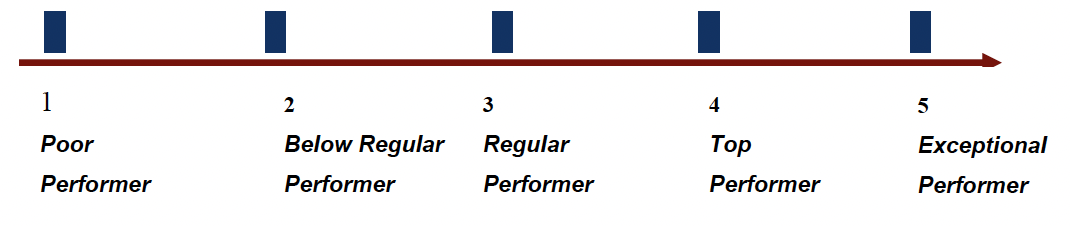
3.3.4 Employee Self-Assessment
- Employees must complete their self-assessment portion of the Performance Appraisal Templates based on their achievements during the entire performance appraisal period.
- Concerned managers and supervisors must ensure that their subordinates have completed the self-assessment portion of the Performance Appraisal Template before conducting the final end of year appraisal meeting.
3.3.5 Review of Performance Appraisal Ratings
- Performance ratings will be reviewed by the next higher authority with an objective of ensuring fairness and uniformity of evaluation standards.
- The Dean of Colleges / Division Heads will have to review the performance rating to ensure fairness and uniformity of evaluation standards.
- Human Resources Department has the authority to harmonize and ratify the performance ratings.
3.3.6 Performance Appraisal Grievance
- Employees have the right to voice performance grievances through the grievance handling process.
- If an employee disagrees with his/her performance appraisal rating and cannot resolve the disagreement with his/her immediate supervisor, the employee may initiate a grievance request.
- No employee shall suffer from any unfair treatment because of the fact that he/she has presented a grievance or complaint under the provisions of this policy.
3.3.7 Development Plan
- Immediate Superior of the concerned employee is accountable for ensuring that the personal development plan is defined as part of the performance dialogue.
- Personal development plans should highlight employee’s strength as well as areas for improvement.
- Personal development plans are critical inputs in designing training requirements and determining training priorities.
- If an employee worked under the supervision of more than one superior, personal development plans will be consolidated from multiple sources.
- Human Resources Department is responsible for reviewing employees’ development plan, defining ways of implementing employee development plan through proper training, more responsibilities, etc.
- Human Resources Department shall include the employees’ development plans as part of the University’s overall training plans and budgets.
3.3.8 Performance Increments
- Performance salary increase will be considered annually following the completion of performance appraisals in order to recognize good performance.
- The University rewards efficient and highly productive employees and provides salary increments as applicable.
- The decision to award increments will be dependent upon the employees’ annual performance appraisal ratings.
- Increments will be given only when the performance rating of the employee is at least Regular Performer (RPs) and above.
- Increments will be awarded to employees based on the summary recommendation prepared by the Human Resources Department in line with the University’s Compensation Structure and approved as per the Delegation of Authority Matrix.
- Increment shall not be granted automatically to an employee because he/she has been in a position for a lengthy period of time. A salary increase must be earned through proven track of good performance.
- Performance increments (If any) shall be effective from the1st of Sep. of every year.
- Performance increments shall not exceed 10% of basic salary. In case a more percentage was requested, it should be for valid reasons with documentations and should be recommended from the Director/Dean, reviewed and recommended from HR Director, recommended from the VP of Administration and Finance and approved from the President.
- Only employees who have completed six months as of 31st of Aug. are entitled for performance increment for the same year.
- The overall salary after merit increments should not exceed the position’s grade salary range.
- Performance increments will automatically increase in housing and transportation allowances.
- A salary may be adjusted for certain employees after successful completion of a probationary period provided such increment had been specifically provided for in the initial offer letter or the employment contract. Approval of such increments should be dealt with as per the Delegation of Authority Matrix.
3.3.9 Performance Appraisal Procedure
| RESPONSIBILITY | PROCEDURE | REFERENCE |
|---|---|---|
| Performance Planning | ||
| BOT & President | 1. Reviews and confirms mission, vision statements, core values and strategies 2. Develops Strategic performance goals, priorities and initiatives | |
| VPs & Deans | 3. Develops and finalize annual business plan 4. Develops colleges/divisions goals and measures 5. Presents colleges/divisions goals and measures to CLM/S | |
| Concerned line Manager / Supervisor ( CLM/S) | 6. Develops employee objectives and performance measures | |
| Objectives Setting | ||
| Human Resources Director (HRD) | 1. Notifies of CVD of the commencement of the performance appraisal cycle and the setting of performance objectives 2. Sends the Performance Objective Setting and Progress Assessment template to CVD | |
| Concerned VPs / Deans (CVD) | 3. Distributes PA 01 to concerned line managers and supervisors 4. Directs CLM/S to set objectives and measures for subordinates | Performance objectives setting and Progress Assessment Form |
| Concerned line Manager / Supervisor (CLM/S) | 5. Reviews JD, KPMs and competencies and prepare a draft for the employees objectives and performance measures 6. Notifies and meet with their employees to discuss, clarifies and familiarize their job objectives and measures. 7. Documents the Performance Objective Setting and Progress Assessment Template 10. Signs the employees Performance Objective Setting and Progress Assessment Template | |
| Concerned Employee | 8. Acknowledges performance objectives & measures 9. Signs the Performance Objective Setting and Progress Assessment Template | |
| Performance Progress Assessment | ||
| Concerned line Manager / Supervisor (CLM/S) | 1. Prepares and informs the employees about the performance progress meeting 2. Conducts quarterly and semi-annual performance progress assessment meeting with the employees 3. Reviews, assesses and records any comment on employee performance using PA01 template 4. Signs the Performance Objective Setting and Progress Assessment Template 5. Develops and document individual action plan for the next period in case the performance objectives were not achieved. | Performance objectives setting and Progress Assessment Form |
| Employee | 6. Acknowledges and sign the performance progress assessment and action plan | |
| Performance Appraisal Review | ||
| Human Resources Director (HRD) | 1. Notifies concerned VPs and Deans of the commencement of Performance Appraisal and Individual Training Needs | |
| Concerned VPs / Deans (CVD) | 2. Directs and advises line managers / supervisors to commence the final end of year performance appraisal phase | |
| Line Managers / Supervisors | 3. Requests employees to complete the self-assessment portion of the PA 02, 03, 04 and agrees on the date of performance appraisal meeting 5. Reviews employee’s performance, achievement and completes their evaluation. Highlights the areas of improvements 6. Meets with the employees to complete and discuss PA & TRN forms with employees 9. Signs final Management Performance Appraisal and Individual Training Need and send it to HR department | Management Performance Appraisal Forms Individual Training Needs |
| Employees | 4. Reviews and rates the achievements and return the forms to their line manager / supervisor 7. If the employee does not acknowledge his performance, then follow grievance procedure 8. otherwise, Signs final Management Performance Appraisal and Individual Training Need | |
| Monitoring & Evaluation | ||
| Performance Management Officer (PMO) | 1. Receives the Performance Appraisal Templates and the Individual Training Needs Template from the concerned line managers / supervisors 2. Reviews and analysis the performance appraisal results 3. Distributes the performance appraisal templates to the related sub-unit within HR department 7. Prepares various performance reports and statistics for the executive management | Individual Training Needs. Management Performance Appraisal Forms |
| HR personnel | 4. Commences the preparation of merit increases and promotions in line with the HR policies | Management Performance Appraisal Forms |
| Training and Development personnel | 5. Commences the analysis of the Individual Training Needs Template and identifies the training courses requirements | Management Performance Appraisal Forms |
| Employee Relation Officer (ERO) | 6. Updates the employees’ master record | |
| Grievance | ||
| Employee | 1. Submits written complaint to direct superior about the grievance 3.2 Appeals to the employee CDH | Employee Grievance Form |
| Employee Direct Superior ( EDS) | 2. Attempts to resolve grievance 3.1.If the complaint is solved, then closes the case, | |
| Concerned Department Head ( CDH) | 4. Attempts to resolve grievance 5.1 If the complaint is solved, then closes the case, otherwise appeals to HRD | |
| Director of Human Resource (DHR) | 6. Attempts to resolve grievance 6.1 If the complaint is solved, then closes the case, otherwise appeals to the President | |
| President | 7. Resolves grievance with final decision, otherwise rises to the labor office | |
3.4 Career Development and Succession Planning
Overview
This policy covers the preparation of a "back up" plan for any separation of individuals occupying critical faculty and non-faculty positions.
Objective
The objective of this policy is to ensure operational continuity and job satisfaction by grooming and developing potential employees, accelerating their progression opportunities and allowing them to smoothly take-over higher and key positions when the need arise.
Policy Details
The Succession Planning process serves the business by expanding the pool of available candidates from which future positions can be filled through the development of Resources from within University.
3.4.1 Career Development Key Activities
Defining the Competencies
- Career Management Committee/Board will approve the job families and the career ladder.
- For each job family, there shall be clear definition of the recommended competencies within each job family competency matrix.
- Department Heads shall assume the responsibility to build awareness on the recommended competencies to their employees.
Nominations
- Minimum eligibility for nomination to Potential Assessment is performance ratings of Top Performers (TPs) in the two preceding performance management cycles.
- All employees who satisfy the condition mentioned above are eligible to be nominated by the concerned Department Heads for the potential assessment.
Potential Assessment
- Career Management Committee / Board with the help of Human Resources Training & Development Supervisor shall be responsible for the design and implementation of the potential assessment process.
- Career Management Committee / Board will carry out potential assessment process.
- Potential assessment process shall be communicated to each of the nominees at least one month in advance along with details of the preparatory work required.
- The potential assessment shall focus on evaluating and defining the employee’s level of maturity on the competencies as defined in the competency matrix, applicable to his/her job family.
- Number of employees through the Potential Assessment process will depend upon the pre-determined number of positions that are likely to be available within each College/Division in the next three years.
Annual Review
Career Management Committee / Board will review the progress of Accelerated Development Plan on an annual basis.
3.4.2 Identifying Key & Critical Positions
- The Human Resources Department shall make a list of the "Key & Critical Positions" in coordination with Department Heads.
- The list of such positions must cover all those positions where the skills are critical for the continuation of Alfaisal University operations, either at the academic level or at the non-academic level.
- The identification of potential successors does not guarantee automatic promotion to the targeted positions.
- The following criteria should help Department Heads to identify the key positions within their departments:
- Managerial positions: Positions with supervisory responsibilities.
- Impact: Positions that have critical financial or business / operational impact.
- Supply Shortage: Positions that are difficult to recruit.
- Specialized Competencies and Critical Tasks: Positions that require specialty or unique expertise and would stop critical action from taking place if they were left vacant.
3.4.3 Identifying Successors
- Identifying the potential successors for each identified position requires a Committee or a Leadership Board to nominate employees who are to be considered succession-planning candidates (successors) for key positions.
- Selected successors should demonstrate high potential/ability that should enable them to achieve success at senior and executive levels.
- It’s not necessary that a successor has to be in the same Department of the identified position.
- At least two successors shall be identified for each of the critical positions based on the following criteria:
- The overall performance review must show exceptional performance
- To satisfy the minimum educational/ experience criteria required for the job/ position
- Have been with the University for a Minimum of 2 years.
3.4.4 Developing Successors
- Each candidate will have a detailed individual development plan (IDP), jointly developed by the candidate and his/her mentor with input from the candidate's supervisor and Human Resources Department, that reflects the candidate's developmental needs.
- Individual Development Plans (IDP) may be reviewed by a Committee or a Leadership Board or Top Management on periodic basis.
- The candidate's individual development plan should reflect managerial, leadership, operational, and/or other technical needs with an associated timeframe for completion. The mentor should communicate the candidate's progress to the top management / committee.
- Succession development plans need to be very specific on what education, experience, training, targeted behaviors or skills the person should have before he/she become ready; plus, when and how the University is going to ensure they get it.
- Succession planning development should require successors to take on special projects within / outside their current job to ensure the experience is gained as quickly as possible.
- When preparing Succession Plans, the Committee or the Leadership Board or Executive Management should review each candidate’s promotion potential in terms of:
- Readiness for the next step and additional experience required.
- The individual’s geographic mobility (if applicable).
- The ability of the individual to satisfy operational and business needs (as opposed to personal career ambitions) through the move being considered.
| RESPONSIBILITY | PROCEDURE | REFERENCE |
|---|---|---|
| Position Identification | ||
| Training & Development Supervisor /Manager | 1. Supports & Notifies CDH to identify key positions for succession planning 3. Collects all initial lists of key positions for analysis and arranges for a Succession Planning Committee meeting to review, discuss and agree on the key management positions 5. Compiles final list of key positions 6. Identifies required skills, experience and competencies for identified positions and set succession criteria | List of key positions Form |
| Concerned Department Head (CDH) | 2. Identifies key positions for all functions | |
| Succession Planning Committee | 4. Meets to identify, discuss and agree on the key managerial and technical positions. 7. Confirms succession plan & succession criteria | |
| Successor Identification and Gap Analysis | ||
| Human Resources Director (HRD) | 1. Confirms the Succession Strategy of Alfaisal University | List of key positions Form |
| Training & Development Supervisor /Manager | 2. Searches through the HR Data- base or Data Bank, skills inventory and employee files to short – list potential successors 3. Extracts performance data of all potential successors based on actual competence and level of professional excellence. 4. Identifies high potential individuals 5. Submits the list of potential successors to the CDH to review and confirm the list of potential successors. 7. Compiles a final list that contains the approved key positions, the position specifications and basic data of the nominees | |
| Concerned Department Head (CDH) | 6. Review and confirm the list of potential successors and may assist in identifying additional potential successors | |
| Planning & Development | ||
| Training & Development Supervisor /Manager | 1. Analyzes successors data against key position requirements 2. Develop a draft Successor development plan and budget 4. When the plan and budget approve, then updates individual training needs analysis 5. Communicates development plans to selected successors 7. Updates employee record | Training & Development Supervisor /Manager |
| Succession Planning Committee | 3. Reviews successors development plan and budget | Succession Planning Committee |
| Tracking & Review | ||
| Training & Development Supervisor /Manager | 1. Records progress on successor development plan 2. Analyzes & reports progress to Human Resources Director 5. If the key managerial positions are not available then follow planning and development procedure, otherwise go to step | Training & Development Supervisor /Manager |
| Human Resources Director (HRD) | 3. Reviews and discusses successor progress with succession planning committee 6. Notifies Succession Planning Committee for successor readiness to assume identified position 7. Confirms appointment & update employee record | Human Resources Director (HRD) |
| Succession Planning Committee | 4. Progresses review for all key managerial positions | Succession Planning Committee |
3.5 Training and Development
Overview
This policy of this Department aims to provide understanding and guidance to the employees of the University with respect to various training and development schemes available to them.
Objective
The policy aims at continuously developing employee competencies and skills to enable higher levels of performance for achieving business objectives.
Policy details
- The University is committed to assist employees in identifying the current and potential training and development needs.
- All full time staff members are eligible to receive training based on University’s business strategy and staff member’s performance and potential.
- A training strategy will be formulated and revised every year by the Human Resources Department. The strategy will outline the objectives and targets of training for the year.
- Training needs will be assessed at the end of fiscal year, i.e. once a year for all employees, following the performance appraisal process.
- Annual training calendar shall be prepared based on University wide individual development priorities and the periodic training needs assessment.
- The University expects that each employee will regularly appraise his/her own training needs and take necessary steps to keep his/her skills and knowledge up to date.
- Evaluation of training effectiveness will be done at the end of the training program to collect and analyze data related to training design and delivery.
3.5.1 Training Cycle
Training and development shall follow a four-stage process, as follows:
- Training needs analysis
- Training Planning
- Design and delivery of training programs
- Assessment of training effectiveness
3.5.2 Training Need Analysis
- Identifying training and development needs, and helping individuals to improve their performance, are key responsibilities for Department managers.
- Employees should also take part in the identification of their training needs.
- There are different inputs used to identify training requirements and opportunities, the primary inputs are:
- Performance Appraisal Results: where training is initiated when the job performance must be improved to fulfill the requirement of the current position.
- - Succession Planning Recommendations: where training is initiated when the job performance must be improved to fulfill the requirement of a future position for long term successors.
- - Request for Promotion: where training is initiated when an employee is or intends to be promoted to position with greater responsibilities requiring higher level or new competencies.
- - Business (Ad-hoc) Requirements: training will be initiated in the following events:
- College / Division objectives require targeted training
- Changes in strategy, objectives and/or targets
- Procedures are changed or new regulation affects the University’s initiatives and activities
- New technology, process, material or equipment is introduced
- New employee is hired and requires specialty training
- All Departments should conduct a formal Training Needs Analysis (TNA) once per year. This TNA will be the base of objective training requirements and priorities.
- The annual TNA determines current employee skill levels, gap between current employee skill, knowledge and attitude levels, the skills/capabilities required for the future, type of required training within the University to support the achievement of business needs.
- Human Resources Department will assist and support all concerned Department Managers in conducting and completing the training needs analysis process.
3.5.3 Prioritization of Training requirements
- Training priorities shall be defined based on the training need analysis conducted earlier, personal development plan inputs coming out of the performance management system and the entry level manpower intake plan through apprentice and other trainee schemes.
- Prioritize the training requirements is based on the following factors:
- Employee’s degree of proficiency for the pre-defined competency
- Level of Impact on business
- Alignment with the divisional / departmental objectives
- Frequency of performing tasks that relate to missing competencies
- Number of employees who need the same training
- Priority level (High, Moderate, low)
3.5.4 Training Plan and Budget
- Based upon the annual TNA, the Human Resources Department in consultation with concerned Department Managers should produce an annual Training Plan in advance of the annual budgeting process.
- Human Resources Department should translate the training requirements into behavioral, technical and general management programs.
- Training plan and budget for the University are prepared during July of each fiscal year for the successive year.
- Based on the training plan, Human Resources Department shall prepare a training budget that includes a cost estimation of the following:
- Trainer costs
- Trainee costs
- Certification cost
- Facilities costs
- Board and lodging costs
- Travel costs
- Licensing costs
- Cost of development of training material, stationary, etc.
- Other miscellaneous costs
- The training plan and budget shall be reviewed and approved as per the Delegation of Authority Matrix.
3.5.5 Design of Training Calendar
- Human Resources Department is responsible to develop the training calendar by listing the various programs that need to be conducted and defining the objective, participation, topics to be covered and expected results for each of the training programs.
- Based on the availability of Resources and competence, decision needs to be taken on in-house vis-à-vis external training delivery.
- Training design, content development and the method of training delivery for each of the programs will be finalized keeping in view the recommended objective, participation, expected results and the budget allocation.
- Training Calendar shall have the required mix of technical training and management development initiatives.
3.5.6 Training Nominations
- The training calendar shall comprise of both external as well as internal programs, shall be drawn based on approval of the annual training budgets and circulated to all the Department heads.
- Each Department is expected to finalize the nominations to the programs published in the calendar within 30 days from the time they receive the calendar
- Human Resources Department will accept the nominations on cross-referring to the employees' personal development plans.
- Departmental Heads shall make necessary arrangements to relieve the nominated employees for training.
- Nominee shall not be attending more than one training every 2 contractual year, unless it is ultimately necessary and shall be approved from the VP of Admin. And Finance
3.5.5 Design of Training Calendar
- Human Resources Department is responsible to develop the training calendar by listing the various programs that need to be conducted and defining the objective, participation, topics to be covered and expected results for each of the training programs.
- Based on the availability of Resources and competence, decision needs to be taken on in-house vis-à-vis external training delivery.
- Training design, content development and the method of training delivery for each of the programs will be finalized keeping in view the recommended objective, participation, expected results and the budget allocation.
- Training Calendar shall have the required mix of technical training and management development initiatives.
3.5.6 Training Nominations
- The training calendar shall comprise of both external as well as internal programs, shall be drawn based on approval of the annual training budgets and circulated to all the Department heads.
- Each Department is expected to finalize the nominations to the programs published in the calendar within 30 days from the time they receive the calendar
- Human Resources Department will accept the nominations on cross-referring to the employees' personal development plans.
- Departmental Heads shall make necessary arrangements to relieve the nominated employees for training.
- Nominee shall not be attending more than one training every 2 contractual year, unless it is ultimately necessary and shall be approved from the VP of Admin. And Finance
3.5.5 Design of Training Calendar
- Human Resources Department is responsible to develop the training calendar by listing the various programs that need to be conducted and defining the objective, participation, topics to be covered and expected results for each of the training programs.
- Based on the availability of Resources and competence, decision needs to be taken on in-house vis-à-vis external training delivery.
- Training design, content development and the method of training delivery for each of the programs will be finalized keeping in view the recommended objective, participation, expected results and the budget allocation.
- Training Calendar shall have the required mix of technical training and management development initiatives.
3.5.6 Training Nominations
- The training calendar shall comprise of both external as well as internal programs, shall be drawn based on approval of the annual training budgets and circulated to all the Department heads.
- Each Department is expected to finalize the nominations to the programs published in the calendar within 30 days from the time they receive the calendar
- Human Resources Department will accept the nominations on cross-referring to the employees' personal development plans.
- Departmental Heads shall make necessary arrangements to relieve the nominated employees for training.
- Nominee shall not be attending more than one training every 2 contractual year, unless it is ultimately necessary and shall be approved from the VP of Admin. And Finance
3.5.7 Training Delivery & Implementation
- Human Resources Department must confirm training commencement date with the nominee’s direct supervisor prior to implementing the Training Plan.
- The Direct Supervisor of the trainee must be aware of training commencement date so as to ensure nominee’s job commitments are accomplished prior to commencing training and in order to plan for the period of time the nominee will be away on training.
- Human Resources Department must conduct a pre-course briefing with the training delegate prior to the commencement of training delivery and hand over the Training Evaluation Template in order to assess the training contents. The course briefing should include:
- Practical arrangements (venue, timings, duration, trainer details).
- Training objectives.
- Program content.
- Evaluation criteria and review methodology.
- Human Resources Department is responsible to confirm with the selected training provider, and finalize contractual agreements that cover fees and logistics related to training.
- Human Resource Department must ensure a timely delivery of services that may include:
- Flight, accommodation and transportation arrangements
- Per-Diems and expenses
- Visas & Permits
- The Training Provider is responsible for delivering training activity line with the contractual agreement to ensure meeting the objectives set of the training.
- Human Resources Department may conduct random review of the effectiveness of the training activities to ensure that professional training standards, methods and techniques are applied and ensuring an appropriate training environment and monitoring the delivery of the course.
3.5.8 Assessment of Training Effectiveness
- In order to justify the costs of training, training activities must be evaluated to determine whether the training objectives set at the outset have been entirely achieved, and if not, the degree to which they have been achieved.
- Trainers are responsible for evaluating training outcomes at the end of the program itself and providing written evidence of the effectives of training to the Human Resources Department by filling the Trainee Evaluation Template.
- The trainee must also fill the Training Evaluation Template directly on the last day of the training. The purpose of this evaluation is to evaluate the trainee’s response to the contents of the training course, the trainer’s style, the comfort of the venue and the quality of course materials, handouts, exercises, etc.
- Human Resources Department must collect the evaluation templates previously submitted by both the training provider and the trainee following training delivery.
- Both the Training and the Trainee Evaluation Templates should be thoroughly analyzed by the Human Resources Department to highlight the knowledge gained throughout the training as well as to assess the overall effectiveness of the training provider for future considerations.
- The direct supervisor of the trainee is responsible for evaluating the effectiveness of training by recording knowledge or behavior change to the workplace as a result of training activity and recording the findings within the coming performance appraisals to allow for a proper comparison.
- All training records must be maintained within the Human Resources Department and copies should be also kept in respective employees’ personnel records.
3.5.9 Overall Training Programs
- The University provides its employees training and technical/academic educational opportunities according to its development needs and plans through the following programs:
- Educational Scholarships
- In-house training
- Local training
- Overseas Training
- Management/Leadership Training Programs
- Competency Based Training & Development Programs
- Apprentice and Summer Training Programs
In-House Training
- In-house training aims at providing the employees with experience, administrative or technical skills or conduct for enhancing their competencies and capabilities in all aspects related to their work. Such training may not result in the attainment of a particular academic qualification, yet it shall comprise courses, seminars, workshops and shall be classified as follows:
- Orientation Programs: these programs aim at acquainting the new employees with the rules and regulations applicable in the University in addition to the functions and activities of the different departments. The Human Resources Department together with concerned Department Managers are responsible for delivering orientation programs for new hires.
- On the Job Training: Department Heads shall prepare a training program for their employees’ including the functions and responsibilities that an employee is required to perform according to his job descriptions. A quarterly report about the employee’s performance will be sent to the Human Resources Department.
- Internal Courses: these courses include short seminars and workshops internally organized with the help of the University’s cadres or external experts.
Local Training
- These programs are held locally in the Kingdom of Saudi Arabia and aim at providing the participants with new knowledge, skills or developing the existing skills.
- Employees participating in training programs within the kingdom are entitled to receive per diem allowance in line with the HR Policies (refer to Business Travel Policy).
Overseas Training
- These programs are held abroad and aim at developing the skills and acquiring new knowledge and obtaining new information related to employee’s work.
- The University provides travel time to be granted to employees training trips between 1 - 2 days before and after travel depending on destination of travel.
- Travel days shall be decided and approved by line managers / supervisors depending on the number of training days and flight duration of hours.
- Should a trainee employee wish that his/her family accompanies him/her, he/she shall bear all their expenses abroad during the training period and any other expenses.
Management/Leadership Training Programs
- The management/leadership training programs have been designed to provide managers, supervisors and key personnel with appropriate skills and competencies. In particular, such programs would enable the management to develop:
- Improved skills and capabilities of management and key line personnel
- Development of a life-long learning culture
- Employees’ achievements and accredited qualifications
Competency Based Training & Development Programs
- A competency based training and development program aimed at preparing employees for current and potential future positions and/or promotions in particular, such programs would assist the employees for their initiatives towards:
- Career development & succession planning in action
- Improved skills and abilities of employees
- Improved productivity and work performance
- Human Resources Department would recommend suitable development plans depending on the number of participants, availability of internal Resources as trainers and costs associated with each of the training options.
Professional Certification Programs
- The University provides encourages its employees to attain certain professional and certification programs related to their position technical competencies and business requirements.
- The university provides covers up to 75% of the actual fees for professional certification and accreditation.
- The maximum number of employees enrolled in Professional Certification Programs should not exceed 5 employees at any given year.
- On their return, employees shall be obliged to work for the University for periods equal to two times of the training duration periods of their professional certification programs or one year after training whatever is longer. If employee resigns or leaves work before he/she completes the minimum said amount of time, employee shall bear all the expenses of the training including travel, per diem or any other expenses spent from the University towards this training.
Professional Association Memberships
- The University encourages certain levels of its Executive Management and Management & Senior Professionals employees to stay abreast of current practices and trends in areas of their specialties and disciplines.
Summer Student Trainee Programs
- The University provides work experience to its students as well as other university and high school students during their summer vacation and compensates them accordingly as per University’s Compensation Structure.
- The program serves both as a service to the community and a source of future recruitment for the University.
- The program duration is up to a maximum of three months.
3.5.10 Line Management Responsibilities
- Every employee undertaking supervisory or senior responsibilities is required to acquaint his/her immediate subordinate with the means of performing the work with a view to create qualified cadres capable of assuming the responsibilities and duties of the senior positions in the absence of their occupants.
- Each employee should train employees working with him, who are appointed in the University and provide them with all possible assistance for performing their jobs efficiently and with ability.
- The different departments have to specify, in accordance with the directives of the Human Resources Department, the short term and long term requirements for the development of their employees. This will be carried out in the light of its latest approved activities and the planned services, new work methods, new utilities they intend to operate and levels of efficiency that are needed to operate such utilities and services.
3.5.11 Trainees’ Responsibilities
- An employee who is sent for a training course should undertake the following:
- Report directly to work after training. Any delay in reporting to work without permission or acceptable reasons shall subject the employees to a disciplinary action.
- Fulfill all the training requirements, attendance and active participation in the training activities.
- Employees shall be obliged to work for the University for periods equal to two times of their total training duration periods, on their return from the training depending on the type, duration and cost of training provided, or one year after training whatever is longer. If employee resigns or leaves work before he/she completes the minimum said amount of time, employee shall bear all the expenses of the training including travel, per diem or any other expenses spent from the University towards this training.
- No undertaking is required for participating in exhibitions, conferences, seminars, researches, surveys, and meetings.
- The period of obligation to work for the University shall commence from the end of the first training of the given calendar year.
- The University will recover the cost of training on a pro-rata basis if any employee leaves the University prior to the fulfillment of the above stated obligation.
- The violations to the University’s regulations and misconduct during the training period are governed by the disciplinary procedures applicable by the University.
- Employees should prepare and submit a report about the training program attended by them within one week of reporting to work at the University to their direct supervisor and the Human Resources Department. The report should specify the subjects of the training program, main experiences & skills that improvement of work.
- Employees should respect the social traditions, culture and public ethics of the host country and observe and abide by its laws and regulations, be honest and exemplary in their behaviors as a University staff.
- Trainee must write a summary about the training course and submit it to his/her line manager and HR Training and Dev. Section.
- Depends on the natural of the training, trainee should train other employees after he/she finishes training if needed.
3.5.12 Training Rules and Regulations
- All employees on training within or outside the Kingdom will maintain their regular pay and benefits during the training period.
- For employees on training, duration of training is included in work experience and end of service calculations.
- An employee on training is not allowed to absent himself for any reason except for sickness. All other absences need to have prior approval from their respective line managers and supervisors.
- Summer Students trainees are not entitled to any leave except in cases of emergency.
- Apprentices are given leave according to the Apprentice Scheme.
- Employees on training assignments are required to take the designated examinations and acquire certifications for such exams when applicable.
- Training should be related to the job content.
- Employees while on training should abide by University rules and regulations, code of conduct as they reflect the image of the University.
- Trainees cannot change the place of training or the nature of training, without prior approval of the Human Resources Department.
3.5.13 Training & Development Procedure
| RESPONSIBILITY | PROCEDURE | REFERENCE |
|---|---|---|
| Training Needs Identification & Analysis | ||
| Line Manager / Supervisor | 1. Identifies the employees’ training needs using individual training needs template | Individual Training Needs Template |
| Training & Development Personnel | 2. Collects all individual training needs templates and studies the training requirements 3. Highlights the training needs for all individual 4. Summarizes all training requirements using training needs analysis system 6. Compiles final training requirements’ study for planning and budgeting purposes | |
| Training & Development Supervisor/ Manager | 5. Prioritizes the training initiatives based on meetings with the concerned Deans / VPs | |
| Training Planning & Budget | ||
| Training & Development personnel | 1. Translates training requirements extracted from HR System into behavioral, technical and general management programs 2. Identifies cost effective training solutions to address training requirements 7. 1If the training plan and budget is not approved, then modifies the final Training Plan after review all comments or amendments from Deans / VPs 8. If the training plan and budget is approved, then develops the final Training Plan after review all comments or amendments from Deans / VPs | Training & Development personnel |
| Training & Development Supervisor/ Manager | 3. Discusses and coordinate different training delivery solution with HRD 5. Compiles a comprehensive training plan for each college / division using training plan | Training & Development Supervisor/ Manager |
Human Resource Director (HRD) | 4. Selects most appropriate solution 10. Sends final consolidated training plan to VP for Finance and administration | Human Resource Director (HRD) |
| Concerned Deans / VPs (CDH) | 6. Reviews training plan and budget 9. Endorses the final training plan | |
| Training Implementation and Delivery | ||
| Training & Development personnel | 1. Schedules and confirms training with nominee’s line managers / supervisors and training providers 2. Conducts a pre-course briefing with the trainees 4. Confirms with the selected provider and finalize contractual agreements 5. Liaises with responsible personnel to ensure the timely delivery of all related services (flight, accommodation, per-diems, visas and permits) | Training & Development personnel |
| Government Relations Officer (SSO) | 3. Ensures adequate facilitation of the training. | Government Relations Officer (SSO) |
| Training Provider | 6. Conducts a training | |
| Monitoring & Evaluation | ||
| Employee | 1. Completes Training Evaluation Template | Training Evaluation Form |
| Training Provider | 2. Completes Trainee Evaluation Template | Trainee Evaluation Template |
| Training & Development personnel | 3. Collects the filled evaluation templates 4. Analyzes evaluation forms to assess the effectiveness of provided training 5. Maintains a record of all training delivered to employees and a copy should be forwarded to ERO 7. Submits a performance appraisal template to the trainee’s supervisor to assess the trainee’s effectiveness | Trainee Evaluation Template |
| HR employee | 6. Updates employee training data and record | |
3.6 Work Schedules
Overview
The Work Schedules policy covers start and end of work and a description of different work schedules.
Objective
The work schedules policy envisages establishing work conditions and timings to be followed in the University as standard procedures.
Policy Details
3.6.1 Regular Schedule
The normal workweek consists of a total of (40) forty hours a week, covering (5) five days a week, Sunday through Thursday followed by two days off with pay, Friday and Saturday. The start and end hours of regular daily work will be from 8:00 AM to 5:00 PM including lunch break. The hours and days are based upon the business needs and requirements of the department, and may vary from one department to another.
Flexi-time 'sliding time' can be arranged between the employee and his supervisor. A flexi time scheme allows employees, subject to certain conditions, to vary their working hours to suit to their individual requirements. Flexi-time is subject to the operational needs of the concerned department. Flexi-time may only be taken in consultation and with the approval of the staff member’s supervisor.
- From 7:00 AM to 3:00 PM excluding lunch break
- From 8:00 AM to 4:00 PM excluding lunch break
- From 9:00 AM to 5:00 PM excluding lunch break
3.6.2 Prayer and rest periods
- All Muslim employees will be allowed reasonable time off during work periods to fulfill their religious obligations.
- The time period assigned for prayers and lunch should not exceed one hour a day.
- The time duration of lunch should not be counted as part of the regular working hours.
3.6.3 Shift Schedule
The standard working hours for employees in the shift schedule is 8 hours a day, the number of days of work and rest will be as per the work cycle for operations. There will be three shifts for employees working under the shift schedule. The work timings and breaks of the shift will be determined by respective line managers and supervisors as per University’s business and operational requirement.
3.6.4 Ramadan Schedule
Working hours for employees during the month of Ramadan will be reduced to 5 hours a day, the exact work timings will be announced by the Human Resources Department. There will be no equivalent decrease in the level of salary paid to the employees and those employees who are required to work for eight hours will be compensated with two hours overtime.
3.6.5 Time keeping & Attendance
- Administrative Employees (Grade 9 & Below) must be enrolled to the Attendance System.
- Each employee must be present, at his/her workstation, for every scheduled workday.
- Employees are expected to adhere to the official work schedule and are required to notify their line manager via phone in the event of absence / lateness from work for any reason such as being sick or having transportation problems.
- The University may request its employees to sign the attendance register on arrival at work as well as on departure from work.
- It is the responsibility of each assigned department’s timekeeper to submit time and attendance form, timely, and accurately to Alfaisal University’s Human Resources Department at the end of working hours of each Wednesday.
- Department managers are responsible for ensuring the punctuality of their subordinates and to monitor their attendance.
- The University has the full right, in the case of an employee’s repeated attendance violations, to apply disciplinary actions as stipulated in the University’s Code of Conduct.
- Employees are not to enter/remain in the workplace outside the working hours unless required by professional responsibilities, and authorized to do so by their immediate supervisor.
Time Keeping & Attendance Procedure
| RESPONSIBILITY | PROCEDURE | REFERENCE |
|---|---|---|
| Employee Relations Officer | 1.Tracks the attendance of the employee biweekly thru the Time Attendance System. 2.Sends the audited Time Attendance Report to each head of the department/s biweekly. 3.Receives Time Attendance reviews by department head/s for actions. 4.Submits department head/s reviews and recommendation regarding time attendance to HR Director for approval. 5.Issues Warning Letter / Absent Deductions notifications to employees and Payroll Officer as recommended by HR Director. | Attendance Management System |
| Payroll Officer | 6. Reviews and endorses the Monthly Attendance details to the payroll system no later than 16-18th of each month. 7. Confirms receipt of the Monthly leave Report and process the employee payroll system accordingly. | ERP System |
3.6.6 Absences
There are two categories of absence: planned and unplanned.
- A planned absence must be approved in advance. Planned absences occur when an employee takes vacation or other scheduled absences. Because these absences must be pre-approved by a supervisor, disapproved. Any employee not reporting to work when a request for annual or any other types of approved leaves have been denied will be considered as unexcused / unauthorized absence and will be subject to disciplinary actions according to HR Policies.
- An unplanned absence is usually an absence due to illness, injury, or emergency. In the event of a need for an unplanned absence, an employee should contact his/her supervisor immediately. A supervisor will determine if an unplanned absence is excused or unexcused based on proper justification and according to HR Policies. If the employee fails to contact his/her supervisor for unplanned absence within a reasonable amount of time or if the reason for absence is unacceptable to the supervisor, then the absence is considered unexcused /unauthorized and therefore unpaid and subject for salary deduction according to HR Policies.
3.6.7 Rest Days
For Employees on Regular Schedule
Employees under the regular schedule will have two days off per week, Thursday and Friday.
For Employees on Shift Schedule
Employees under the shift schedule will also have two day of rest during the week similar to employees working on regular schedule; however these will be rotated for different employees as per the published shift schedules to ensure that the operations do not come to a standstill. If shift schedule employees do not avail their rest day(s), they are entitled to be compensated for their extra work.
3.6.8 Overtime & Compensatory Days Off
- 3.6.8.1 Overview:
An authorized payment for additional work done outside of regular working hours or over official holidays and weekends as per the Saudi labors law. - 3.6.8.2 Eligibility for overtime:
All employees who are employed in the following positions are not eligible to receive overtime:- Faculty members
Managerial position and above
However, The University provides its employees in Management & Senior Professionals Bands who are not eligible for overtime pay and who work on rest days/public holidays compensatory time off for the number of such days worked subject to a maximum of 5 working days per year.
Employees shall not be assigned to work overtime in the following cases:
- During leave period
- During Training
- If they were late for more than (5) hours per week
- 3.6.8.3 Responsibility of Supervisor/Manager
- Supervisors/Managers will assign overtime in a fair and reasonable manner, taking into consideration the needs of the unit, and the abilities, availability, and willingness of employees and overtime budget.
- Concerned line Managers and Supervisors are responsible for managing and controlling overtime.
- Supervisors are responsible to determine and to assign work schedules.
- Work outside of approved schedules should not be allowed, unless approval is obtained or an emergency exists.
- An employee who declines overtime assignments with no acceptable legitimate reason (if overtime requested was under 2 hours a day and for an urgent matter), or who works unauthorized overtime, may be subject to disciplinary action
Any non-exempt employee who works overtime must be compensated as per his/her basic salary at the time of overtime worked for all overtime worked. Hour rate will be calculated as basic salary/30 calendar days. The formula is as follows:
Number of overtime hours x 150 ÷100 x Basic Salary ÷ 240
- 3.6.8.4 Overtime Hours
Overtime is time worked, exclusive of meal breaks, in excess of forty (40) assigned and approved hours in a standard work period of five (5) consecutive days.- Time Worked
Time worked for overtime purposes consists of any hours worked after work period or during weekends or official holidays. The maximum allowable overtime is 2 hours a day on working days and 4 hours during weekend and public holidays. Which means that overtime worked hours should not exceed 18 hours/week. Overtime should not exceed 720 hours/year. Overtime payment should not exceed 50% of basic salary/week.
- Time Worked
- 3.6.8.5 Overtime Pay
- When a non-exempt employee works authorized overtime, he or she is paid at one and a half (1-1/2) times the employee's regular rate of basic salary.
- The University may compensate employees with additional leave days in lieu of overtime hours.
- If the overtime requested exceeds the overtime budget, it will be compensated as additional leave days in lieu of overtime hours.
- Overtime hours worked is rounded to the nearest quarter of one hour.
- The compensatory time (Additional leave days) must be used within 90 days of the date in which it was earned. If the days were not used within 90 days, they will not be cashed or carried on for the next year, neither will be considered at the final settlement.
- Exempt employees do not receive overtime pay.
3.7 Vacation & Holidays
Overview
The policy outlines vacation and holiday entitlements which are competitive, consistent with operating requirements, and in compliance with the Saudi Arabian Labor Law.
Objective
The policy endeavors to allow employees leave as per the standard rules and procedures
Policy Details
All leave applications will be submitted using the forms as per the specified leave entitlement policies.
3.7.1 Annual Leave
- The university provides the following annual workdays’ vacation to its non-faculty employees:
- Executive Management Band: 30 Working Days
- Management & Senior Professionals Band: 30 Working Days
- Supervisory, Professionals & Skilled Band: 25 Working Days
- Clerical, Semi-Skilled & Support Band: 25 Working Days
Leave Policy Guidelines
- A new employee should have finished probation period before being eligible to take annual or emergency leave.
- Leave days are accrued on monthly basis throughout the year.
- The employee must complete and submit a Leave Request to his/her superior at least 15 days before his/her leave commencement date.
- The number of leave days requested must not exceed the total number of leave days accrued at the commencement of the employee’s leave. The total of accrued leave days will be rounded to the nearest whole number.
- Employees are prohibited from working (whether paid or unpaid) during the period of their leaves.
- Employee starting date of work is taken as the base of leave calculation.
- Employee is entitled to compensation for the accrued days of the leave if he/she leaves the University without using his leave.
- Annual Leave shall be requested at least 1 week before the leave starts.
- Employee cannot take any leave before the leave is accepted and finalized
Deferring Annual Leave
- For compelling business reasons or personal reasons only, an employee may defer all or part of his/her leaves entitlement of the current year to the following year. However, the maximum leave days that can be deferred should not exceed 20 days of non-faculty the employee’s annual leave entitlements.
- Leave deferrals must be utilized in full before end of the following year.
- The balance of leave entitlement should not exceed 50 days at any time.
- Leave deferral requires prior approval from line manager or supervisor and as per the Delegation of Authority Matrix.
Week Ends and Public Holidays within Annual Leave Periods
Since leave is granted on the basis of business days, regular and week end days-off shall be not counted as part of the employee’s annual leave. However, public and official holidays such as Eid Al-Fitr, Eid Al-Adha and the National Holiday are not included within the leave and shall be automatically compensated or added to the employee annual leave balance if these days fall within the annual leave.
Late Return from Annual Leave
- If an employee, for unavoidable reasons, fails to return from his/her leave on time, he/she must notify his/her supervisor immediately of his/her delay, of the reason thereof, and of the expected date of his/her return (in writing).
- Late return from leave requires prior approval from line manager & supervisor.
- Upon return from leave, the employee has to report to his/her supervisor.
- An employee who fails to comply with the provisions of the above and/or to present proper justifications to support his/her claim is liable to disciplinary action and the additional leave days will be first deducted from his/her annual leave balance if it does cover and then the excess leave shall be deducted from his/her monthly payroll.
Early Return from Annual Leave
When the employee returns from leave earlier than the stipulated period, he/she shall fill the Return from Leave Form and the rest of the days will be added to her/his balance.
Recall from Annual Leave
- Requesting an employee to interrupt his/her leave to resume duty is against University policy. Therefore, calling an employee from his/her annual leave shall be done only on exceptional circumstances for extreme business requirements and requires prior approval as per the Delegation of Authority Matrix.
- The employee shall be reimbursed for the transportation costs and any other additional costs he/she incurs during this recall.
Sickness during Annual Leave
- An employee who falls sick during annual leave will not be eligible for sick leave unless the sickness requires him/her to be admitted to a hospital. In such case the employee should instantly inform his/her immediate supervisor about such sickness. The employee upon return will have to submit documentary proof of the sickness and days of sickness to be granted a sick leave. The number of authorized days for which he/she had fallen sick will be considered as sick leave.
- Any claim for sick leave, which is not accompanied by an appropriate medical certificate and submitted within 7 days from the date of resumption of duty shall be treated as part of the annual leave, or leave without pay, as determined by the employee’s line manager or supervisor and the Human Resources Director in consultation with the employee’s concerned Department Head.
3.7.2 Public Holidays
- University will grant the following recognized official holidays to its employees with full pay:
- 10 calendar days on the occasion of Eid al-Fitr.
- 10 calendar days on the occasion of Eid al-Adha.
- 1 day on the occasion of the national day of the Kingdom (1st of Mizan (corresponding to the 23rd of September 23rd). If the National Day falls within a weekend, employees will have a a Friday, employees will have 1 day off on the Thursday (a day before the National Day). If it was on a Saturday, employees will have Sunday off (a day after the National Day).
- In order to maintain operations throughout the year, eligible employees whose shift schedules require that they work during public holidays shall be paid overtime wages as per the overtime policy and Labors Law.
- The Human Resources Department should announce details of Eid Al-Fitr, Eid Al-Adha holidays and any other public holidays.
3.7.3 Marriage Leave
- Upon an employee’s marriage, a paid leave for a period of three (5) calendar days will be granted.
- The employee should not defer or postpone this type of leave. Hence, it should be taken on occurrence. (within a week)
- The marriage certificate will be required to be uploaded when requesting a Marriage Leave.
- Marriage leaves require prior approval from line manager or supervisor and as per the Delegation of Authority Matrix.
3.7.4 Child Birth Leave
- When a child is born to a male employee during the course of his employment with the University, he shall be granted a paid leave for one (3) days.
- The employee should not defer or postpone this type of leave for more than a week from the child birth date.
- A birth certificate is required to be uploaded when requesting a Child Birth Leave.
- The University shall have the right to request supporting evidence for this type of leave.
- Child birth leaves require prior approval from line manager or supervisor and as per the Delegation of Authority Matrix.
3.7.5 Compassionate Leave
- In event of the death of an employee’s immediate family member, which is defined as his/her father, mother, brother, sister, grandfather, grandmother, wife, children and grandchildren, the employee will be entitled to a paid leave for three (5) calendar days that can be used within 2 weeks of the date of death.
- Additional four (2) traveling calendar days will be granted to all expatriates. The employee should not defer or postpone this type of leave.
- The University shall have the right to request supporting evidence for this type of leave.
- Compassionate leaves require prior approval from line manager or supervisor and as per the Delegation of Authority Matrix.
- A female employee whose husband passes away shall be entitled to a fully paid compassionate leave for (15) calendar days as of the date of death if the employee is non-Muslim. For Muslim female employees, the compassionate leave is (130) calendar days that starts from the first day of the death.
3.7.6 Emergency Leave
Eemployees are allowed an emergency leave up to a maximum of (10) work days per year, as follows:
- It covers all other emergency situations which cannot be postponed and require the immediate presence of the employee and any other situations where the employee finds it necessary to be present.
- Emergency paid leave requires the employee to provide proper and valid justifications.
- Expenses associated with emergency leaves such as (tickets, visas, etc.) are paid by the employee.
- Emergency leave require prior approval from line manager or supervisor and as per the Delegation of Authority Matrix.
- Emergency Leave cannot be carried over to the next year.
3.7.7 Hajj Leave
- A Muslim employee will be granted a Hajj leave of not more than (15) calendar days including Eid Al Adha holidays with pay starting from the 7th day of Dhu Al Hijjah according to Um al-Qura calendar once during employment with the University.
- Only Muslim employees who have completed at least two (2) years of continuous service with the University are entitled to Haj leave.
- In order not to interfere with the work schedule, this leave maybe granted to a specified percentage of Muslim employees depending on with work and business requirements.
- Hajj leaves require prior approval from line manager or supervisor and as per the Delegation of Authority Matrix.
3.7.8 Examination Leave
- The Examination Leave shall be granted for the final exams only. It will not be granted for any monthly exams or any other kinds of exams.
- An employee who is pursuing his/her studies at an educational school, institute or university and is required to sit for an examination shall be granted leave with full pay for the actual number of days of the examination.
- To be legible for this leave, an employee should not be re-appearing for examinations, it should be his/her first attempt and his/her enrolment in the institution / university should have prior approval from Director/Head of Dep. and HR as per the Delegation of Authority Matrix.
- Employee shall apply for the exanimation leave at least fifteen (15) days ahead of the exam due date.
- Employee shall have to produce the following documents to qualify for this leave.
- Academic Transcript.
- Certificate of enrolment at an educational institution.
- Schedule of Examination
- Evidence of attendance for all days of the examinations might be requested afterwards.
3.7.9 Maternity Leave
- A female employee shall be entitled to a maternity leave for the four weeks immediately preceding the expected date of delivery and the subsequent six weeks. The probable date of delivery shall be determined by the physician of the University or pursuant to a medical report.
- The medical report from an accredited hospital is required to be uploaded when requesting a Maternity Leave.
- Maternity Leave should be requested at least 2 months prior to actual leave.
- During the Maternity Leave, a female employee will entitled for a full salary.
- A woman may not work during the six weeks immediately following delivery.
- When a female employee returns to work after her maternity leave, she shall be entitled to a rest period or periods not exceeding in aggregate one hour a day for a period of two years from the childbirth date for nursing her infant. Such period or periods shall be calculated as part of the actual working hours and shall not entail any deduction in her salaries. This period(s) timing shall be previously agreed upon in writing with the line manager and submitted to HR Department.
- The female employee is required to submit appropriate supporting documents before/after the commencement of the leave.
- Maternity leave may be combined with the employee’s annual leave if was approved as per the Matrix of Authority.
- The University shall cover the maternity and delivery expenses for its female employees as per the University medical insurance policy.
- The University shall not terminate a female employee or give her a warning of the same during her maternity leave.
- A female employee shall forfeit her entitlements if she works for another employer during her Maternity Leave. In such event, the University may deprive her of her full salary for the duration of the leave or recover any payments made to her.
3.7.10 Sick Leave
- Employee should immediately report his/her sick leave to his/her Department Manager and the Human Resources Department and provide them with the necessary supporting documentation for review and considerations. This should be requested through the HRSS system.
- An employee is entitled to a sick leave on an annual basis if he/she provides a medical report by an approved hospital that includes the number of sick days, as follows:
- First thirty days with full pay.
- Next sixty days with three fourth (3/4) pay.
- Following thirty days without pay.
- Sick leave will be granted on submission of a medical report approved by University that states the number of sick leave days. Where sickness continues for longer than 120 days in a certain calendar year then he/she will be referred to an authorized medical committee, which will decide the employability status of the employee.
- If employee exhausts all sick leave days in a calendar year then he/she should be referred to an authorized medical committee, which shall decide the employability status of the employee.
- Regular days off and public holidays falling within a period of sick leave are included within the leave.
- Period for which the employee is on sick leave will be included in calculating the end of service benefits and annual leave.
- Unpaid Sick Leave beyond 90 days is not subject to GOSI contributions by the University.
- Any employee who suffers from kidney failure is eligible to have the hemodialysis days as sick leave days. Such employee needs to upload the medical report that indicates this.
3.7.11 Unpaid Leave
- Unpaid leave can only be granted in extraordinary circumstances.
- Employee is not eligible to request for unpaid leave if he/she has any annual leave days.
- Unpaid leave has to be approved by the Department Head and subject to final approval as per the delegation of authority
- If Unpaid Leave exceeded 20 calendar days, GOSI will be stopped during the unpaid leave.
- Last weekend at the end of the unpaid leave will be calculated as unpaid leave.
Leave Procedure:
| RESPONSIBILITY | PROCEDURE | REFERENCE |
|---|---|---|
| Concerned Employee | 1. Employee will complete a Leave Request through HRSS | Human Resources Self Service (HRSS) |
| Concerned Employee’s Direct Supervisor | 2. Reviews and approves the leave request | HRSS |
| Department’s Head | 4.Reviews and approves the leave request and sends it to the HR Department 5.Maintain a proper schedule for leaves taking into consideration the responsibilities and requirements of each employee and monitor accrued leaves. | HRSS |
| HR Personnel | 6.Reviews the compliance of the leave request with the policies and procedures and verifies the leave approval 7.Maintain a record of all leaves taken on the HR system 8.Contact employees when needed to clarify any unclear point or explain a procedure | HRSS |
| Concerned Employee | 5. On the day prior to travel, employees should ensure the following procedures are completed: An email or memo is sent to all persons concerned, clearly stating the period during which they would be on leave. The message should state the return date and contact details. Provide their immediate supervisors with detailed leave notes listing all pending matters. | Concerned Employee |
| Concerned Employee | 6. Informs the immediate supervisor in case they are sick / absent and cannot attend to the office. Completes the application request along with necessary supporting documents and send for the approval of the Department Heads after rejoining the office | HRSS |
| Department’s Head | 7. Reviews and approves the leave request and sends it to the HR department | |
| HR assigned Personnel | 9.Reviews the compliance of the leave request with the policies and procedures and verifies the leave approval 10.Maintain a record of all leaves taken on the HR system 11.Contact employees when needed to clarify any unclear point or explain a procedure 12.Send for payroll to process |
3.8 Business, Professional Dev. & Training, Research & Conference Presentation Travel
Overview
University-approved travel is defined as transportation on Alfaisal University business in excess of one’s normal commute. Alfaisal University-approved travel includes roundtrip transportation from point of origin to the intended destination. This policy is based on pre-budgeted funds set for the list of categories of travel listed below. The university is not obliged in any way to confirm contractually to the below listed stipulations. If it is anticipated that the cost of travel activities will exceed the budgeted amount, the activities will require prior approval.
Objective
The Travel Policy is intended to ensure the efficient use of the business, professional development and training, and research and conference presentation travel funds. Approval will be granted if the request is deemed reasonable and necessary, and based upon Human Resources (HR) Policies, conducive to employee performance and academic excellence. Any additional university-related travel will require preauthorization, and reimbursement will be at the sole discretion of the approvers outlined below. It is the ultimate responsibility of the approver to ensure that travel-related expenditures represent a worthy use of university funds.
3.8.1 Planning and Budgeting for Business Travel
- Each Department Head shall identify the number, nature, destination and cost of business travel at the start of each fiscal year. Estimated costs of business travel for various destinations shall be circulated by the Human Resources Department to assist in budgeting University’s wide business travel cost.
- Business travel plans must be approved by line manager or supervisor and as per the Delegation of Authority Matrix.
- Human Resources Department shall make budgetary provision for business travel at the start of each fiscal year based on estimates.
3.8.2 Entitlement for Non-Faculty Members:
- Business Travel is governed by business needs and is separate from all other defined travel.
- Professional Development & Training is limited to once a year unless an exemption is made by the VP of Administration and Finance.
- Invitation Travel is unlimited and the leave required to attend will fall under paid leave. However, employees must disclose fully any financial assistance included in the invitation to avoid double-funding of the travel.
- All authorized business travel reimbursement will be covered at the rate of 100% and shall include the following: roundtrip transportation costs from origin to destination, training/ event/ conference fees, and any required membership and registration fees. In addition, a daily per-diem rate dependent upon employee rank shall be applied. Per-diem rates will cover local transportation, accommodation, food, and documentation expenses. These per-diem rates shall be inclusive of days of travel, and shall apply per person, per trip, per year.
- Business travel for administration and faculty at the instructor, lecturer, and senior lecturer rank the subsequent per-diem rates will apply (Table 1): SR 2000 for North America, South America, Western Europe, Australia and Japan; SR 1500 for the Middle East, Asia, and travel within the Kingdom requiring an overnight stay, or exceeding a five hour drive; and SR 250 for local travel: Travel within a three-hour SR 0.50 per kilometer
| Table 1. Summary of per diem rates by geographic region | ||||
|---|---|---|---|---|
| Per Diem (SAR) | 2000 | 1800 | 1500 | 250 SAR (additional mileage reimbursed at 0.50 SAR per km) |
| Geographic Region | North America, South America, Western Europe, Australia and Japan | Eastern Europe, Eastern Asia and South Africa | Middle East, Africa and KSA | Riyadh |
- For senior management and leadership, a per-diem rate shall be calculated on a case-by-case basis for business travel. This rate will require pre-authorization from the VP of Administration and Finance.
3.8.3 Eligibility
- Fulltime faculty and staff applying for professional development & training should have at least three months of service prior to travel sponsored by the university and should not be in the last six months of their contract unless approved prior to any contractual adjustments. All business, research and conference presentation, grant and invitation travel are exempted from this restriction.
- Faculty and staff who will be leaving the university under voluntary separation or are being dismissed from service within six months are not eligible for professional development & training travel support; unless the travel has been preapproved prior to resignation. All business and grant travel are exempted from this restriction.
Table 2. Summary of Eligibility Requirements for Business, Professional Development & Training, Research and Conference Presentation Travel
| Eligibility | Annual Numeration | Per-Diem | Tickets | Supporting Documents | |
|---|---|---|---|---|---|
| Business | Faculty & Non- Faculty | Based on business needs | Yes | Yes | Yes |
| Professional Development & Training | Faculty & Non- Faculty | 10/15k Once a year unless exempted by: Provost and VP of Admin & Finance | No | Yes | Yes |
| Research and Conference Presentation | Faculty | Two per year 10/15k each unless exempted | No | Yes | Yes |
| Grant | Faculty | In line with grant | No | No | Yes |
| Invitation | Faculty & Non- Faculty | Approval of Provost/Dean | Partial/None | Partial/None | Yes |
3.8.4 Requirements for Business, Professional Development & Training
- Quality of the conference(s) and activity/function will be determined by the employee’s immediate supervisor, with supporting justification, and the final approval of attendance to be granted by the employee’s dean or department head.
- The following warrant the efficient use of university funds: business travel, professional development & training. Business travel will be based on business need and is not to be included in any of the aforementioned categories.
- Expenditures should be within preapproved departmental budgets.
- For senior management and leadership, a per-diem rate shall be calculated on a case-by-case basis. This rate will require preauthorization from VP Administration and Finance.
- No reimbursement will be processed unless the travel has been properly preapproved.
- For professional development & training, research and conference presentation the employee must apply by uploading all required supporting documents on the HR Portal 20 working days prior to the departure date for travel; and five working days prior for business or university- mandated travel.
- No duplicate reimbursement is permitted for any employee of the university whose travel is supported by a third party. Expenses covered by a third party must be fully disclosed and adjustments will be made towards the total reimbursement for approved travel.
- The point of departure and return for all university-approved travel must be determined prior to the scheduled date of departure.
- For all types of travel, the requirements of the Finance and Human Resources departments must be fulfilled by the approver.
- The approver of travel requests will be as follows:
- Academic: Immediate Supervisor, and/or Dean, Department Head or Provost
- Administrative: Immediate Supervisor, and/or Dean, Department Head or VP Administration and Finance
- Business/University-mandated: Immediate Supervisor and Dean, Department Head or Provost
3.8.5 Externally Funded Conference/Workshop Attendance
External Research Grants and Contracts may also be used to provide funds for conference attendance; per the approved budgets and grantor agreement policies and guidelines.
3.8.6 Non-Funded Participation in Conferences and Workshops
- Faculty invited to conferences, workshops or institutions with costs covered by the conference or workshop organizers or foreign/external institution may travel on business leave without cost to Alfaisal University.
- Documentation is needed from the conference/workshop management or foreign/external institution indicating that the faculty member has been invited and that all costs are covered
3.8.7 Travel Guidelines:
- Air Tickets:
Criteria for airline tickets will be as follows:- It is preferred to use the National carrier.
- Most direct route and least expensive fare.
- Transferrable, refundable, arranged and purchased by the university.
- Airline travel classes will be as follows:
| Employee Category / Job Grades | Travel Class (Local & International) |
|---|---|
| President | Business Class |
| Vice presidents and members of the Council of Deans | Business Class |
| All other employees | Economy Class |
3.8.8 Indirect Route or Interrupted Travel
Advance approval is required when an employee takes an indirect route or interrupts travel by a direct route other than for university business. Any resulting additional expenses shall be paid for by the employee. The reimbursement of expenses shall be limited to the actual cost incurred, or the charges that would have been incurred via a direct route whichever is less. Any excessive resulting travel time will not be considered work time, and will be charged to the appropriate type of leave. The employee shall be responsible for accurate reporting of such leave time.
3.8.9 Miscellaneous/Other Travel Expenses
Charges for a change in itinerary and excess baggage will not be reimbursed by the university except when there exists a reasonable explanation for the charges. Charges will be reviewed and accepted or rejected by the approver.
3.8.10 Confirmation of Attendance (Upon Completion of Travel)
Employees receiving reimbursement for business, professional development & training, research and conference presentation are required to submit a copy of the name badge; in addition to all other specified documents for reimbursement.
3.8.11 Additional Considerations
- Travel expenses are to be reimbursed uniformly throughout the university. This policy applies to all university employees.
- The university is not obligated to reimburse employees for expenses that do not comply with the principals of this policy.
- Entertainment expenditures are not reimbursed.
- When a trip is postponed or cancelled by the employee for any personal reason after the purchase of the ticket, employee can cancel the ticket or change it and give the amount that was paid by the University back to the University with no deduction. If the trip was cancelled or postponed by the University or the inviting centre, the employee should cancel the ticket or postpone the date and send all documentations and invoices to the University to check and if approved, the employee shall not bear any of the changed ticketing expenses.
- All costs for business communications will be reimbursed including costs to send and receive faxes, phone calls and packages.
- All visa costs will be reimbursed.
- The maximum limit of paid travel time to be granted to employees on business assignments will be as follows:
- Arab Countries:
- 1/2 day on the day of departure
- 1/2 day on the day of arrival.
- Other Countries:
- 2 days on the day of departure.
- 2 days on the day of arrival.
- Arab Countries:
Business Travel Procedure
| RESPONSIBILITY | PROCEDURE | REFERENCEE |
|---|---|---|
| Department Head | 1. Nominates the names of the employees that they would like to send for Business Trip by using, Business Trip Request Form | HRSS |
| Concerned Employee’s Direct Manager | 2. Reviews the number of days required for the trip, training, meeting etc. including the resting days and decides whether the employee will arrange for the hotel or ask Alfaisal University to pay for the hotel on the employee’s behalf. | |
| HR Concerned Personnel | 3. Reviews the entitlements before forwarding the approved form to the Finance Department for disbursement of daily allowances. 4. Prepares travel arrangements including hotel bookings as per management’s approval. | |
| Director of Human Resources |
| |
| Finance Department | 5. Processes and pays the total daily allowance entitled by the employee. | |
| Concerned Employee | 6. While abroad, the employee shall inform the department head whenever there is a change from the planned schedule and seek his/her approval and the approval of the concerned employee in HR. On return from a Business trip, the employee shall submit the change of days on the HRSS. | |
| Department Head | 7. Reviews and approves the claim before forward it to the HR Department. | |
| Director of HR |
| |
| HR Concerned Personnel | 8. Requests Finance Department for any recovery or payments against the total daily allowance paid. | |
| Finance Department | 9. Recovers or pays the employee against the total daily allowance paid. |
3.9 Work Relations
Overview
The policy covers the basic principles that govern the disciplinary and grievance procedures followed by the University and standards of business ethics/conflict of interest situations.
Objective
The objective is to achieve the highest level of ethical work practices and professionalism in business. It also seeks to propagate employee satisfaction by creating an effective system of grievance handling and disciplinary procedures.
Policy Details
3.9.1 Conflict of Interest
- All employees have the responsibility to avoid both conflicts of interest, and situations which give the appearance of a conflict of interest.
- Employees are prohibited from having a direct or indirect personal interest in the University’s contracts or projects or with the contractors doing business with the University.
- Employees are prohibited to purchase, or influence the purchase of, goods or services from an organization in which they have a direct or indirect personal financial interest
- Employees are prohibited to accept gifts, cash or other items of any kind, except those associated with usual business practices and courtesies and of a nominal value from persons or organizations involved with the University.
- Employees are prohibited to utilize the University’s funds for unlawful purposes
- No employee should hold a controlling “personal stake” in another firm, which does business or intends to do business with the University; this includes holding a position, having a controlling financial stake or any form of ownership in such a firm.
- University employees are prohibited from engaging in any trade other than their span of work as employees of the University.
- Any employee misusing his/her position for the acquisition or acceptance of a bribe of personal benefits will be dismissed at the first offence without notice or benefits and without prejudice to proceedings of Public Prosecution.
- Any employee not following the policies above will be dismissed at the first offence without notice or benefits.
3.9.2 Business Ethics
- The University shall maintain the highest ethical standards in its conduct of business. It shall be honest in its dealings with internal as well as external stakeholders. The University shall avoid all situations, which can be termed as illegal or dishonest.
- The University’s records/audits shall be maintained at the highest level of integrity. Any instance of falsification will be dealt with strictly.
- University information of confidential nature shall not be disclosed to third parties and any information regarding any other organization with which the University does business shall be kept confidential. This information might have come by the means of normal business dealings. Any such information shall be disclosed only after prior approval from the University delegated authorities.
- In case of legal dealings confidentiality shall be maintained at all times.
- All employees of the University are to abide by the rules of the Kingdom of Saudi Arabia during the conduct of business dealings. Any violation is considered as breach of the University policy on business ethics.
- All employees are to show concern for the society and its customs in due course of business.
- No employee should indulge in any sort of bribery, dishonest means to gain favors for the University. Any such actions could lead to punitive action against employees.
3.9.3 Dress Code
The dress and personal appearance of all employees should reflect a professional image. As a University, we meet people on daily basis in the course of conducting our business. The reputation of the University, as well as staff own reputation, is judged partly by our personal conduct and appearance. Employees are expected to dress in a clean and neat manner, appropriate for their respective job responsibilities and business environment.
As a general rule this means all staff members should wear business suits or local dress (Thobs & Ghotras).
Female Employees are required to wear conservative clothes and wear an Abaya or a Lab-coat over their clothes.
3.9.4 Gross Misconduct
There are certain situations in which the University considers poor employee conduct as so serious as to warrant dismissal.
The following conduct by an employee constitutes legal grounds for dismissal without end of service benefits and on condition that the employee is given the opportunity to show his reasons behind his objection to the dismissal:
- If, during or by reason of the work, the employee assaults the employer, the manager in charge or any of his/her superiors.
- If the employee fails to perform his essential obligations arising from the work contract, or to obey legitimate orders, or if, in spite of written warnings, he/she deliberately fails to observe the instructions related to the safety of work and University as may be posted by the University in a prominent place.
- If it is established that the employee has committed a misconduct or an act infringing on honesty or integrity.
- If the employee deliberately commits any act or default with the intent to cause material loss to the University, provided that the latter shall report the incident to the appropriate authorities within twenty-four hours from being aware of such occurrence.
- If the employee resorts to forgery in order to obtain the job.
- If the employee is hired on probation.
- If the employee is absent without valid reason for more than twenty days in one year or for more than ten consecutive days, provided that the dismissal be preceded by a written warning from the University to the employee if the latter is absent for ten days in the first case and for five days in the second.
- If the employee unlawfully takes advantage of his/her position for personal gain.
- If the employee discloses work- related industrial or commercial secrets
3.9.5 Sexual Harassment
The University is committed to creating and maintaining a community where all persons who participate in University programs and activities can work and learn together in an atmosphere free of all forms of harassment, exploitation, or intimidation. Every member of the University community should be aware that the University is strongly opposed to sexual harassment, and that such behavior is prohibited both by local laws and by University policies.
An employee is considered engaged in harassment if he or she intentionally:
- harms or intimidates another person by malicious conduct;
- subjects another person to offensive physical contact;
- interferes with or damages the property of another person without permission or a reasonable ground to believe that permission has been granted; or
- Subjects another person to alarm by threatening to inflict physical injury to or to cause damage to the property of that other person.
Additionally, any administrator, supervisor, manager or faculty member who is aware of sexual harassment and condones it, by action or inaction, is subject to disciplinary action.
The University will respond promptly and effectively to reports of sexual harassment, and will take appropriate and severe actions on employees that violate this policy up to and including termination of service. Supervisory personnel who are contacted by an individual seeking to file a complaint about sexual harassment in their unit or area of responsibility shall assist the complainant in contacting the appropriate complaint-receiving officials identified below.
- Informal Procedures
- The complainant may attempt to resolve the matter directly with the alleged offender and report back to the complaint-receiving official.
- The complaint-receiving official may notify the alleged offender of the complaint, paying appropriate attention to the need to maintain confidentiality. The complaint-receiving official may take whatever steps short of formal sanctions that he or she deems appropriate to affect an informal resolution acceptable to both parties.
- Where the alleged offender is a student, the complainant and accused may choose to participate in mediation.
- If a complaint is resolved informally, no record of the complaint will be entered in the alleged offender’s personnel file or student records. However, the complaint-receiving official will, in the form of a confidential file memorandum, record the fact of the complaint and the resolution achieved.
- Formal Procedures
In formal resolution procedures, the written and signed complaint will be directed to the following officials:- If the formal complaint is against a faculty member, other instructional personnel, or staff employed in a college, it should be directed to the dean of the college.
- If the formal complaint is against a staff member in a unit other than a college, it should be directed to the Human Resources department.
- If the formal complaint is against a student, not acting in an instructional or other employment capacity, it should be directed to the Office of the Vice President for Student Affairs.
- If the formal complaint is against a person outside the University (non-employee, non-student), it should be directed to the dean of the college if the behavior is occurring in a college or school, to the Human Resource department if the behavior is occurring in the work environment outside an academic unit, or to the Office of the Vice President for Student Affairs if the complainant is a student.
- If conflicts or other problems exist with either the dean, the Office of the Vice President for Student Affairs or the Human Resource department handling the formal complaint, the formal complaint may be filed with the Director of Human Resources, or if conflicts exist with Director of HR, individuals may consult with the Provost.
3.9.6 Non-discrimination Policy
Alfaisal University is a community of people with respect for diversity. The University emphasizes the dignity and equality common to all persons and adheres to a strict nondiscrimination policy regarding the treatment of individual faculty, staff, and students. In accord with governmental law, the University does not discriminate on the basis of race, color, religion, sex, national origin, ancestry, age, disability, or veteran status in employment or in any program or activity offered or sponsored by the University. In addition, the University does not discriminate on any basis not related to the applicable educational requirements for students or the applicable job requirements for employees. The University maintains a grievance procedure incorporating due process available to any person who believes he or she has been discriminated against.
3.9.7 Receipt of Gifts Policy
Gifts, business entertainment or other benefits are often accepted as a legitimate and recognized part of commercial life. Problems, however, arise when they begin to compromise, or even appear to compromise, commercial relationships. For this reason, employees are not permitted, as a general rule, to offer or accept gifts or other benefits from students, clients, suppliers, business partners and associates. In case a staff member accepts any gifts, he must declare the gift details, including its monetary value, in writing to his immediate supervisor under advice to the Director of Human Resources.
3.9.8 Non-Smoking Policy
The University recognizes that cigarettes and tobacco smoke is a hazard to the health of the University community. Because of the harmful consequences of cigarettes and tobacco use, both active and passive, the University has adopted the following policies:
- The University designates all buildings as smoke-free. Therefore, smoking is prohibited in University buildings including offices and hallways. This policy applies to all University buildings on and off campus.
- Smoking at outdoor events (specifically including those in the stadium) is restricted to designated areas.
- Smoking is prohibited in vehicles leased or owned by the University.
- Visitors to Alfaisal University are included under this policy as temporary members of the University community.
3.9.9 Confidentiality
- All employees must abide by strict confidentiality rules in respect of the University business contacts and their affairs.
- Employees should not use, divulge or communicate any such information to third parties, both during and after the term of employment.
- Upon termination, all records and documents at the employee’s procession must be returned by the employee to the University.
- Any employee providing information and forms related to the University or associated business contacts without permission will face the following disciplinary action:
- At first offence – written warning
- At second offence – termination with benefits
- Any employee divulging any secret of the University or associated business contacts will face the following disciplinary action:
- At first offence – dismissal without notice and benefits
3.9.10 Undertaking of Other Work
- University employees are not allowed to undertake any other full or part-time work without the approval of management and HR and as per the authority matrix.
- Details of any honorary or semi-honorary duties undertaken by an employee must be notified to management, however as these duties are unlikely to interfere with the University duties they do not require the approval of management.
- Any employee undertaking any other unauthorized full or part-time work will face the following disciplinary action:
- At first offence – written warning
- At second offence – termination with benefits
3.9.11 University Property
- Each employee shall be held directly responsible for the safeguard of the University’s funds and properties under his/her custody.
- Negligence or deliberate misuse of University property shall be regarded by the University as a highly serious offense, and penalized accordingly
- The use of University tools and equipment – including telephones, computers and email applications shall be restricted for official business use only.
3.9.12 Rights to Ownership-Inventions/Patents
- Inventions made in due course of work are treated to be as property of the University. The employee will be rewarded for such an act but the usage/patent of the invention will belong to the University.
- Special awards may be given for any extraordinary achievements made by the employees.
3.9.13 Grievance Procedure
- Grievance Procedure deals with the effective handling of employee complaints against operational conditions or fellow employees.
- Grievance Procedure promotes an atmosphere of employee satisfaction wherein employees can work at optimal levels.
- The University will take severe disciplinary action against an employee if the grievance contains false accusations or is intentionally defamatory to the University, Its superiors or employees.
First Level Hearing
- An employee must initiate his/her own complaint (a written complaint needs to be submitted to the immediate supervisor).
- The employee shall discuss his/her grievance with his immediate supervisor. The supervisor will conduct an investigation and then reply to the employee regarding the complaint within three (3) working days (the reply may be verbal or written, as appropriate).
Second Level Hearing
- In the event the matter is not satisfactorily addressed at the supervisor's level, then the employee may appeal to the Department Head who shall attempt to resolve the complaint within five (5) working days.
- If the matter is not satisfactorily resolved at the Department level, then, the employee should seek the assistance of the Human Resources Operation Manager.
- If the Human Resources Operation Manager cannot satisfactorily resolve the issue between the Complainant and the concerned party or department, then, the Human Resources Employee Operation Manager shall advise the Complainant to submit the complaint in writing to the Director of Human Resources Department.
Third Level Hearing
- On submission of a written complaint by the employee, Director of Human Resources shall notify the concerned party / Department Head that there is an employee complaint pending.
- Director of Human Resources will schedule a meeting for all the parties to resolve the matter. At that meeting, the Director of Human Resources functions as a neutral mediator seeking to arrive at a solution acceptable to all parties.
- The Complainant(s) and Supervisor may bring in other fellow employee from within the University as witnesses at this point in the process.
- The Complainer’s concerned department Head shall have three (3) working days after the parties meet to respond in writing to the complaint. In case the nature of the grievance is such that it can have implications for other employees as well, the complaint may be escalated to the higher levels.
3.9.14 Employee’s Rights as per Law
- If the grievance or complaint is not finally settled within the University, or the employee is not satisfied with the final written decision, the employee may submit his/her grievance with the relevant jurisdiction authority according to the Saudi Arabian Labor Law.
- In such case, it is the responsibility of the Human Resources Director or his/her representative to follow up and solve such a grievance or complaint with the government agency.
3.9.15 Fair Treatment to all Employees
- No employee shall suffer from any unfair treatment because of the fact that he/she has presented a grievance or complaint under the provisions of this policy.
- An employee must be allowed time off from regular duties as may be for grievance hearings without any deduction in pay.
3.9.16 Disciplinary Process
Classification of Penalties
Penalties that may be imposed on an employee shall be classified into three types:
Type I: Warnings
Verbal Warning: If an employee commits for the first time some of the offences listed in the Schedule of Infringements & Related Penalties, he/she may be issued a verbal warning by the Department Head describing the offence and advising and explaining how he/she could correct his/her conduct to avoid the offence depending on the seriousness of the offence and the other circumstances that are left to his discretion. Verbal warning could be in writing to have it included in the employees file as "Verbal Warning"
First Warning: If an employee commits for the first time one or more of the offences listed in the Schedule of Infringements & Related Penalties, he/she may be issued a written warning by the Department Head describing the offence and explaining how he/she could correct his/her conduct. A copy should be sent to HR for filing.
Second Warning: If an employee commits for a second time one or more of the offences listed in the Schedule of Infringements & Related Penalties, he/she may be issued a second written warning by the Department Head describing the offence, emphasizing the seriousness of repeated violations of University rules, and explaining how he/she could correct his/her conduct. A copy should be sent to HR for filing.
Dismissal Warning: If an employee commits for a third time one or more of the offences; he/she may be issued a dismissal written warning by the Human Resources Director describing his/her latest offence, outlining his/her previous offences, explaining how such conduct could be corrected, re-emphasizing the seriousness of repeated violations of University rules, and warning him/her that the committing of any further offence shall result in the termination of his/her service.
Disciplinary Procedure
| RESPONSIBILITY | PROCEDURE | REFERENCE |
|---|---|---|
| Concerned Department Head (CDH) | 1. Informs HR Operation Manager of need for disciplinary action | |
| HR Operation Manager | 2. Notifies employee of offence & arrange disciplinary meeting 3. Conduct disciplinary meeting 4. Decides on violation & recommend disciplinary action & send to HRD for final decision 5. Communicates final decision to EDS & employee 6.2 If the employee accepts, then Initiates disciplinary actions / warning letter | |
| Employee | 6.1 If the employee does not accept, then initiates the grievance procedures |
Type II: Termination of Service
Termination of Service after Prior Warning:
If an employee commits for the fourth time one or more of the offences listed in the Schedule of Infringements & Related Penalties, he/she shall be subject to termination of his/her service with payment of the notice period and end of service award.
Termination of Service without Warning:
If an employee commits one of the offences listed in the Schedule of Infringements & Related Penalties in a flagrant manner which seriously prejudices the interests of the University or its employees, - determined by the concerned department’s Director and the Director of HR with possible legal consultation from an in house or out house legal advisor - he/she shall be subject to immediate termination of service with payment of the notice period and end of service award.
Termination of Service without Payment of End of Service Award:
If an employee commits an offence listed in Article no. 80 in Labors Law, his/her service may be terminated without payment of notice period and end of service award, provided the workman is given a chance to state his/her reasons for objecting to the termination.
3.9.17 Employee’s Suspension
If an employee is detained or taken into custody by the competent authorities in cases related to work or occasioned by it, the employer shall continue to pay the worker 50% of the wage until the case is decided, provided that the period of detention or custody shall not exceed one hundred eighty (180) days. If said period exceeds that, the University shall not be required to pay any portion of the wage for the excess period. If the employee is acquitted or the investigation is closed for lack of evidence or invalidity thereof, the University shall return to the employee the amount previously deducted from his/her wage. However, if he is convicted, none of the payments made shall be recovered unless the judgment provides otherwise.
3.9.18 Schedule of Some Infringements Penalties Related to Working Hours:
| Type of the infringement | Penalties | ||||
|---|---|---|---|---|---|
| First | Second | Third | Fourth | ||
| 1 | Unexcused retardation (lateness) of coming to work up to 15 minutes even if it doesn’t affect the work of others | Verbal warning | 5% | 10% | 20% |
| 2 | Unexcused retardation (lateness) of coming to work up to 15 minutes and affecting the work of others | Verbal warning | 15% | 25% | 50% |
| 3 | Unexcused retardation (lateness) of coming to work between 15 minutes and 30 minutes even if it doesn’t affect the work of others | 10% | 15% | 25% | 50% |
| 4 | Unexcused retardation of coming to work between 15 minutes and 30 minutes and affecting the work of others | 25% | 50% | 75% | Full day |
| 5 | Unexcused retardation (lateness) of coming to work between 30 minutes and 60 minutes even if it doesn’t affect the work of others | 25% | 50% | 75% | Full day |
| 6 | Unexcused retardation (lateness) of coming to work between 30 minutes and 60 minutes and affecting the work of others | 30% | 50% | Full day | 2 days |
| 7 | Unexcused retardation (lateness) of coming to work for more than 1 hour whether it affects or does not affect the work of others | Written warning | Full day | 2 days | 3 days |
| In addition to the deducting of late hours | |||||
| 8 | Leaving the work before end of working hours without permission or acceptable justification for less than 15 minutes | Verbal warning | 10% | 25% | Full day |
| In addition to the deduction of absence hours | |||||
| 9 | Leaving the work before end of working hours without permission or acceptable justification for less than 15 minutes | 10% | 25% | 50% | Full day |
| In addition to the deduction of absence hours | |||||
| 10 | Stay at the work place or return back to it after working hours without justification | Verbal warning | 10% | 25% | Full day |
| 11 | Absence without written permission or acceptable justification for one day during one contractual year | 2 days | 3 days | 4 days | Deprivation of the annual increment or promotion for one time |
| 12 | Continues absence without written permission or acceptable justification from two to six days | 2 days | 3 days | 4 days | Deprivation of the annual increment or promotion for one time |
| In addition to the deduction of absence hours | |||||
| 13 | Continues absence without written permission or acceptable justification From seven days to 10 days during one contractual year | 4 days | 5 days | Deprivation of the annual increment or promotion for one time | Termination with EOSB |
| In addition to the deduction of absence hours | |||||
| 14 | Continues absence without written permission or acceptable justification from 11 to 14 days during one contractual year | 5 days | 5 days | Deprivation of the annual increment or promotion for one time and a termination warning as per article 80 in Labors Law | Termination with EOSB |
| In addition to the deduction of absence hours | |||||
| 15 | Unexcused absence from work for more than 15 consecutive days in one contractual year | Termination without EOSB or compensation provided that a warning letter has been issued to the employee after 10 days of absence (as per Article 80 of Labor Law). | |||
| 16 | Unexcused absence from work for more than 30 non-consecutive days in one contractual year | Termination without EOSB or compensation provided that a warning letter has been issued to the employee after 20 days of absence (as per Article 80 of Labor Law). | |||
3.10 End of Service
Overview
This policy applies to voluntary and involuntary employee separation.
Objective
The policy endeavors to ensure that end of service is handled in a consistent manner based on the type of termination.
Policy Details
3.10.1 Types and conditions for termination
Employees could be terminating under any one of the following situations:
- Employee resignation: Employee can choose to willfully resign from the services of theUniversity after he/she has discussed the reasons for his/her resignation with his/herImmediate Superior.
- During Probation: if the University finds the employee unfit during the probationary period,it may terminate the services of the employee without notice or justification.
- Due to medical unfitness: Employees who are proven to be medically unfit by an approvedmedical authority are liable to be terminated from the services of the University.
- Due to offences: Termination due to offences as listed in Types I, II and III of the Scheduleof Infringements & Related Penalties listed in Chapter 11, according to the type of theinfringements and/or Article 80 of Labors Law.
- Non-renewal of employment contract: Employees with specified term contracts shall benotified one as per the notice period stipulated in their employment contracts of terminationof their services from the University. In the non-specific contracts, the employee’s servicesmay be terminated at any time during the contract period provided the employee is giventermination notice as per the employee's contract.
- Due to retirement: On attaining the retirement age of 60 years (Hijra) for Saudi maleemployees and the age of 55 years (Hijra) for Saudi female employees.
- Breach of employment contract: An employee is liable to be terminated when he/shebreaches a clause of the employment contract.
- Government Directives: an employee can be terminated in accordance with Governmentdirectives; end of service will be paid as per the said directive or as per the Saudi ArabianLabor Law.
3.10.2 Notice period
With exception to termination under Type III offences listed in the schedule of Chapter 11 above, both University and employee are required to submit a written notice of two months prior to the effective date of separation.
3.10.3 Payment in lieu of Notice Period
If either party fails to submit such a notice in due time, the University or employee as the case may be will have to compensate the other party for the requisite notice period using the employee’s last salary as the basis for calculation. The University has the right not to approve the payment in lieu of notice period due to work issues if the employee wishes to leave.
3.10.4 End of Service Award
For details refer to chapter on “Remuneration, Allowances and Benefits”.
3.10.5 Termination
- The Function/Department Head and the Human Resources Director will be responsible for managing the termination process.
- Upon preparing the termination letter, the Human Resources Director should consult with the Legal Counselor of the University to ensure compliance with the Saudi Arabian Labor Law requirements.
- In case of resignation, the Immediate Superior in consultation with the Departmental Head will make a decision on acceptance or rejection of the request as per the Delegation of Authority Matrix.
- If the resignation is accepted, the Departmental Head will duly authorize the same giving the date on which the employee could be relieved from the services.
- His/her Immediate Superior will communicate acceptance or rejection of the request for resignation to the concerned employee in writing and send a copy to direct line manager.
- If approved, direct line manager shall send the resignation to HR Department for final approval and process.
3.10.6 Exit interview
- The objective of the exit interview is to consolidate the employee feedback on circumstances leading to resignation, his/her feedback on policies and systems of the organization and sense of fair treatment.
- An employee whose services are terminated due to resignation, retirement and non-renewal of employment contract will have an exit interview with the Department Head and the Human Resources personnel.
- Feedback from exit interviews should be analyzed by the Human Resources personnel and actions should be determined to prevent noted deficiencies in the future.
3.10.7 Clearance
- The Human Resources personnel will issue the employee whose services are being terminated with a final clearance form on HRSS.
- Clearance form (e-form through HRSS "Separation Checklist & Clearance Management") should be finalized to qualify for end of service entitlements.
3.10.8 Service Certificates
- Service certificate confirming their duration of employment with the University and the last position held is granted to employees leaving the University and after all dues are settled and clearance certificate is signed.
- The University reserves the right to inform third parties, including clients or subcontractors, of the departure of an employee. This may be done directly or through advertisements in local publications.
3.10.9 Final Exit Visa
- A final exit visa shall be prepared for every expatriate employee at the end of his/her service, unless his/her employment will be transferred to another employer.
- If the employee wishes to transfer to another employer and the University agreed, employee loses the right for the annual flight ticket(s) for that year.
- The expatriate employee departing on final exit shall be escorted to the airport where he shall be given his/her passport and air ticket, and the final departure certificate shall be stamped by the concerned authorities.
3.10.10 Transfer of Sponsorship
- In the event that an employee wishes to accept a job offer from another organization, the University may approve the transfer the employee’s sponsorship, or issue the employee with a Non Objection Certificate.
- Authorization of sponsorship transfer should be approved as per the Delegation of Authority Matrix.
3.10.11 Farewell Party
For employees who separate on conditions other than scheduled offence, their respective Departments may organize a farewell party and a memento/gift will be given to the concerned employee paid for by the concerned department’s budget and approved as per the Delegation of Authority Matrix.
3.10.12 End of Services Procedure
| RESPONSIBILITY | PROCEDURE | REFERENCE |
|---|---|---|
| End of Contract | ||
| HR Personnel | 1. Initiates the process 60 days prior to expiry of contract 3. In case of Renewal, extends/renews contract around 60 days prior to the end of contract. If not, the employee shall be notified 60 days prior to end of contract 4. HR conducts exit interview 5. Ensure completion of clearance form and release of end of service dues 6. Issue End of Service certificate | |
| Concerned Department Head (CDH) | 2. Discusses the case and give recommendations on termination / renewal of contract to ERO and send to HR | |
| Human Resource Director (HRD) | 4. In case of Termination, discusses case with Legal Counselor if needed | |
| Medical Unfitness | ||
| Concerned Department Head (CDH) | 2.2. In case of unfitness, then discusses the case and possibility of transfer with HRD & Legal Counselor | |
| HR Operation Manager | 1. Refers the case to approved medical authority 2.1 If the employee is fitted, then employee retained 2.3.If the transfer is feasible, then transfers employee after obtaining approval of HRD, CDH and Legal Counselor | |
| HR personnel | 3. conduct exit interview 5. Ensures completion of clearance form and release of end of service dues 6. Issues service certificate | |
| Human Resource Director (HRD) | 2.4.If the transfer is not feasible, and termination is decided then notify employees 30 days prior to proposed date of termination | |
| Layoff | ||
| Vice President (VP) | 2. Estimates numbers of employees to be laid off and discuss with DHR & Legal Counselor | |
| Director Of Human Resource (DHR) | 1. Undertakes study on manpower norms, numbers and attributes of employees based on request of the President 3. Discusses lay off plan with legal counselor and develop risk mitigation strategy | |
| President | 5. Issues termination letters and send copies to employees Divisions | |
| Non Competence | ||
| Human Resource Director (HRD) and Head of the concerned department | 2. Reviews the case | |
| HR personnel | 1. Initiates the process if the employee has rating & no sign of progress received low performance 2.1 In case of termination, Issues a termination letter and start termination process 2.2.In case of retain, issues final warning letter to employee in coordination with Department Head and monitor performance progress | |
| Resignation | ||
| Concerned Department Head (CDH) | 1. Upon employee resignation, CDH discusses the case with HRD 2. CDH approves the letter and specify a date for releasing the employee | |
| Human Resource Director (HRD) | 3. Receives a copy of the authorized resignation and discuss with employee4 . ERO to conduct exit interview for employee 5. Ensures completion of clearance form and release of end of service dues 6. Issues service certificate | |
| Retirement | ||
| HR personnel | 1. Discuss the case with the head of the department 2. Initiates the process 60 days prior to the employee attaining retirement age 5. Retirement notice issued to employee & GOSI for Saudi employees 6. Conducts exit interview and send to HRD 7. Ensures completion of clearance form and release of end of service dues 8. Issues service certificate | |
| Concerned Department Head (CDH) | 3. Authorizes the date of releasing the employee | |
| Human Resource Director (HRD) | 4. Identifies final Retirement date | |
3.11 Documents and Records
Overview
This policy provides the details of information that should be maintained as records for all employees of the University.
Objective
The policy endeavors to ensure that appropriate personnel records are updated and maintained in line with best practices.
Policy Details
3.11.1 Employee Records
- Human Resources Administration Assistant shall maintain an individual file for each employee.
- The employee file should contain the following documents and records:
- A copy of Employee Data Application and Interview Assessment Form
- The original Employment Contract, and any modification or amendment thereto such as job offer and job description.
- Photocopies of all relevant academic certificates and CV.
- Photocopies of all Identification Documents (Saudi National Identity Card, Personal Identification, Passport, Iqama / Resident, work permit, Family ID, Visa, etc.).
- Copy of medical insurance and the addition to GOSI
- Record of receiving handbooks and HR policies.
- Original medical reports carried out as per University requirements if required.
- A copy of the probation period evaluation e-form.
- Copy of Performance Appraisal e-form for each year the employee has been in service.
- Record of all planned and completed training activities, and photocopies of all training certificates.
- Record of any Rewards or Penalties the employee has received.
- Any change in status of employee as (Personal Action Form, Warnings, Promotions, increments, social status…etc.)
- Record of any sponsorship the University has provided to the employee to third parties.
- Contact details, including home address and telephone number, and emergency contact. A copy of the stamped final departure certificate.
- Human Resources Administration Assistant is responsible for updating and maintaining employees’ personal files throughout the employee’s employment with the University
- Employee records are confidential and must be maintained under the custody of the Human Resources Department.
- Employee records should not be disclosed to individuals outside of the University without the employee's prior written authorization, except where information is required to be disclosed by law or legal process. University and his/her new employer conducts a verification of employment; Human Resources Administration Assistant is authorized to provide information upon such a request.
3.11.2 Updating or Deletion of Information in Personnel Records
- Employees must advise the Human Resources Employee Relations Officer of any changes of address, telephone number, bank account or other personal circumstances such as changes in marital status, having new dependents, etc.
- The Human Resources Employee Relations Officer is responsible for updating and maintaining accurate employees’ personal files throughout the employee’s employment with the University.
3.11.3 Review of Personnel Records
- An employee has no right to review his/her personnel records/file unless authorized by his/her line Manager. Review of personal files should be in the presence of an Officer Representative from the HR Department.
- The employee has no right to withdraw, alter or destroy any documents in his personal record/file.
3.11.4 Expatriate Passports
- Passports of all University-sponsored expatriate employees shall remain in the custody of the employee throughout their service.
- The passport shall be returned to the employee upon receiving his/her Iqama Card and other official documents.
- The employee is responsible of checking the expiry date of his/her exit/re-entry visa and passport expiry.
3.11.5 Announcements
- All official announcements and memos shall be sent by e-mail.
3.11.6 Inquiries about Former Employees
- Third parties wishing to obtain information about a former employee’s service in the University must address a written request to the HR Department, which is the only entity authorized to disclose information about former employees.
- Disclosure of information about a former employee can only be done if he/she has given his/her written consent. This written consent must outline which information the former employee accepts to have divulged, and to whom.
- Given an employee’s written consent, the University will not be held responsible for any decision taken by third parties on the basis of information provided about the service of former employees.
- Information that may be presented to third parties about the service of former employees is limited to the following:
- First and last day of service in the University;
- Position/s held;
- Overall performance appraisal;
- Last wage earned.
| RESPONSIBILITY | PROCEDURE | REFERENCE |
|---|---|---|
| HR Administration Assistant | 1. Receives offer letter, signed employee contract and action form 2. Reviews completeness and accuracy of information 3. Creates employee record and personnel file 4. Sends work commencement form to employee’s direct superior 6. Updates employee record. File Approval to Hire and sends copy to Payroll 7. Requests and follows up on employee ID card & complete other related activities (medical card, email account, network access ) | |
| Concerned Department Head (CDH) | 5. Fills in work commencement form and forwards to HR Dep. |
3.12 Payroll
Overview
The University is committed to providing employees with accurate and on time payroll that encourages a relaxing and comfortable environment conducive to individual productivity.
Objective
The following policies have been developed to ensure that:
- The University discharges its payment obligation towards employees in an efficient and accurate manner.
- The University can demonstrate that it is complying with all legal or contractual requirements relating to payment and to working time.
Policy Details
3.12.1 Payroll
- Employee payroll and related benefits are calculated from the day of joining the University.
- Calculation of payroll and related benefits are based on Gregorian calendar.
- For newly hired employees during a partial month, the salary should be paid pro-rata based on the actual number of days worked to the number of working days of that month.
- Payroll and related compensation and benefits will be paid at the end of each Gregorian month. If the end of the Gregorian month falls on weekends or public holidays, the payroll will then be disbursed one day earlier.
- Payroll and related compensation and benefits will be paid in Saudi Arabian Riyal.
The University will ensure that appropriate systems are in place to ensure that payment liabilities to employees are discharged properly, and for minimizing the potential for employees to be overpaid or paid incorrectly.
3.12.2 Payroll Preparation
- Human Resources Department is responsible for maintaining the employees’ payroll information as well as preparing the monthly payroll.
- Payroll calculation should consider all the earnings, benefits and deductions components affecting the total payment to employees.
- Allowances and other compensation are reflected in the payroll on the same month they are due to the employees.
- Payroll preparation should commence at the beginning of the month until the cutoff date which fixed at the 16st of each month, this will provide:
- Early payroll processing
- Early transfer of funds to employees accounts
- Early reconciliation and closing of the books
- More time to calculate, validate, and process payroll
- Employees’ payroll data are strictly confidential information and should not be shown or divulged to unauthorized persons. These should be locked in safe cabinets after office hours.
3.12.3 Payroll Deductions
- Transactions involving deductions from employees’ salary, such as GOSI contributions, and salary advances, etc. should be processed promptly for them to be reflected in the monthly payroll.
- Nationals of the Kingdom of Saudi Arabia whose sole employer is Alfaisal University normally receive a monthly deduction from their payroll of nine percent (9%) of the sum of their base salary and housing to GOSI. Alfaisal University contributes eleven percent (11%) as an employer contribution.
- Nationals of the Kingdom of Saudi Arabia whose sole employer is Alfaisal University normally receive a monthly deduction from their payroll of one percent (1%) of the sum of their base salary and housing to SANED {GOSI}. Alfaisal University contributes one percent (1%) as an employer contribution.
- Alfaisal University contributes (2%) of the sum of the base salary and housing as an employer contribution for sponsored employees of any nationality. The sponsored employee is exempt from providing a contribution.
- If an employee commits one of the offences listed in this document, he /she is liable to the appropriate penalty. The deduction can be in terms of hours or days deductible from his/her basic salary.
- If government authorities, for a personal reason not pertaining to his/her work, detain an employee, the University will pay half of his/her fixed base salary from the date of detention for three months.
- If the detention of the employee continues after three months, the University will suspend his/her employment.
- In all cases, deduction including repayment of loans, advances, fines, etc. shall not exceed 50% of the employee’s total monthly salary.
- If the employee is proven innocent, the University has the option to reinstate his/her employment in from the detention date accordance to the Delegation of Authority Matrix, and pay him/her the balance of any compensation due for the 1st three months of detention period only.
- If the employee is proven guilty, the University will terminate his/her employee in accordance with the provisions of the Saudi Arabian Labor Law and Delegation of Authority Matrix and pay all his/her dues for the period of service. Per executive level or expatriate contracts, the University is authorized to deduct a voluntary contribution, on a monthly basis, toward a retirement fund of the employee’s choice. The University will contribute a greater percent toward the retirement benefit of the employee on a monthly basis.
- If the employee has any questions or witnesses any errors regarding payroll, he/she should approach the Payroll Supervisor for clarification about the issue.
4.0 Administration Services Policies
4.1 Government & Academic Relations
Overview
This policy covers the rules, standards and guidelines that govern the University's government relations activities as well as travel services.
Objective
The objective of the Government & Academic Relations policy is to ensure that the University conducts its immigration and government relations activities in accordance with applicable University, GOSI and Saudi Labor laws and regulations in a timely manner and in a way that reflects a positive image of the University to the immigration office, government entities, regulators and policy makers.
Policy Details
- The University shall comply with all legal and regulatory requirements in its immigration and governmental activities and interactions with government and public officials.
- The University recognizes the importance of immigration services and government relations to achieve its business objectives and enhance its public image to the regulators and policymakers.
- Gifts or payments to immigration and government officials to obtain favorable treatment are strictly prohibited and if proven, will be dealt with in accordance with the disciplinary policy & processes.
- The Government & Academic Relations department is also responsible for arranging employee’s airfare ticketing.
- The Government & Academic Relations department is responsible for facilitating immigration and government’s work related requirements in relation to the University’s operations and activities, such as:
- Customs Clearance.
- Residency / Work Permits for University’s employees.
- Authentications and attestation from the Chamber Of Commerce, Ministry of Foreign Affairs, Ministry of Education and other government departments.
- Employee legal related issues (exit re-entry visa, exit visa, adding dependents to Iqama, driving licenses, etc.)
- Work visas for employment with the University.
- Family residence visas / Iqama for employees’ families.
- Visit visas for people who are invited for business purposes.
- Transfer of sponsorship for new non-Saudi local hires.
- Visit visas to foreign countries for training and business purposes
- Licenses form Baladieh / Ministry of Municipality and Rural Affairs, and other governmental and legal entities.
4.1.1 Residency / Work Permits
- The Government & Academic Relations department shall maintain a record of all issued visas on a timely basis; monitor the remaining number of allowed visas, and expiry dates. This record shall contain the following:
- Visa Number.
- Visa Validity.
- Position.
- Number of recruited personnel for this position.
- Residency, work permits, and other subjects related to labor law must be performed and completed to guarantee the legal presence for employees and legal status for the University.
- The University shall pay for the renewal of employee’s residency permits (Iqamas) and work permits.
- The Government & Academic Relations department shall commence the processing of necessary legal requirements (such as new Labor Card, Iqama, etc.) as soon as the new employee joins the University. A non-Saudi employee shall not engage in or be allowed to engage in any work except after obtaining a work permit.
- The Government & Academic Relations shall always maintain a copy of all employees’ residency or other documents such as a passport copy.
- Important records such as work permits and exit re-entry shall be kept available on respectable governmental websites
- Prior to renewal of a work permit, efforts must be made to ascertain that there are non-Saudi national applicants who possesses the required qualifications and is willing to undertake the same scope of work in question.
- The University shall bear the fees of sponsorship transfer for non-Saudi employees being accepted to work for the University.
- The University may not employ a staff to work in a profession other than the profession specified in his residency permit.
4.1.2 Passports and Residency Permits Administration
- The Government & Academic Relations Department shall keep track of all residence permits (Iqamas) for all the non-Saudi employees of the University.
- When passports are submitted to Government & Academic Relations for any purpose, they shall be kept in safe fire proof cabinets with limited access to designated Government Relations authorized employees.
- The Government & Academic Relations department is responsible to follow up and ensure adherence to all above policies related to passports and residency permits.
- Employee is responsible for any penalties due to late Iqama submittal or late payment of associated fees for dependents for renewal if being notified by the Government Relations department.
- Employee is responsible for paying all expenses related to the loss of residency permits (Iqama).
- Employee is responsible for paying all expenses related to the loss of passport.
- The University shall pay the fees of adding new dependents in the employee’s residency permits (Iqamas).
4.1.3 Travel & Hotel Arrangements
- The Government & Academic Relations department is in charge for all University’s travel arrangements.
- Travel arrangements are applicable to University’s business including training and conferences that is authorized and duly approved where the employee is away from his established work location for a minimum period of 24 hours.
- The Government & Academic Relations department shall negotiate contracts with travel service provider/s based on cost effectiveness and quality of services provided.
- All business missions/leaves’ travel ticketing arrangement must be done through the University’s approved service providers.
- The Government & Academic Relations department shall review the services travel agents, and other service providers on quarterly basis.
- Non-Saudi employees proceeding on official and approved annual leave are entitled to travel tickets as per the University’s Compensation & Benefits Structure.
- Any requirement of business travel must be requisitioned by the employee and approved by the appropriate Department Manager and HR Department in accordance with the Delegation of Authority Matrix.
- Once the business travel/leave is approved, the employee must submit online ticket request through GR E-Forms and attach copy of the approval to make the necessary bookings and arrangements in accordance with this policy.
- Bookings for business travel shall be made as much in advance as possible in order to provide the travel agent with lead time to determine the most cost effective manner of travel.
- The Government & Academic Relations department shall maintain a Travel Register indicating name of employee, dates of travel, when and whether ticket received, and acknowledgement of receipt of ticket by employee.
- The Government & Academic Relations department must follow the following steps when receiving invoices from travel agents and other contactors.
- Reconcile and verify bills against travel itineraries, travel request forms and Travel Register.
- Submit to the Finance Department for settlement within 7 working days of receipt of the bill.
- Finance Department shall again verify the bill and make payment within the due date based on service contract.
4.1.4 Medical Insurance
The Medical Insurance Coverage for Alfaisal University employees is governed by the following policies:
- Faculty & Admin Staff:
The University provides medical care for all of its employees and their eligible dependents in two categories:- Citizens Medical Coverage: Medical Insurance (MI) will cover male employees and all of their eligible dependents (wife and all sons & daughters up to the age of 18). Medical Coverage beyond 18 years old may be accepted if the son or daughter is still a student; provided that the employee brings documentation from concerned University / Institute certifying their enrolment. For Saudi female employees, the University covers the husband if he is jobless or is not covered under any medical insurance scheme.
- Expats: Medical Insurance (MI) will cover the employee and his/her eligible dependents with limitation to a wife and three kids whose ages are not more than 18 years old.
- Students:
- International Students: Under certain circumstances, the University will provide Medical care for students under its sponsorship.
- Government Relations Department handles daily health care requests such as: ▪ Quotations from 2 to 3 MI companies are acquired by Government & Academic Relations Department (GAR) each year by the 1st of September and presented to the president and concerned VPs for approval by the end November.
- Final revision of list of employees and their dependents and students are conducted and filtered before being added to the approved MI.
- Requests from HR are Receive and processed to add or remove employees and family members to/from MI policy.
- Students who are under Alfaisal University will be added to MI after their arrival and in conjunction with their Iqama issuance.
- As per the university policy, employees on grade 10 and above are added to the VVIP MI coverage. Employees on grade 9 and below are added to the VIP MI.
- Visiting faculty can be added to the MI policy under special circumstance and after having the needed approvals
- Employee’s reimbursement claims can be submitted to the insurance company through the GAR department or by the employee directly.
- Certificate of Insurance Coverage for travel proposes can be provided to employees upon request.
4.2 Communication Policy
Overview
This policy covers the processes and guidelines that direct the HR communication policies and activities.
Objective
The objective of the policy is to create an effective and healthy HR communication culture at Alfaisal University. Effective communication means the provision and exchange of information and instructions, which enables the University to function efficiently and employees to be properly informed of developments. Effective communication involves the management of relationships and the need for staff involvement. Communication is as much about attitude and behavior as it is about message. Two-way communication is expected throughout the University, and employees are encouraged to take advantage of the Communication Policy.
Policy Details
Alfaisal University strongly believes that direct and open communication is fundamental to create and sustain the healthy and open communication culture; where employees and managers can comfortably and candidly discuss work issues or employment concerns honestly, and with mutual respect and trust.
- The Management of the University is very keen to institutionalize a healthy & friendly environment, where all employees feel confident, respected, motivated, committed and productive.
- All Managers and supervisors are obliged to listen and respond to employee concerns in a timely manner.
- Alfaisal University’s communication Policy features several tools; the most important is the Open Door Policy.
- Alfaisal University believes that ongoing communication usually prevents problems from arising in the first place.
- Alfaisal University holds meetings with its employees at least once every one year although more frequently whenever possible, even in a more informal setting.
- Another important tool will be the developing Suggestion Program. Ideas that can improve business, operations or safety are welcomed and, in some cases, may be rewarded. Two-way communication is expected throughout the University, and employees are encouraged to take advantage of the Communication Policy.
- To support Alfaisal University as a thriving and successful institution we must communicate effectively with each other, with our staff and with our customers. Staff must have the information they need to achieve success in their positions.
- As part of Human Resource’s commitment to continuous improvement and development of its services, the Human Resources will be seeking regular feedback from staff on how the Human Resource Department and the institution can improve and enhance effective communications. Employees are encouraged to provide their comments and suggestions on all HR & Administration Support Services related matters by filling out and sending the (Feedback Form).
- Every member of staff has a role and a responsibility to support effective communication.
4.2.1 Suggestion scheme
Employees are encouraged to submit any suggestions or ideas and possible improvements within the University that may be made.
Suggestions may also at any point of time can be e-mailed to the Human Resources Director or Heads of Departments.
Suggestions could focus on, but are not limited to, the following areas:
- Improvement of HRD services.
- Improvement of communication means between HRD and Alfaisal University staff.
- Human Resources & Administration Support Services policies and procedures amendment, addition or deletion.
- Alfaisal University’s staff benefits.
- Training and development programs.
Submitted suggestions will be reviewed by the Human Resources team, and in case the suggestions are not within the scope of HR responsibility, HR will forward them to the appropriate person for consideration.
Suggestions will be implemented where possible/appropriate and communicated to all relevant employees.
4.2.1.1 Standards for Communications
All communications at Alfaisal University should be:
- Open, honest, professional and transparent
The reasons for decisions are available. Decision makers are accessible and ready to engage in dialogue. When information cannot be communicated the reasons for non-disclosure are articulated and questions are expected and answered - Factually accurate and timely
Information arrives at a time when it is needed, is relevant and able to be interpreted in the correct context. - Clear
Messages are communicated in plain English or Arabic when needed. They are easy to understand and are not open to misinterpretation - Two way
Systems exist to support communication up and down the institution as well as across the sites and various teams. - Efficient
The communication and the way it is delivered is “fit for purpose”, cost effective and appropriate to the recipient.
4.2.1.2 Electronic Communication
The electronic communication system at Alfaisal University is to be used primarily for purposes consistent with carrying out the College's educational mission. Examples of this system include, but are not limited to, the central computing facilities, the campus-wide network, local-area networks, attached computers and printers, stored programs and data, electronic mail, newsgroups, access to the Internet, the University telephone facilities including voice mail, departmental networks, campus CCTV, and the public computing facilities and related services, including Library computers.
This policy applies to all users of this system, including but not limited to faculty and visiting faculty, staff, managers, students, guests, and external organizations and individuals accessing external services, such as the Internet and Library systems, via Alfaisal University electronic communication system..
By using this system, users agree to the guidelines contained herein. Electronic mail and internet may be used for personal communication, but this may not take priority over intended business and academic uses. Priority for using this system will always be given to members of the University community. Because the University cannot guarantee the privacy of messages or documents stored on the system or transmitted through the system or through the internet, use of the system for sending confidential or private personal information is discouraged. Users should be aware that electronic mail communications and voice mail communications can be a potential source of evidence in the process of attorney discovery in discrimination lawsuits or other litigation.
Users of the University's system should not disclose their passwords to others. Documents or information stored in the system should not be accessed by anyone other than the author or recipient, or by the University, as stated below.
General policy requirements applicable to the use of the system are as follows:
- Offensive, harassing, defamatory, or otherwise inappropriate communication via the system is prohibited.
- Use of the system is subject to all legal and University prohibitions against discrimination and harassment based on age, color, disability, gender, gender, national or ethnic origin, race, religion, veteran status, or any other basis protected by applicable Saudi laws.
- Obscene, objectionable or other offensive material, including material that may be interpreted as harassment by others, may not be viewed, downloaded, printed or transmitted via the system.
- System users are liable for any action or negligence that directly or indirectly results in adverse effects upon the system or its Users. The execution of computer programs intended to gain unauthorized access to, or make unauthorized use of, the system is prohibited. Users must abide by the terms of all software licensing agreements and copyright laws. Also, users are prohibited from downloading software onto any Library or Office computers or Labs unless given prior approval by the IT Director
- Users of the system are obligated to respect the rights of others, the intellectual rights and the intellectual property rights of others when using these Resources. Duplicating and/or distributing information, recordings, or images in violation of applicable copyright laws is not permitted.
- Unless granted proper authority, users are forbidden to access, transmit or release any information or data of a confidential nature, secured through their position with the University, to a person not authorized to receive such information.
- University policy prohibits acts that are wasteful of system Resources. Examples include, but are not limited to, sending or forwarding chain letters; sending mass electronic mailings not directly pertinent to University business; creating unnecessary multiple jobs or processes; excessive uploading or downloading of large files, or, creating unnecessary output or printed material.
- The University system may not be used for personal financial gain, inappropriate or illegal activity of any kind. Users may not download to, install upon, create links to, or otherwise place on the system any data or program which consists of any advertisements for commercial enterprises, without prior approval.
- The campus electronic mail system exists primarily to facilitate business communications between individuals and specific groups. To the extent that there is excessive use of "Everyone Group" messages (or similar mass mailings) to numbers of individuals who, given a choice, would choose not to receive them, the effectiveness of the system is compromised. Such messages must be restricted to University emergencies and urgent operational messages, notification of University meetings and events, and notification of University-sponsored events or other events off-campus, which relate to the University's educational goals. Messages such as notice of lost and found articles, promotion of political causes, and listing of personal sale items should not be sent via the University e-mail system. Alfaisal Portal can be used for listing of personal items sale. Lost and Found items can be directed to Security personnel. a
- Employees should ensure that their use of the internet does not adversely affect the ability of other faculty and staff in Alfaisal University to use this resource. Use of high-bandwidth applications such as streaming radio, television, and movies on-demand should be avoided or restricted to the evening and night hours.
- Information stored on university computer systems is confidential and shall not be shared with individuals outside the university without the express written consent of the executive management.
- The University is the owner and administrator of this system. The University may exercise the right to access information stored on the system for business purposes such as retrieving University business-related information, troubleshooting problems, responding to complaints of misuse, and in order to comply with legal and regulatory interests. Where practical, efforts will be made to obtain express consent from the individual employee or student whose information is to be accessed. It is for these and other reasons that the University cannot guarantee the privacy of messages or documents stored on, or transmitted through the system.
- Violations could result in penalties imposed upon the user of the system. These penalties could include disabling of the User’s account(s), student suspension, student expulsion, employee suspension or termination, termination of access to the system, or liability for expenses incurred by wasteful usage.
- The University maintains the right to monitor network use and discipline users, including faculty, staff members, managers and students, in accordance with Human Resources & IT Services electronic communication policy guidelines.
- All Alfaisal University faculty and staff receive an email account, which is created in the following manner:
- Faculty/Staff: New accounts are created upon notification from Human Resources Department that you have accepted a position at Alfaisal University.
- All regular full-time, temporary full-time, regular part-time and some temporary part-time employees receive exchange email accounts.
- Account usernames are created by using the first digit of the person’s first name, and your last name. Your middle initial may be used to create a unique ID. Employee’s username remains the same and is used for login purposes. Faculty and staff email accounts all end with the "@Alfaisal.edu" domain suffix.
General Guidelines for Email Use
- Users should refrain from using Alfaisal email ID for personal emails.
- Passwords (sensitive systems /applications) should not be sent through emails.
- Users should not subscribe or participate in any email list using their Alfaisal email ID that provides access to unsuitable content.
- Alfaisal reserves the right to track, access, block, drop or redirect mails which could damage the harmony and integrity of Alfaisal.
Acceptable Use of Emails Guidelines
- If a user receives an email containing offensive, obscene, or improper content, he should immediately inform the ITS (IT Services).
- Users should immediately inform any identity theft or spoofing to the ITS.
Email Broadcasting
Email Broadcasting is meant to reach specific audience in order to convey important, relevant information. Alfaisal email broadcasting system is for the delivery of important, emergency or time-sensitive information. Messages which must be communicated quickly should use multiple methods of conveyance.
General Email Broadcasting Statements
- The message must be from a valid alfaisal.edu email account
- ITS will create and maintain secure/unsecure groups for targeted university audiences.
- Designated personnel are only authorized to send broadcast messages to specific secure group(s).
- All broadcasting messages should have a short and clear descriptive subject for the message.
- The use of attachments should be minimal for all bulk broadcasting messages.
- It is the responsibility of the department to determine the appropriateness of the messages, proofreading, and following the guidelines for sending broadcast messages.
- The message must concern Alfaisal, and it must be sponsored by a department.
- The broadcast subject should be sent by only one person and not be redirected from another.
- The email subject should reflect the Topic/Agenda/Event that is scheduled to occur.
- A signature is required from department personnel that contain a phone number.
- All html links if provided must be functional and from a valid source
- Broadcast messages must be sent at least one business day prior to the event or program being publicized.
- Messages concerning personal events, business or promotional in nature should not be broadcasted.
- This provision explicitly prohibits the posting of unsolicited electronic mail to lists of individuals, and the inclusion on electronic mail lists of individuals who have not requested membership on the lists.
- Student’s electronic mailing list for a class in which they are registered would be used for the purpose of official communications between authorized University personnel and an identified group of students.
Email Broadcasting Guidelines
- Check the email twice before sending.
- Know your intended group or audience.
- User should consult ITS or refer the Policy Based Distribution Groups Document for the Distribution Groups available in the Exchange Server.
- Broadcast email messages are not recommended as the only means of communication for circulating emergency or particularly time-sensitive information.
- Keep it simple. Brief, plain text messages are advised not to use graphics, embedded images or attachments instead can use links to direct recipients to a portal / website where they can obtain more information
- Use resources wisely. Email is a university resource which should be used sensibly.
Email Safety and Spam Control
Email protection is “enabled” on the Exchange Server to provide defense against malicious infections such as Spam, virus, Trojans, worms, spoofing and other malware. Users may not purposely send or forward emails containing viruses or other malicious infections.
The system scans incoming email for spam and viruses. Symantec Firewall may "Quarantine" any attachments that may be harmful. The system alerts you when a potentially harmful attachment has been received, and will allow you the option to deliver the message if it is legitimate. During extreme virus outbreaks, Campus Technologies reserves the right to block certain attachment types such as "exe" files.
General Email Safety and Spam Control Statements
- If the user receives any infected email, immediately notify ITS to take proper action.
- Spam Filtering is enabled on the Exchange Server based on a spam score as determined by the ITS department.
- Spam mail(s) will be either quarantined or redirected to the Junk folder of the recipient.
- Emails that are identified by the scanner as infected will be automatically quarantined.
- Quarantined emails will be kept for 7 days; after which they will be automatically deleted.
- The user is responsible for checking the Junk folder regularly to ensure that spam emails have been categorized correctly.
- If a genuine email is categorized as Junk, the user should set it to "non-spam" as specified within the email in order to receive it in inbox i.e.to the safe list.
Email Safety and Spam Control Guidelines
- If the user receives a message from an anonymous source, or strange subject line, he should inform ITS and delete that email immediately.
- The user should not reply to emails from unknown senders.
- Users should avoid using their Alfaisal email address in chat rooms, newsgroups, and mailing lists. The chances of receiving spam emails increase when an email is publicly posted.
- Users should consider using filtering on incoming mail in their email client (Microsoft Outlook).
- Emails identified as spam will be automatically received into the junk folder. Users are advised to regularly check the junk folder to identify any emails that were mistakenly categorized as junk by the Exchange.
Mailbox maintenance email archiving and storage
- Alfaisal ITS offers email accounts in Outlook, and Webmail access. Users are responsible for setting the mailboxes on their personal smart devices.
- ITS provides the default configuration in Microsoft Outlook. Users are responsible for setting personalized mail features such as signatures, out of office replies that are in line with Alfaisal standards.
- User’s mail boxes are configured with a size quota set as follows: Executives 6 GB, Faculty & Staff 4 GB.
- Maximum size of email attachments may not exceed 20MB. Any email exceeding this size will be rejected and bounced back to the sender.
- Users are responsible for keeping their email account's size under the assigned quota threshold by deleting unnecessary emails and/or archiving old emails by storing them locally. ITS will provide required assistance.
- Whenever mailbox reaches 90% of its allocated size, the user will be automatically warned to clear up space from his email account. When the account reaches 100% the user will automatically receive an email notification and will not be able to receive new mails. In order to receive/send new emails again, the user should clear up space in his account by deleting unwanted emails, archiving old emails, deleting emails with big attachments, etc. For assistance on how to clear and archive emails, users can contact the ITS.
- Spam emails will be received in the junk folder which also adds up to the mailbox quota.
- Email accounts are backed up regularly on a daily, weekly and monthly basis.
Mailbox guidelines
- In order to have a safe and secure network environment, all users at Alfaisal must adopt the following precautions:
- Webmail is enabled to provide access to email through https://mail.alfaisal.edu for Employees. Users can access their webmail through any web browser.
- Whenever users access their webmail from a public PC, they should make sure to log off (Sign off) their Alfaisal Outlook Web Access email account before ending their session.
- Should a user require delegating access rights to view or send an email on his/her behalf, these rights should be granted very cautiously and to very few. The user however, will be held responsible for emails generated and sent from his account.
- ITS recommends you to keep your server Mailbox Low and within the allotted quota for better performance and faster access to your emails.
- ITS reserve the rights to increase / decrease the Mailbox Quota of any individual
- Forward suspected hoax messages to itsupport@alfaisal.edu
Email Account Policy for Employees Leaving Alfaisal
- Alfaisal email account will be deactivated after ITS signing off the clearance form.
4.2.1.3 Internet Use
The Internet is a global entity with no control of users or content. Therefore, available Resources may contain material of a controversial nature. Not all sources on the Internet provide accurate, complete or current information. Users need to be good information consumers, questioning the validity of the information.
- Internet services shall not be used in a manner that would violate any law or infringe any copyright, trademark, trade secret, right of publicity, privacy right or any other right of any person or entity.
- Internet services may not be used for the purpose of transmitting or storing of material that is obscene, libelous or defamatory.
- Attempts to obtain unauthorized access to or alteration of either local or remote computer systems or networks are strictly prohibited.
- Faculty, staff may not create connections or use devices on the campus network that compromise network security or media access controls. These include, but are not limited to, routers (both hardware and software), NAT (network address translation) or IP masquerading, wireless access points or client devices, manual configuration of TCP/IP settings, IP tunnels, or any methods allowing external connections to be made to the internal network.
- The internet service is available throughout the University for all employees.
4.2.1.4 Backup Management
A backup policy in-placed, to protect the business critical applications/data at Alfaisal University to ensure that it is not lost and could be recovered in the event of an equipment failure, intentional destruction of data or disaster.
The policy limited to the server(s) and critical application(s) however, not applicable for the data on the user’s computer.
4.2.2 Phones
Each office is equipped with a desk telephone for the employee which can be used as per the following guidelines;
- Phones to be used for business management matters, employees are discouraged from using the phone system for personal purposes.
- External local calls to landline and mobile should be kept to minimum.
- Courtesy phones such as common areas can be used to place, with permission, short campus calls / Emergency calls.
A list of Alfaisal University phone numbers and e-mail addresses of personnel is available at https://portal.alfaisal.edu under the section of Telephone Directory.
4.2.3 Security & Information System Privacy
Computers are wonderful tools that allow us to work efficiently and effectively; however, the benefits they bring also create the potential for serious risks to the privacy and security of our information.
- Adequate security shall include the following:
- Protection of the privacy of information.
- Protection of systems against unauthorized access.
- Protection of information against unauthorized modification.
- Protection against dissemination of data in any form and,
- Protection of systems against denial of service.
- University computer and network resources may be accessed or used only by authorized individuals.
- The university reserves the right at its sole discretion for the following;
- To restrict or disable any account or use of computer and network resources, and to inspect, copy, remove or alter any data, file, or system resources which may undermine authorized use in order to protect the security and integrity of computer and network resources.
- The university reserves the right to suspend network access or computer account, as defined in this policy if user-maintained files, programs or services are believed to have been operating in violation of either law or policy.
- To inspect or check the configuration of computer and network resources for compliance with this policy and to take appropriate actions it deems necessary to protect university computer and network resources.
- The university can apply the provisions of this policy and the rights reserved to the university without prior notice to the user.
- The university is not responsible for the content of users' personal web spaces, nor the content of programs or files that users maintain either in their personal allocated file areas on university-owned computer resources or on personally-owned computers connected to the university computer and network resources.
- IT Services reserves the rights to conduct periodic scans of the university servers, computers and network resources (which include but no limited to personally-owned computers connected to the university's computer and network resources) for common security vulnerabilities, violations of policy or law.
Reporting of Security Incidents (All Users)
It is ethical responsibility of one and all to report security breaches or other security-related incidents. A critical factor of security is to address security breaches promptly.
- Individuals aware of any breach of information or network security, or compromise of computer or network security safeguards, must report such situations to the IT Services Staff or the IT Director immediately.
Account Password Security
- All users are required to change their password after the receipt of their account details from ITS.
- All users will be required to change their passwords periodically or at least every two months.
- Passwords are case sensitive.
- All user-level and system-level passwords must conform to the guidelines described below.
- In case a password is forgotten, then the user shall contact IT Services to reset the password.
Password Guidelines
- Strong Password Characteristics:
- Must be at least eight alphanumeric characters in length
- Contains Upper Case (A-Z), Lower Case (a – z) Numeric (0 – 9) & Special Characters (?, !, @, #, %, etc.)
- Should NOT be a word found in a dictionary (English or foreign).
- Should NOT have common usage word such as: Names of family, pets, friends,
- Should NOT have Birthdays and other personal information such as addresses and phone numbers.
- Should NOT be a word or number patterns like aaabbb, qwerty, zyxwvuts, 123321, abc123 etc.
- Should NOT be any of the above spelled backwards.
- Protecting Passwords:
- Choose a password that is memorable.
- Try to avoid writing down passwords and under no circumstances leave a password in a place readily accessible to others.
- A user should not give password to other users. ITS will never ask for your password to complete a support query or other tasks. The only person who needs to know a user password is the user him-or-herself.
- The user should take care when entering the password to prevent others from seeing what was typed.
- Users should not enter their passwords into computers or websites unless they are sure that it is a university related system/website.
- Don't reveal a password directly or indirectly to ANYONE.
- Don't reveal a password on questionnaires or security forms.
- Don't reveal a password to co-workers while on vacation.
- If someone demands a password, refer them to this document or have them to contact IT Services
- Do not store the passwords in a file on any computer system (including PDA, Mobile phones, or similar devices) without encryption.
- If an account or password is suspected to have been compromised, change the password immediately
Leaving a Computer Unattended
If you are leaving your work area, make sure to lock your computer r. If you are leaving your work area for a few minutes or leaving for the day, make sure your workstation (or laptop) is secured and that you have logged out of all applications. Don’t just power off the desktop and leave your application session logged in.
Also, make sure sensitive or confidential information is not lying on your desk when you leave, even for a short time. Whether it’s a computer disk, USB or paper, lock it in a desk drawer. And don’t forget about paper-based information! It requires the same protection you take for electronic information.
Computer Issuance
- Computers (laptop/desktop/PDAs/handheld) are issued only to employees in a full-time position. For various reasons, including budgetary ones, it is not possible for the university to provide laptops to all employees.
- Persons not directly employed by the Alfaisal including, but not limited to, students, volunteers, retired employees, employees hired on a per diem basis or consultants, or employees on extended leave or with an employment status of ‘inactive” shall not be eligible for the issuance of any computing device.
- Employees by default are issued a standard desktop computer, based on the job related duties and responsibilities. Desktops are generally more powerful than laptops.
- Employees are eligible to have only single unit (Desktop / Laptop) only based on their eligibility. Executives (grade 14 and above) are eligible to have multiple units.
Criteria for laptop eligibility
Eligible employees to receive ITS defined standard laptop computers must fulfill one of the following criteria:
- Must be a member of executive management (group 14 and above).
- An employee receiving approval from their manager and meeting one or more of the following criteria: Significant time (average of 50% or more) spent outside the office at the request of the university.
- Their jobs require constant accessibility. Use of a specialized software. Frequent travelling (on and off campus). Perform field related activities (Exhibitions, Road shows, school visits, IT support etc.). Meet criteria of security policy and departmental approvals (IT Director or business unit head for staff and Deans of respective college for the faculty).
- The policy also recognizes the need for some shared departmental laptop.
Responsibility
Users are expected to take precautions to ensure that laptops & Desktop are Users are expected to take precautions to ensure that laptops & Desktop are not stolen, lost, or damaged. If laptop or desktop is lost, stolen, or otherwise damaged such that they cannot be restored to normal working order, the employee may be responsible for the prorated cost of the laptop or desktop (first year or less: 100%; second year or less, 70%; third year or less, 40%; Above 3 years, 25%). In case of theft or loss within the campus, the user must file a report with the university Security Department if stolen outside the campus user must file a report with the police and should provide a copy of the police report to the IT Services within 48 hours of the discovery of the loss.
4.2.4 Printer Usage
- Alfaisal staff and faculty members are entitled to use the MFP (Multi-Function Printer) available in the campus. Standard multi-function heavy duty machines are placed in each block of the campus building.
- Members of executive management (group 14 and above) are entitled for a separate Standard A4 laser printer.
- Executive secretaries, secretaries of the deans are entitles for a desktop laser printer for convenience and confidentiality based on the business requirements
- MFPs are password protected and the users can either use the RFID Printing card provided to them by Facilities or can use Alfaisal email credentials to be used/keyed to the MFP for printing and Scanning
- All draft printing should be print in Black & White.
- Color printing should be used for the final production or whenever necessary
- Users may ONLY print on paper that is provided by the Facility department and the paper types supported by the printer.
- To minimize the color printing a specified quota of pages are fixed for each user per month for the color printing however there is no quota for printing in gray scale. Once the quota exceed the job will continue to print in the gray scale.
- The quota can be increased for a particular user based on the business needs and upon his / her Dean's or Department head approval.
- The printers are to be used only for administrative, course or research work and other university related matters.
4.3 Office Stationery & Supplies
Overview
This policy covers the rules, standards and guidelines that govern the University's office stationery and supplies activities.
Objective
The objective of the Office Stationery and Supplies policy is to ensure that the various Colleges, Divisions, Departments and Offices have sufficient office stationary supplies to meet business requirements and enable them to perform their duties and functions.
Policy Details
- To define guidelines and standards for publishing and printing of stationery and define procedures for ordering and distribution of stationery.
- To define standard and non-standard stationery items and define a process for ordering and distribution of stationery items.
- The purchase of stationery and office supplies and materials shall follow the policies and procedures being developed by the Procurement.
- The purchase of office supplies shall be based on established re-order points of the items which shall not go beyond the three-month requirement.
- Office supplies and materials shall be obtained locally. The Facility Department shall make sure that the items available shall meet the quality specifications of the users. In the absence of the requested items, these will be substituted with items nearest to the specified commodity, in consultation with the requesting Department.
- The Facility Department shall maintain a stock card for each item in the store room which shall record the purchases, price, withdrawals and running balance of stock.
- The Facility Department shall ensure that, in maintaining a certain supply level of stocks, the stock levels will be sufficient to meet the projected requirements for a certain period of time while attempting to keep stock levels as low as possible. This will avoid using excessive storage space and avoid wastage due to expiration of items and/or inventory surplus.
- Requests for office supplies/materials shall be originated from the Department level and not by individual user, allowing for easy monitoring and control. This shall be done on a monthly basis.
- It is the responsibility of the Facility Department to check that the amounts requested from the University’s departments are reasonable and in line with, where appropriate, previous usage quantities.
- The use of stationery/letterheads bearing the Alfaisal University logo shall be limited to external communications. Inter-office communications shall be on paper with letterhead. The same size of paper shall be used in all office documentation, policies, procedures, and manuals. As much as possible, office forms shall be on A4 size paper as a standard size.
4.3.1 Types of Stationery
Stationery, for the purpose of this policy, comprises of:
- STANDARD STATIONERY: Standard and uniform printed communication, including graphic material that is, and must be used, across the Alfaisal University.
- NON STANDARD STATIONERY: Non-Standard printed communication, including graphic material that is used for a specific purpose by one/few Alfaisal University’s Departments.
Standard Stationery
Standard Stationery includes only the following items:
- Letterheads
- Continuation Sheets (Pages)
- Half Sheets / Pages
- Envelopes
- Pens & Pencils
- Memo Pads
- Fax Cover Letter Pads
- Business Cards
- Newsletters
- Greeting Cards
- Purchase Orders
- All internal Alfaisal University’s forms
Non-Standard Stationery
Non-Standard Stationery includes, but is not restricted to:
- Posters
- Flyers
- Pamphlets
- Leaflets
- Brochures and Guides
- Graphic material
- Other specific publicity material
General Guidelines for Printing Stationery
- Only stationery that is approved and supplied by the Facility Department shall be used by employees to conduct the Alfaisal University’s business. Private stationery for conduct of the Alfaisal University business shall not be permitted.
- Alfaisal University stationery shall not be used by employees for personal purposes.
- All STANDARD stationery shall be approved by the Facility Department in accordance with the Delegation of Authority Matrix.
- All NON-STANDARD stationery must have approval in accordance with the Delegation of Authority Matrix.
- Specifications relating to Logo, Paper, inks, and typefaces used shall be standard on all printed materials in order to promote a consistent visual identity. Logo size will differ based on size of material on which it must be printed. These standards will be set by MPR/ the Development Division and enforced by the Facility Department.
- The printing and supply of stationery will be done by outside suppliers identified by and contracted by the Facility Department in accordance with the Procurement Policies and Procedures of the University.
- To obtain economical rates, consistent visual identity and better quality control, the Alfaisal University shall have no more than two approved third party suppliers of printing and publishing services.
- An individual’s name and title cannot be printed on stationery unless the individual is an employee of the Alfaisal University. Memo Pads, however, may incorporate in an individual’s name and title with prior approval from the immediate line manager of supervisor and the HR Department.
- The employee shall not tamper, alter, personalize or modify the Alfaisal University’s stationery for any purpose. This includes introducing or altering the design, logos, graphics, markings, wordings, color, etc.
- All STANDARD stationery that is printed shall be done in Arabic and English languages. While facing the printed item, its right side shall have the English version and left side, Arabic.
- Business cards for non-faculty members shall not contain the educational qualifications of the employee. However, doctoral titles for can be used subject to prior approval from concerned line manager or supervisor and the HR Department.
- This policy applies to all providers of printing and publishing services to the University regardless of the vendor and it is the employee’s responsibility to ensure that the vendor complies with these policy guidelines.
4.3.2 Types of Office Supplies
- Office Supplies include the following types:
- Commonly used stationery items such as pencils, writing pads, registers, adhesives, scales etc. to carry out the Alfaisal University business and;
- Commonly used office equipment consumables such as printer cartridges, toner cartridges, paper for photocopying and printing etc.
- The Facility Department will ensure the availability of sufficient office supplies to be allocated to each department based on prior approval from concerned line manager or supervisor.
General Guidelines for Requesting Office Supplies
- Only stationery that is approved and supplied by the Facility Department of shall be used by employees to conduct the Alfaisal University’s business.
- The concerned Department’s Administrative Assistants/Secretary shall create an MRS in ERP system, obtain authorization of Head of Department and notify the Facility Department by the fifth last working day of the month for the use of the next month.
- The Facility Department shall consolidate the order, procure and/or distribute the printed stationery and office supplies by the last day of the previous month for next month’s use, record usage and obtain acknowledgement of concerned Department’s Administrative Assistant/Secretary.
- Non-Standard printed stationery and office supplies shall be ordered at least 15 working days prior to date of requirement. Administrative Assistants/Secretaries shall create an MRS in ERP system, obtain authorization of Head of Department (for non-standard stationery) and inform Facility Department for placing order.
- Clear and complete specifications and instructions must be given by Department’s Administrative Assistants/Secretaries of the nature of non-standard requirement. If the specifications or instructions are not clear or complete, it will delay the order and the Facility Department would seek additional clarifications, until the requirement is clearly defined.
- Non-Standard Printed Stationery requests shall be accompanied, to the extent possible, by:
- Hard copy of material to be printed
- Soft copy of material to be printed, through e-mail; on disk (wherever possible)
- Any necessary photographs (if applicable) or illustrations
- Sample of previous or similar publication, if available
- No NON-STANDARD printing or office supplies shall be procured until the final proof /sample is approved by the concerned Head of the requesting Department and by MPR wherever applicable. The Facility Department shall obtain approval of the Head of Department on the proof of printed stationery and on the quotation for stationery/office supplies.
- Facility Department shall record all stationery and office supplies ordered and supplied in separate registers maintained by them. Reconciliation of the suppliers invoice with the register shall be done prior to authorization for payment is given by the Facility Department to the Financial & Accounting Department.
- Facility Department is responsible for safe storage of stationery and supplies until distribution. After distribution to concerned Departments, the Department’s Administrative Assistants/Secretaries shall become responsible for safe storage and proper utilization of their office supplies and stationery.
- Office stationery and supplies shall be kept under lock at night or out of working hours and the keys with the Facility Department and Department’s Administrative Assistants/Secretaries for safety reasons and to prevent misuse of the University’s office supplies.
4.3.3 Planning and Budgeting for Office Stationery and Supplies
- Each Head of Department shall identify the quantity of standard and non-standard office stationery and office supplies required for the year at the start of each year. Estimated costs of various standard items shall be circulated by the Facility Department to assist in budgeting.
- Facility Department shall make budgetary provision for stationery and supplies at the start of each year based on estimates of the concerned Head of Departments.
- Overuse and above the budget requests shall be approved based on proper and business justification in accordance with the Delegation of Authority Matrix at the request of the concerned Department’s Head.
- The Financial & Accounting Department shall settle supplier invoices in accordance with the Procurement Policy and terms and conditions of the service contract.
4.4 Office Support Services
Overview
This policy covers the rules, standards and guidelines that govern the University's office support services activities.
Objective
This policy is aimed at providing administrative support services in a coordinated manner as required by all Colleges, Divisions, Departments and Offices to allow them to fulfill their functional responsibilities. Office support services assist in enhancing the effectiveness of the operating departments and include diverse activities such as mail services, phone services, office machinery services, utility bills, administrative logistics, refreshment service, etc.
Policy Details
4.4.1 Mail Services
Incoming Mail
- Incoming Mail is mail that is received from external sources and consists of the following:
- Mail delivered through Saudi Post
- Mail delivered to University office by courier/s
- Hand delivered mail at University by other individuals/organizations
- It is the policy of the University to centralize all incoming and outgoing mail and courier services.
- Each function shall give the use of electronic mail higher priority in order to reduce mail costs, expedite mail dispatch and save paper work.
- The Facility Department shall assign a Messenger/Driver to deliver/collect mail packages to/from the Saudi Post Authority before working hours and at regular intervals during the day.
- The Facility Department is responsible to contract with express services (DHL, FedEx, Aramex, UPS, etc).
- All incoming mail to the University shall be received and sorted out by the Facility Department and will be ready for distribution within the same day using the form (Alfaisal University AD -10 Incoming Mail Form).
- Incoming mail shall be time stamped, sorted and distributed to concerned Divisions/ Departments early enough to minimize delay and ensure that the mail has reached the recipient.
- Administrative Assistants/Secretaries are responsible to collect incoming mail from the Facility Department Mail area.
Outgoing Mail
- Mail that is for outside distribution or that is to be sent to other employees is known as Outgoing Mail and will be dispatched / delivered as per the following outgoing mail dispatch/delivery schedule:
- Dispatch through Saudi Post
- Dispatch through express/courier mail
- Dispatch internally for inter-office mail
- All outgoing mail shall be sent to the Administration Services to manage its distribution (external or internal). This needs to be done within the same day.
- Outgoing mail shall be collected from Administrative Assistants/Secretaries in different Departments, on a regular basis during the day using (Alfaisal University AD-11 Outgoing Mail Form).
- All outgoing courier mail (DHL, FedEx, Aramex, UPS, etc.) shall have the approval of the Concerned Department Manager.
- Once collected from Departments, mail shall be sorted out by class, urgency and destination by the Facility Department.
- Once volume justifies, outgoing mail shall be dispatched to the post office by the Facility Department.
- All external mail shall utilize University’s envelopes (Envelopes are labeled with University’s name, logo, and address).
4.4.2 Photo Copiers
- The ITS Department must ensure the availability of adequate copying machines either through leasing or direct purchase, at the various University’s premises and locations.
- Private Photo copying, whilst permitted in small quantities, shall be discouraged, to prevent disruption in the use of the machine for the University activities.
- A logbook shall be maintained for all Photo Copiers order to keep track of all charges.
- Photo Copiers shall be located in a locked room; entry to that room shall be restricted to authorized personnel only.
- The ITS Department by utilizing the services of Facility Department responsible to ensure valid maintenance contracts for all the copying machines in the University and that proper maintenance is carried out on all these machines.
Only the authorized personnel shall operate photo copying machines.
4.4.3 Telephone and Fax Machines
- The ITS Department by coordinating with Facility Department must ensure the availability of adequate telephone sets and fax Machines either through leasing or direct purchase.
- A logbook shall be maintained for Telephone and Fax Machines in order to keep track of all communication charges.
- If needed, Fax Machines shall be located in accessible room/area and entry to that room/area shall be restricted to authorized personnel only.
- A separate fax machine shall be used by each Department in order to expedite response times.
- Administrative Assistants or Secretaries shall sort out and distribute faxes according to their priority to Departments.
- Copies of faxes shall be time stamped and filed at the secretarial level to ensure adequate recording of all incoming and outgoing faxes.
- The ITS Department by utilizing Facility Department Services is responsible to ensure valid maintenance contracts for all the University’s Telephone Sets and Fax Machines.
- Only authorized personnel shall operate Fax Machines and other office machinery.
4.4.4 Telephone Calls
- An automated call distribution system shall be in place, and it is responsible for managing all the phone calls of the University.
- Outgoing telephone calls are for business purposes only.
- All international calls shall be recorded using the automatic billing system. A printed report shall be produced, sorted out and sent for approval by the respective Department Manager on monthly basis.
- Telephone bills shall be received by the Facility Department, sent to ITS Department for review, then prepared and forwarded to the Finance Department for processing.
4.4.5 Bulletin Boards
- The Facility Department is responsible for the University Bulletin Boards.
- Advertisements of the University that are posted on the bulletin board shall be agreed upon by line manager together with the MPR and Facility Departments approve it and a removal date is determined and removed on agreed expiry/removal dates.
- Employees shall not have the right to post any document or personal notice on the bulletin boards unless the concerned line manager together with the MPR and Facility Departments approve it and a removal date is determined.
4.4.6 Utility Bills
- The Facility Department is responsible to collect and receive University utility bills.
- University utility bills (Telephone, Electricity, Water, etc) received from utility Companies shall be paid within specified time frame without any delays.
- The Facility Department shall coordinate with the Finance Department to prepare the necessary vouchers concerning all utility bills.
4.4.7 Vehicles Administration
- The Facility Department should maintain a file for every vehicle owned or leased by the University. This file should include copies of:
- Original vehicle registration and official documents.
- Date of vehicle purchase.
- Estimara date and motor vehicle periodic inspection (MVPI) Fahes Dawri documents.
- Vehicle reports and tickets issued.
- Lease information, if applicable.
- Original insurance policy document.
- Vehicle maintenance record (includes all the maintenance invoices);
- Vehicle expected maintenance date.
- Status of maintenance and repairs history.
- Driver’s personal information.
- All vehicles gas consumption.
- All University’s vehicles should be either owned or leased and maintained in the University’s financial books as fixed assets.
- All University’s vehicles must be insured by a reputable insurance company.
- A logbook will be maintained for each vehicle. The face of the logbook (cover) shall bear the name of the driver, vehicle type and plate number.
- A ledger for the cost of fuel and maintenance of each vehicle shall be maintained at the Finance Department.
- The Facility Department shall ensure the availability of sufficient gas coupons to fuel the University’s vehicles.
- The Facility Department is responsible for ensuring that the University’s vehicles are well maintained and ensured.
4.4.8 Telephone Directory
The ITS Department is responsible to maintain and update the University’s directory at all times.
4.4.9 Office Keys
The Facility Department is responsible to control all office keys of the University including key issuance, duplication and custody.
4.4.10 Office Reception
- Facility Department is responsible for monitoring receptionist works and behavior on constant basis.
- Reception personnel are considered the ambassadors of Alfaisal University, they should be polite, professional, neat, well spoken, and give attention to customers and visitors.
- Reception personnel should use standard and concise greeting words while answering telephone calls.
- Reception personnel shall control the reception area with assigned department and guide and assist visiting clients and guests.
- Reception personnel shall allow authorized personnel only to enter the premises of the University.
- Reception personnel shall ensure that they register on the visitor’s logbook the name of the visitor, date and time of arrival, purpose of visit, person to visit, and the time the visitor is leaving the premises.
- Reception personnel shall provide directions or escort visitors / clients to their destination.
4.4.11 Community Services & Social Responsibility
- The HR Department in coordination with MPR and Facility Department should plan the nature and level of social, cultural, religious, sports and other related activities for its personnel as per management directives.
- If so requested by senior management, the HR/ Facility Department is responsible for the negotiation of any rates or special packages for health clubs, vehicles insurance, etc., for its employees.
- The Facility Department should make available and maintain mosque facilities.
- The HR Department by coordinating with Facility Department may facilitate, organizes and sponsors Omrah trips and religious competitions as per management directives.
- The HR Department by coordinating with Facility and MPR Department may facilitate employees who wish to conduct sports tournaments and other social events for University employees and their families as per management directives.
- The Facility Department shall participate in public services activities and sponsor community activities (cleaning of public areas, garbage collection, etc.) as per management directives.
4.4.12 Planning and Budgeting for Office Support Services
- Each Head of Department shall estimate the office support services including mail services, phone services, office machinery services, utility bills, travel services, administrative logistics, etc. required for the year at the start of each year. Estimated costs of various standard items shall be circulated by the Facility Department to the various Managers to assist in budgeting.
- Facility Department shall make budgetary provision for the office support services and supplies at the start of each year based on estimates of the concerned Heads of Departments.
- Use over and above the budget shall be approved based on proper and business justification in accordance with the Delegation of Authority Matrix at the request of the concerned Department.
- The Finance Department shall settle supplier invoices in accordance with the Procurement Policy and terms and conditions of the service contract
4.5 Filing & Archiving Services
Overview
This policy covers the rules, standards and guidelines that govern and clarify the University's archiving services and activities.
Objective
This policy has been developed to ensure that essential records and documents of the University are retained for the required length of time. This will be achieved by filing documents and records in accordance with the need for future access to these records and while at the same time ensuring safe and secure shortage of important University’s records.
Policy Details
- The intention of this policy is to provide clear guidelines to all employees regarding the appropriate filing, retention and disposal of University’s records and information via an agreed archiving process.
- The University has an obligation to implement and preserve good archiving procedures and processes to protect its records and information.
- Each Department within the University is responsible for the filing and storage of its own records and documentation. As far as possible this shall be within the same Department or close to the area of work within the University’s premises if frequent day-to-day access is required.
- Local filing procedures regarding the archiving of files and destruction of files reaching their destruction date shall be agreed on with each College / Department.
- As Colleges / Departments are responsible for their own filing and archiving. There is NO need for other departments to retain duplicate copies, unless they have a specific need for their own purposes, e.g. Finance & Accounting will file or archive ALL invoices. Therefore, individual departments will avoid keeping duplicate records.
- To use filing/storage space to its best advantage within colleges / departments there shall be a discipline to constantly review whether the records need to be archived.
- The Facility Department is responsible for managing and allocation of space for all closed files to be archived in the University’s central archives.
- It is the responsibility of all line managers and staff to ensure that records and information are filed and archived correctly.
- It is the responsibility of all line managers to identify and destroy or archive unnecessary records and paperwork on a regular basis.
- It is the responsibility of all employees to keep information of a confidential nature safe and properly filed for easy access and reference.
- Every employee will be responsible for the management of archive records for their business areas under the advice of their line managers.
- The HR Department is responsible for maintaining employees’ personnel files and records in safe and fire poof cabinets.
- The HR Department will adopt appropriate and adequate security measures for storage of and access to HR archival records in whatever format, dependent on the record type.
- Shredding of University’s documents and files are only allowed after the expiry of the retention period.
4.5.1 Filing
- Copies of all incoming and outgoing documents shall be filed in a systematic manner according to their nature either sequentially or by date.
- Filling system shall be capable of preserving necessary information and of retrieving it accurately and quickly when required.
- Department Administrative Assistants/Secretaries shall coordinate with their Department Managers to design the filing system that is most suitable for their business requirements and operations.
- The basic elements that shall be available in an effective filing system are: ▪ The method or combination of indexing methods.
- Suitable stationery and supplies.
- The basic procedure for filing and retrieval material.
- A designated Committee to handle the process of reviewing all documents and determining retention and destruction periods of data and records.
- Periodic review of University’s documents and records.
- All documents shall be grouped and filled according to a predefined classification scheme.
- The newest addition to a file shall always be placed on top of other papers in the file.
- When filling documents that can be classified in more than one file, a cross-reference sheet shall be prepared and filed as appropriate.
- When filing a document that needs follow up, a follow up slip shall be prepared and filed in a tickler file.
- When a document is withdrawn from a file, an out card shall be inserted in its place. The card shall show the date of the withdrawal and the name of the person who has the document in order to easily locate the document and ensure its prompt return.
4.5.2 Sending Records to the Central Archives
- All formal documents and communications issued or received by the University shall be archived in the Central Archiving System by the respective department’s Administration Services Staff through Facility Department.
- The Archives might consist of important data and information, Board of Trustees (BOT) meeting minutes, committees’ meetings minutes, contracts and agreements of any kind, correspondence of senior management, financial records, past employee records, projects records, research records of former staff, records of collaborations with outside bodies, etc. shall be archived by the Administration Services of the concerned Department in line with the Archiving Policy guidelines.
- The University’s archival records are those records which are no longer current but which have been chosen to be preserved, for a specified length of time.
- Before the archiving process is implemented, all collections of paper forming a file must be checked by the concerned Departments for duplicates to ensure that the minimum number of papers is kept. In addition, only papers considered essential to the file shall be kept.
- Any duplicates identified must be destroyed in local confidential paper disposal facilities or by other appropriate confidential methods e.g. shredding machines by concerned Departments.
- All remaining papers and records must be correctly filed according to departmental procedures and needs. The file must not contain loose papers unless the file is to be sealed.
- Each file must be clearly and appropriately labeled with detail of the file content and agreed archive date or destruction date as a minimum.
- Each Department is responsible for cataloguing its records. The retention must be completed, including a signature from either the concerned Dean of College or Head of Department.
- The Facility Department if requested shall provide carton boxes specifically designed for archiving purposes.
- The concerned Department Manager who intends to send records to the Central Archives shall fill out a form or send an email to the Facility Department.
- A log book shall be maintained for all, incoming documents coming to the Central Archives by the Facility Department stating:
- Source
- Addressee
- Incoming date
- Subject
- Classification
- All incoming documents shall be filed in a systematic manner according to their nature either sequentially or by date.
- It is extremely important to note that each box of records that is sent to the Central Archives has a cost implication in terms of the cost of moving the record, the cost of storing the record for the agreed retention period and the cost of retrieval.
4.5.3 Retrieval of Records from Central Archives
- Only complete boxes will be retrieved from the University’s Central Archives, not individual files.
- Retrieval can be arranged by completing the Retrieval Form (Alfaisal University AD-08 Retrieval Form) which shall indicate the Box Reference Number and File Number if appropriate.
- The Requester for records retrieval shall fill out the above form and send it to the Facility Department stating the number of box and the contents of the box.
- Boxes can only be retrieved by fax or by email with an official Retrieval Form including and authorized signature from the manager or supervisor of the requesting department.
- Archive boxes that need to be returned to storage can either be returned immediately or await the next collection.
4.5.4 Records Retention
- The records that are eligible to become archived may need to be kept permanently because they are evidential, or for some other legal reason, they may be a historical record of the University, they may have a wider value to the community or they may have a business need value.
- All University files, information and documents that are no longer needed in day-to-day operations shall be retained for a specific period of time in the University’s central archives depending on their importance.
- Each Department shall develop a Records Retention Schedule for all its records and documentation specifying the type of documents as well as the retention period for each type of records.
- All records that are kept at the University’s archive will be included in the Records Retention Schedules.
| RESPONSIBILITY | PROCEDURE | REFERENCE |
|---|---|---|
| Archiving | ||
| Concerned Department Assistant Administrative | 1. Files the documents according to predefined classification scheme. 2. Groups all documents in box files3. Places labels with details of the box file 4. Completes Archiving Form and send it with the box files to the Facility Department | Archiving Form (AD – 07) |
| Concerned Department Head (CDH) | 2. Checks the box files and approves archiving them | |
| Archiving Coordinator | 5. Checks the correctness and completeness of all coming box files 6. Updates a log book for all incoming box files to the central archiving unit. 7. Archives all incoming documents according to their nature either sequentially or by date | |
| Retrieval | ||
| Concerned Department Assistant Administrative | 1. Completes the Retrieval Form. | Retrieval Form (AD – 07) |
| Concerned Department Head (CDH) | 2. Checks and approves the Retrieval Form before sending it to the Facility Department | |
| Archiving Coordinator | 3. Reviews the request 4. Retrieves the requested box file and hand it over to the department’s messenger | |
1.3 Policy Presentation and Updating
Human Resources Department is responsible for the overall updating and management of the Policy manual. Human Resources Department is also responsible for any revisions, alterations or additions from time to time. The process of distributing this manual will be conducted and monitored by the Human Resources Department. The updating of the manual is the responsibility of Human Resources Department. The policy manual will also be available for easy reference on the University’s website and Intranet.
1.4 Organization of Manual
The Human Resources Policy Manual is organized as following:
- Introduction to Manual
- Role of the Human Resources & Administration Support Services Department
- Human Resources Policies
- 3.1 Manpower Planning
- 3.2 Selection and Recruitment
- 3.3 Remuneration, Compensation and Benefits
- 3.4 Performance Management System
- 3.5 Career Development and succession Planning
- 3.6 Training and Development
- 3.7 Work Schedules
- 3.8 Vacation & Holidays
- 3.9 Business Travel
- 3.10 Work Relations
- 3.11 End of Service
- 3.12 Documents and Records
- 3.13 Payroll
- Administration Support Services 4.1 Immigration & Government Relations Service
- 4.2 Communication Policy
- 4.3 Office Stationery & Supplies
- 4.4 Office Support Services
- 4.5 Filing and Archiving Services
1.5 Policy Clarifications
The Managerial and the Supervisory employees share administrative responsibilities. The functions, which have primary responsibility for the policy manual, are referred to in the text by title or function.
All queries relating to the interpretation of the Policy Manual should be addressed to the appropriate Function Heads having primary administrative responsibility. All cases wherein any clarification pertaining to the Policy Manual is required where responsibilities are not clearly assigned amongst functions should be referred to the Human Resources Department. In cases where the Policy Manual does not suitably cover a situation, all such exceptions are to be added, addressed and dealt with by VP for Finance & Administration.
1.6 Definitions
The following are some of the key terms used throughout the manual and their definitions:
- Apprentice: is the non-employee trainee engaged by the University to be trained within a specified period of time as per a training contract.
- Delegation of Authority Matrix: Means the authority vested in an individual/Department to approve/disapprove of a process/decision.
- Basic Salary: Employee’s regular monthly basic salary, which excludes all allowances, bonuses, business and training assignment payments, overtime or any other compensation.
- Business Assignment: Refers to any official work, overtime work or any other compensation (which may include, but is not restricted to business visits, training) at a location that is away from the regular work location of the employee.
- Business Ethics: Refers to the conduct of business dealings, maintaining the highest standards of ethical, professional and moral concerns.
- University: Means the “Alfaisal University”.
- Conflict of Interest: Refers to situations wherein personal interests clash with those of the University’s interests.
- Contract Location: Refers to the location specified as the work location in the contract of employment.
- Point of Origin: The place mentioned as the point of origin of the employee in the employee contract.
- Co-Op Trainee: Refers to students from Universities and colleges trained by the University.
- Function Head: Refers to the (Heads of the Functions/Major Divisions) who are the first level and direct reports to the President.
- Department Manager / Department Head: Refers to the Head of a Department within a Function or a College of the University. Department Managers / Department Heads are the first level direct reports to Function Heads.
- Direct Hire: Refers to employees who have been directly hired by the University.
- Disclosure: Constitutes a statement by the employee wherein he/she discloses a personal interest in the business of another organisation, which does or intends to do business with the University.
- Eligible Dependents: Refers to the persons who have been designated as dependent on the employee according to University’s policies. This includes dependents (wife and all children for Saudis up to the age of 24 years. And for non-Saudis, the wife and three children) whose ages are not more than 18 years old, and who reside permanently in Saudi Arabia).
- Employee Orientation: Refers to the period at the start of employment wherein an employee is inducted and made aware of the working conditions, rules and regulations of the University.
- Permanent Employee: Is a person who is recruited as a permanent employee by the University under an employment agreement for a specified or unspecified period to work for the University and be under its direct control and supervision after having undergone the designated probationary period. This excludes apprentices, daily rate hires, outsourced contractor’s employees and summer and Co-op trainees.
- Temporary employee: Is a person who is recruited as a temporary employee by the University under an employment agreement for a specified or unspecified period to work for the University and be under its direct control and supervision after having undergone the designated probationary period. This includes apprentices, daily rate hires, outsourced contractor’s employees and summer and Co-op trainees.
- Exit Interview: The exit interview which is conducted by the HR representative with the employee upon separation from employment. Separation for the purpose of this policy can be due to resignation, non-renewal of contract, retirement or medical unfitness. It will exclude separation due to lay off, disciplinary or non-performance reasons.
- Flex-time: Employees can choose when they work, subject to achieving total daily, weekly or monthly hours in the area of what the employer expects, and subject to the necessary work being done.
- Director of Human Resources: Refers to the Director of Human Resources Dep., who has overall responsibility for Human Resources related matters across the University.
- In-kingdom Training: It refers to the training imparted at the University’s facilities (internal training) or training imparted anywhere else within the Kingdom.
- Involuntary Termination: Refers to situations when the University ends the services of an employee due to any reason whatsoever.
- Iqama: Refers to the residence permit for non-Saudi employees issued by the Saudi Arabian Government.
- Job Description: Is a statement to provide employees in the University with information on the roles, key responsibilities and expectations for the position they are occupying, along with reporting relationships and the broad skills and qualifications required for the job. It is a dynamic document, which is subject to change as per business requirements.
- Job: A group of related activities, which have been approved for an employee to perform. Every job is defined in terms of basic function, duties, responsibilities, and scope and qualification requirements via a job description. Each job is placed in the grading structure as per University approved classification and grading scale fitment.
- Merit Increase: An increase in an employee’s base salary based on job performance.
- Minimum of Range: Refers to the start/base of the grade salary range.
- Midpoint of Range: Refers to the mid-point of the grade salary scale.
- Maximum of Range: Refers to the maximum salary that can be paid within the grade salary range.
- Immediate Superior: Refers to an employee who is an Immediate Superior/supervisor for the employee.
- Next Higher Authority: Refers to an employee who is in-charge of and supervising the Immediate Superior of the employee.
- Overtime: Any time spent in excess of the official normal scheduled hours of work by a non-management employee are considered as an overtime.
- Personal Interest: Refers to holding a position, ownership, investment or stock in another business.
- Potential Assessment: It is the assessment conducted to evaluate the potential of an employee to occupy a position in a higher grade.
- Probationary Period: Refers to the designated period of ninety (90) days that a newly hired employee has to undergo in order to have confirmed employment status. It can be extended to another 90 days by the University with the approval of the employee.
- Promotion: The reassignment of an employee to a different job classified in higher grade based on the University needs, existence of a vacant approved job, fulfilment of job requirements relative to peers and subject to approval as per the Delegation of Authority Matrix.
- Regular Work Schedule: Is the official daily work schedule determined by the University.
- Saudization: Is the policy to promote and develop quality Saudi nationals to take jobs of higher administrative/technical skills and to increase the number of Saudis in the workforce.
- Scheduled Days Off: Days within the work cycle designated for rest.
- Date of Hire: Refers to the date the employee joins the University as mentioned in the employment contract.
- Shift Schedule: A schedule in which work hours are scheduled for a specific time in the day. Certain employees may be rotated amongst various shifts.
- Summer Trainee: Refers to non-employee students trained by the University.
- Permanent Transfer: Refers to the reassignment of an employee from one location/Department/job to another based on business requirements of the University for a period of more than 180 days.
- Temporary Transfer: Refers to the temporary reassignment of an employee from one Job/Department to another for a period of less than 180 days.
- Travel Time: The travel time, for which the University grants days off to employees so as to compensate them for the time spent in travelling.
- Work Location: Locations where the University business is based.