1. General Principles
1.1. Purpose
This document outlines the policies and procedures governing research sponsored and conducted in collaboration with Alfaisal University. It sets forth definitions, policies, and procedures for approval, processing, budgeting, and accounting for research funded from internal and external sources as well as ethical practices.
1.2. Background
Eminence in research is crucial to achieving the University's goals of becoming a leading educational institution and a model in the region. It is also a critical component to the University’s mission of conducting world class research that benefits the Kingdom of Saudi Arabia, the region and the world. Collaboration between Alfaisal University and individuals, companies, and other universities in the local environment is fundamental to conducting research which can be applied to benefit and develop society.
1.3. Definitions
Statements defined below are to be applied in interpretation of these regulations:
Scientific Research: Search for knowledge that is built on a scientific basis and accomplished because of individual or joint effort.
Principal Investigator: a faculty member or equivalent, who represents the research group or is assigned the mission of supervision and management of the whole group.
Co-Investigator: a faculty member or equivalent, who participates with a group of researchers on a project.
Reviewer: a faculty member or equivalent, who is an expert in the field and who is assigned to review a scientific project.
Adviser: a faculty member or equivalent who is an expert in the field and who provides service or advice.
1.4. Research Themes & Initiatives
Research themes are broad areas of focus that guide research efforts within a particular field or discipline. They are used to define the scope of research and to identify the key questions and issues that researchers aim to address. Research themes can be broad and encompass many different subtopics, or they can be more specific and focused on a particular aspect of a discipline. At Alfaisal University the focus remains on eight (8) main themes, energy systems, advanced manufacturing & high value materials, digital technologies, human capital, food and environment, health and pharmaceuticals, urban and logistics, and economy and privatization (https://research.alfaisal.edu/) (Figure 1).
These themes are in coordination with Vision 2030, the Ministry of Education, and the sustainable development goals and are in alignment with government agencies who are aligned within these themes. As new research is conducted and new insights are gained, research themes may shift and evolve to reflect these developments. In addition, the Office of Research & Innovation, in consultation with faculty in the Colleges, has also initiated five flagship initiatives Health Innovations (alfa-Hi), Advanced Manufacturing (AIAM), Human Capital (AHCI), Biotechnology (ABI), and Sustainable Development (ASDI).
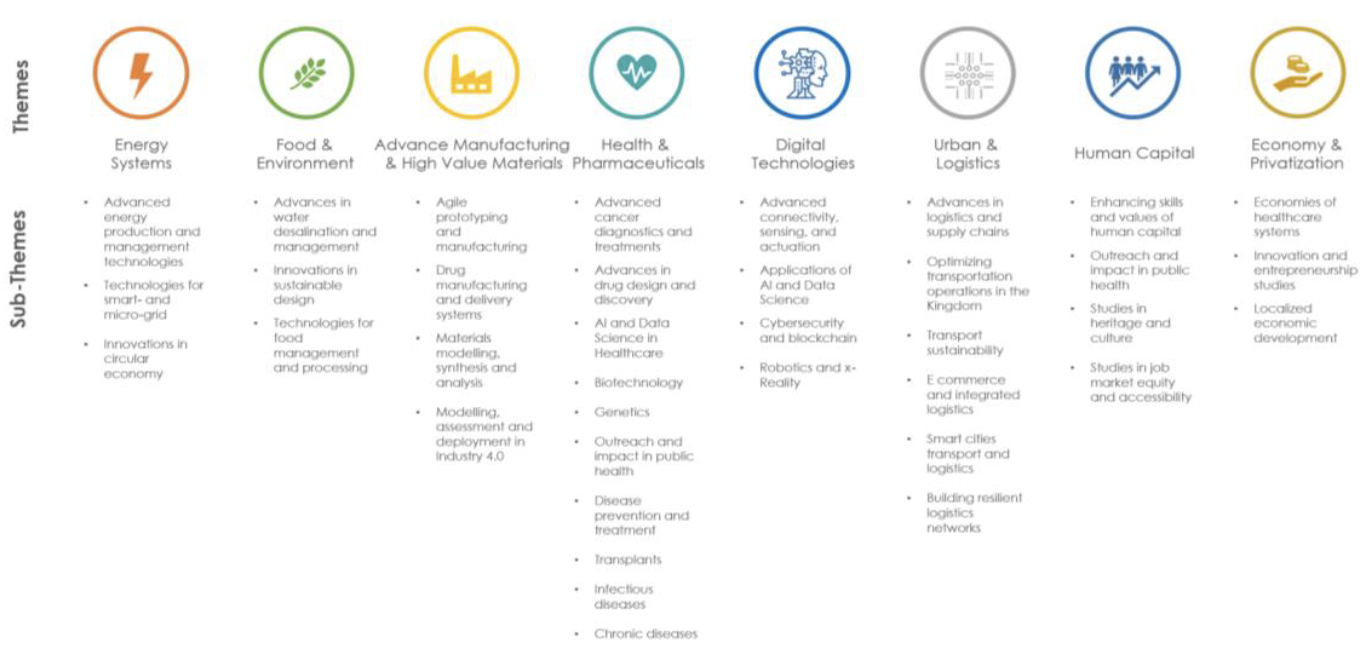
Figure 1. Alfaisal University Themes & Sub Themes (2022)
2. Offices, Councils & Committees that Support Research
2.1. Office of Research & Innovation
The Office of Research & Innovation (ORI) is responsible for assuring adherence to the University’s and sponsor’s policies and procedures, and for following ethical standards in conducting research. It provides direction and guidance in the development, identification, and securing of funding sources as well as proposal development, submission, administering and closure of awards. The Office will convey quality services related to development of research projects, compliance in the conduct of research, intellectual property, technology transfer, and governance issues related to sponsored programs.
Services will be provided to university faculty and staff through administrative support for research projects and contracts. In addition, the Office will provide an important interface with public and private members of the external community that have a vested interest in research. It is responsible for management and promotion of research activities that are carried out by the academic departments through external or internal funding.
2.2. Technology Transfer Office
The Technology Transfer Office (TTO) is the entity responsible for all aspects of technology and Intellectual Property (IP) creation, management, transfer and release at Alfaisal University (https://tto.alfaisal.edu/). The scope of the TTO mandate is as follows:
- Develop, maintain and update programs for technology and IP management and transfer.
- Identify, evaluate and commercialize disclosed technology and IP in a periodic manner.
- Maintain complete records of all disclosed IP and material transfer agreements.
- Educate and motivate members of Alfaisal University on Technology Transfer and IP aspects.
- Values
In all its handlings, the TTO operation will be aligned with efforts aimed at the realization of the Kingdom’s vision and aspirations, abiding by the laws, regulations, and values of the Kingdom, strategically evaluating, protecting, and licensing intellectual property rights of Alfaisal University and its members.
A Director oversees and manages the operation of the TTO appointed by Alfaisal University and will report directly to the VP responsible for Office of Research and Innovation (ORI). Reporting to the VP, the Director is charged with leading the Technology Transfer Office (TTO) with carrying out the responsibilities described below and elsewhere in this Policy
The main TTO structure duties will include technology identification, assessment and filing (protection), technology and IP record management and marketing, technology marketing.
Alfaisal University is responsible for managing and executing the intellectual property policy at the university and represents the institution in all the policy issues that affect its relations with the community, government, private entities and others. It has the right to manage this policy and to grant Delegations and Authorities.
2.3. Research & Graduate Council
The Research & Graduate Council (RGC), which is chaired by the Vice President for Research & Graduate Studies or delegate, is responsible for safeguarding the excellence of research and graduate education. The Office of Research & Innovation and the Graduate School are the administrative arms of the Council and are empowered on its behalf to enforce its regulations and policies. The Council membership consists of vice deans for research and graduate studies from each of the different colleges and disciplines within the institution, as well as the Director of the Graduate School.
2.4. College Research Committees
Each College has a Research Committee consisting of faculty members that is responsible for reviewing applications for internal research funding and making recommendations to the Office of Research & Innovation (ORI) which reports to the Research & Graduate Council (RGC).
2.5. Standing Committee for Graduate Studies
The Ministry of Education Council of Universities’ Affairs requires that an institution should have a Standing Committee (formerly Permanent Committee) to oversee all aspects of graduate studies (adopted at Council of Universities’ Affairs 9th mtg held on 1 August 2022). Chaired by the Vice President for Graduate Studies & Research, it reports directly to the University President. At Alfaisal University membership consists of Deans, Vice Deans of Graduate Studies of colleges, as well as the Director of Graduate Studies, and the Director for Quality Assurance & Accreditation. Many graduate programs, for example, also involve thesis/dissertation research and thus require oversight by the Standing Committee.
2.6. Scientific Council
The Ministry of Education Council of Universities’ Affairs has mandated that an institution should also have a Scientific Council to oversee all aspects of scientific matters pertaining to faculty members, research activities, studies, and publications (adopted at Council of Universities’ Affairs 9th mtg held 1 August 2022). The Council is constituted for a duration of three years. The individual responsible for overseeing scientific research (i.e., VP for Graduate Studies & Research) at the university shall serve as the chair of the Scientific Council. Membership, which is approved by the Alfaisal University Board of Trustees, is comprised of a representative from each college holding at least the rank of associate professor. Three faculty members from external institutions, each holding the rank of at least associate professor, are included in the Council. The Scientific Council also has a Secretary General from the faculty members of the university, nominated by the chair of the Scientific Council and appointed by the President of the University for a renewable term of three years. At Alfaisal University, for example, the Secretary General is responsible for processing all external reviews associated with faculty promotions. The secretary possesses neither voting rights nor is included in the quorum count.
2.7. Institutional Accreditation & Quality Assurance Committee
Established in 2024 by an administrative decision from the President’s Office (Ref.: M/G/24090088; Date: 05/09/2024), the Institutional Accreditation & Quality Assurance Committee plays a crucial role in ensuring and enhancing the quality of education and academic standards at the university by implementing quality assurance policies, maintaining documentation, providing training, and supervising audits to ensure compliance with national and international standards (https://qaa.alfaisal.edu/). The Committee is chaired by the Director of Quality Assurance & Accreditation. Membership consists of the College Vice Deans for QAA, and a Quality Assurance representative from the Graduate School.
Committee responsibilities include:
- Propose and implement quality assurance policies and processes to enhance the quality of teaching and learning and promote quality culture within the university.
- Communicate policies and procedures and provide training and oversight.
- Review and assess the institution’s compliance with accreditation requirements, identify areas of non-compliance, and develop action plans to address deficiencies.
- Participate in the preparation of self-study reports and review visits.
- Supervise internal audits and validation of portfolios at the course, program, and college levels.
- Provide reports to institutional leadership on accreditation status and QA initiatives.
- Promote transparency in the accreditation process and quality assurance activities.
2.8. Institutional Review Board
In compliance with the provisions of the Saudi Law of Ethics of Research on Living Creatures and regulations, and under guidelines of the National Committee of Bioethics (NCBE), Alfaisal University founded and registered an Institutional Review Board (IRB) under the number (HA-01-R-058).The Board consists of 9 members: a chair, vice chair, and 8 members in various specialties”, including Medicine, Business, Engineering, Science, Pharmacy, Biostatistics, Epidemiology, Law, and Public Health, and a community representative. In addition, the IRB has a designated coordinator.
Researchers can apply online to obtain IRB approval of their research projects (https://irb.alfaisal.edu/). The IRB is an independent board and does not report to the University administration.
The IRB is regulated by the NCBE with the mandate to review human subject research studies that take place within Alfaisal University. The purpose of review is to determine if the proposed research meets established regulatory and ethical criteria of the Law of Ethics of Research on Living Creatures. and its regulations, and in compliance with the guidelines of the NCBE. The IRB licenses and monitors the conduct of human subject research at Alfaisal University.
2.9. Sustainability & Strategic Planning Office
The Sustainability & Strategic Planning Office was established to integrate sustainability into the University's growth and development plans. Its aim is to advance sustainability in education, research, operations, and community engagement, while promoting a culture of responsibility and stewardship for the environment (https://sustainability.alfaisal.edu/). The University is deeply committed to its institutional mission of providing excellent and versatile world-class education, research, and innovation that contribute to serving society and achieving sustainable development. Using the University's resources and strategic partnerships, recognizes the critical importance of contributing to the United Nations Sustainable Development Goals (SDGs) and the country’s development objectives.
Core goals:
- Integrate sustainability principles into the curriculum across all disciplines, offering courses and programs that educate students on environmental stewardship and social responsibility.
- Foster interdisciplinary research initiatives focused on sustainability challenges, encouraging faculty and students to collaborate on innovative solutions to environmental and social issues.
- Implement sustainable practices across campus facilities, striving for carbon neutrality, reducing waste, conserving water, and promoting energy efficiency in buildings and infrastructure.
- Engage the campus community through outreach programs, events, and initiatives that raise awareness about sustainability issues, empower students and staff to act, and foster a culture of environmental responsibility and activism.
- Implement a Strategic Sustainability Plan by establishing a clear, actionable roadmap to integrate sustainability across university operations, curriculum, and community engagements, ensuring progress towards United Nations SDGs.
- Commit to Continuous Improvement in Sustainability Practices by regularly reviewing and updating the institution’s sustainability strategies and practices, incorporating the latest best practices and feedback from the community and stakeholders to enhance performance and impact over time.
2.10. Prince Khalid Alfaisal Center for Research & Consultancy Studies
As the commercial or business arm of Alfaisal University, the Prince Khalid Alfaisal Center for Research & Consultancy Studies delivers state-of-the art applied research solutions, educational training and consultation services that contribute to sustainable economic and social development by exploiting the human resources expertise and through building strategic partnerships (https://center.alfaisal.edu/about). The business center offers services to the faculty, students, and community at large in all aspects of the following areas: Research, Training, IP, Corporate Governance, Competitiveness Center, and Innovation. With Alfaisal University’s vast expertise, services and assets on hand, the aim of the center is to stay focused on the vision and mission which is to be in the forefront of innovation, education, and free enterprise both at the national and regional level by providing applied research solutions and consultations.
One of the main initiatives at the Center, for example, is to focus on Human Capital (https://research.alfaisal.edu/initiatives) which is in line with the Vision 2030 to develop a resilient and strong educational base, to prepare for future and global labor markets, and to provide lifelong learning opportunities. To meet this initiative, The Center has configured and tailored an online platform called the Alfaisal Extension that allows for customization of any course either face-to-face, online and/or hybrid to the public, with accessibility from anywhere, anytime (https://center.alfaisal.edu/training).
3. Research Policies & Procedures
3.1. Conference Attendance
This policy establishes the official standards, procedures, and eligibility requirements governing conference attendance support at Alfaisal University. It aims to ensure that university resources are allocated to high-quality, academically reputable conferences that advance institutional research priorities, strengthen scholarly output, and enhance the global visibility of Alfaisal University.
3.1.1 Eligibility Criteria
Applicant Eligibility:
Each faculty member should hold a full-time academic appointment at Alfaisal University. Eligible ranks include professorial faculty (Professor, Associate Professor, and Assistant Professor), as well as Senior Lecturers, Lecturers, and Instructors.
Conference & Research Quality Criteria:
The conference must be associated with a recognized international professional society. The associated journal must be indexed in Web of Science and ranked Q1 or Q2, indicating high scientific credibility. The applicant’s contribution to the conference must be delivered as an oral presentation. The topic presented must be original and must not have been previously published. The event must not be linked to predatory publishers, non-accredited societies, or commercially driven meetings lacking academic rigor.
3.1.2 Application, Review, & Approval Process
Application Submission:
The applicant must complete the official Conference Attendance Application Form (attached in Appendix 1) and attach all required supporting documents. The completed application, along with the Dean’s endorsement, must be submitted to Office of Research & Innovation (ORI). All applications must be submitted at least two months prior to the conference start date. Applications that are incomplete, inaccurate, or submitted after the deadline may not be processed.
Review by Office of Research & Innovation (ORI):
The Office of Research & Innovation (ORI) will review the application to verify eligibility, completeness, and compliance with the Conference Attendance Policy. Applications that meet all requirements will be forwarded to Higher Management for final decision. Decisions issued by ORI regarding conference support applications are considered final and are not subject to appeal.
Post-Approval Financial Process:
Upon receiving executive approval, ORI will formally transfer the approved request to the Human Resources (HR) Department for administrative processing. The faculty member must log in to the Alfaisal HRSS system and submit a Business Travel Claim. HR will provide the necessary step-by-step submission guidance, and faculty may contact HR directly for support. HR becomes the primary point of contact. The applicant must also upload the following documents in HRSS when submitting the claim:
- ORI approval letter
- Ticket information
- Accommodation details
- Registration fees (if applicable)
- Visa fees (if applicable)
Conference support is issued as an advance (outstanding amount) rather than reimbursement and is provided as follows:
- Up to 15,000 SAR for Professorial Faculty (Professor, Associate Professor, and Assistant Professor).
- Up to 10,000 SAR for Senior Lecturers, Lecturers, and Instructors.
- A lower amount may be assigned by ORI for international/local travel, partial eligibility cases, or other situations deemed not qualifying for the full allocation.
- To close the advance, the faculty member must submit the official certificate or letter of attendance to HR and ORI. The advance will remain open until this document is provided.
3.1.3 Processing Timeline
Applications submitted within the required timeframe will be reviewed and processed within 7–10 working days from the date of receipt. Please note that additional time may be required by Higher Management.
3.1.4 Acknowledgments
Recipients of conference attendance support are required to acknowledge Alfaisal University in their conference presentations, abstracts, posters, or related materials, in accordance with ORI guidelines.
3.1.5 Post-Conference Requirements
Following attendance at an approved conference, the applicant should submit a copy of any resulting publication output, abstract, conference preceding, or final published manuscript to ORI immediately upon publication. Failure to comply with post-conference requirements may affect future eligibility for conference support.
3.1.6 Communication & Contact Information
All inquiries or requests for clarification related to this policy shall be directed to ORI designated contact person: Zinab Elbashir. Email: zelbashir@alfaisal.edu
3.2. Publication Fees Support
This policy outlines the procedures, eligibility criteria, and payment mechanisms for supporting publication fees at Alfaisal University. This policy aims to enhance research output, global visibility, and scholarly excellence by providing financial support for eligible fees, to encourage faculty, researchers, students, staff, and adjuncts to publish in high-impact journals.
3.1.1 Eligibility Criteria
Applicant Eligibility: Faculty members, adjunct faculty, postdoctoral research fellows, teaching assistants, research assistants, undergraduate and graduate students, as well as administrative staff, provided they hold an official affiliation with Alfaisal University.
Reimbursement Rates:
| Author Role | Reimbursement Rate |
|---|---|
| First author | 100% |
| Co-author (non–first author) | 50% |
“First author” refers strictly to the first name listed in the byline. “Equal first authorship” is not considered the first author for reimbursement purposes, as per Alfaisal University guidelines.
Publication Eligibility:
Support is provided for all papers accepted for publication in high-quality journals indexed in Web of Science (Q1 and Q2, according to Journal Citation Reports 2025 by Clarivate), or equivalent. If a journal falls within Q1 or Q2 in any of its indexed categories, it is considered eligible for publication fee support. If the journal operates on a hybrid model with both subscription and open-access options, applicants should select the subscription option for publication. If open access is preferred, pre-approval from the Office of Research & Innovation (ORI) is required. If the journal is open access only and meets the university’s eligibility criteria, the publication fee will be covered without additional pre-approval.
Affiliation Requirements
For faculty members, adjunct faculty, postdoctoral research fellows, teaching assistants, research assistants, undergraduate and graduate students, as well as administrative staff, Alfaisal University should be listed as the primary institutional affiliation to be eligible for support.
Correct Affiliation Format
- Authors should use the following format: College of [Name], Alfaisal University, Riyadh, Saudi Arabia.
- Common mistakes such as writing Al Faisal or Al-Faisal or adding Kingdom of Saudi Arabia do not align with the University’s official affiliation format.
- Adding the Department (before the College) is optional but preferred.
- If a ZIP code is required, it should be 11533.
- If a P.O. Box is required, it should be 50927.
- The affiliation should include the author’s official Alfaisal University email address on the published paper. The use of personal email addresses (e.g., Gmail, Hotmail, Yahoo, or Outlook) should be avoided.
Ethical Compliance
All research involving human subjects, human data, animals, or biological samples should have prior Institutional Review Board (IRB) approval. Proof of valid IRB approval (or exemption) should be submitted with the publication fee request.
Submission Fees
In certain academic disciplines, particularly business, economics, and related fields, some journals charge submission fees at the time a manuscript is submitted. These fees are non-refundable, distinct from publication fees, and not required by all journals. Submission fees will be covered for up to two (n=2) submission attempts for the same manuscript.
3.1.2 Application Procedure
All applicants are required to complete the Publication Fee Support Form (attached in Appendix 2) and submit the appropriate supporting documents corresponding to their request type. Table 1 outlines the required evidence for each case to clarify the overall process and ensure consistency in the review and approval procedure.
Table 1. Required evidence for each case to clarify overall process & ensure consistency in review & approval procedure for publication fee support.
| Request Type | Request Condition | Required Supporting Documents |
|---|---|---|
| ORI Direct Payment | The paper has been published, and the publication fee has not yet been paid. ORI will process the payment directly. |
|
| ORI Direct Payment | The paper has been accepted but is not yet published. ORI will process the payment directly |
|
| Finance Department Reimbursement | Applicants who have already paid the publication fee. In this case, the publications fees will be processed by the ORI and forwarded to the Finance Department for reimbursement. |
|
Review & Approval Process: Upon receipt, ORI will review the request for eligibility. Approved requests will proceed for management approval, applicant notification, and payment processing. Requests that are not approved will be communicated to the applicant with clarification, as needed.
Processing Timeline: All publication fee payment and reimbursement requests will be processed by ORI within 5–7 business days upon submission of complete documentation. Please note that this timeline covers ORI’s internal administrative processing only. Additional time may be required by ORI or the Finance Department to complete the final payment or reimbursement.
Acknowledgments: Funded publications that are related to an awarded Internal Research Grant (IRG) or President’s Initiative Fund (PIF), should include proper acknowledgment of Alfaisal University support, following ORI guidelines. The exact wording is not mandatory, but it should clearly indicate that the research was supported by the university.
Example acknowledgment:
“The authors gratefully acknowledge the support of Alfaisal University, Office of Research & Innovation, through the Internal Research Grant (IRG #XXXXX).”
External Funding Policy: If a publication is fully or partially funded by an external agency, external funding should be utilized first to cover publication fees. ORI will only cover publication fees not already funded through external sources. A copy of the external funding award letter or agreement should be attached as supporting documentation.
Exceptions and Special Cases:
- Books and book chapters: Fees will be reviewed on a case-by-case basis, subject to ORI approval.
- Conference proceedings publications: Fees will be reviewed on a case-by-case basis, subject to ORI approval.
Communication and Contact Information: All inquiries or requests for clarification related to this policy shall be directed to ORI designated contact person: Dr. Zinab Elbashir. Email: zelbashir@alfaisal.edu.
3.3. Editorial Support
Alfaisal University is committed to fostering academic excellence and supporting faculty members and students in their research endeavors. As part of this commitment, the university recognizes the importance of high-quality research publications and the need for effective editing services to ensure the clarity and coherence of academic work. To address this need, Alfaisal University will subsidize editing services for up to 500 SAR per manuscript. A faculty member or student may make use of external or internal editing services. To be reimbursed a copy of a paid invoice as well as the edited manuscript should be submitted to the Office of Research & Innovation (ORI) https://research.alfaisal.edu/contact-us. The ORI will then reimburse the faculty member or student for up to 500 SAR.
3.4. Statistical Support
Statistical support is provided through the Department of Biostatistics & Epidemiology (https://com.alfaisal.edu/en/biostatistics-epidemiology). The department offers courses in biostatistics and epidemiology and has strong collaborations with public and private national and international health agencies and institutions. The department hosts seminars and special events to enhance students' learning experience. In addition, there is a University Quality Assurance and Accreditation (QAA) department which is dedicated to assisting the institution in achieving its strategic goals of quality, academic excellence, and continual development on a local and global level (https://qaa.alfaisal.edu/). This department serves as a link hub between Alfaisal University and external regulatory bodies, such as the Ministry of Education (MOE) and the National Commission for Academic Accreditation & Assessment (NCAAA), as well as other professional bodies and external accrediting agencies.
3.5. Research Integrity
The demonstration of professional integrity by faculty members includes recognition that society at large will judge the profession as well as the institution by their statements and behavior. Therefore, faculty members should strive to be accurate, to exercise appropriate restraint, to be willing to listen to and show respect to elements of society at large expressing different opinions.
Scholarly conduct must avoid fabrications, falsifications, plagiarism and other practices that deviate from accepted scholarly work. Faculty must apply academic rigor and integrity in obtaining, recording and analyzing data as well as in reporting and publishing results.
Faculty undertaking research should do so in a manner consistent with professional honesty and within the public interest. Research should be designed to enhance knowledge in a particular field of scholarship and should demonstrate sound methodology, accuracy and maintain the factual integrity of the data.
Faculty must use funds designated for research purposes in the prescribed manner.
Faculty members and other researchers who are full-time paid employees at Alfaisal University should declare Alfaisal University as their academic affiliation in any publication produced during their stay at the University.
3.6. Investigator Eligibility
The Principal Investigator (PI) for grants must normally be a full-time faculty member at Alfaisal University. Co-Investigators may be from Alfaisal or another institution. A Co-Investigator must consent to take over the project if the PI is unable to continue.
3.7. Research Misconduct
This section outlines the conditions that protect and encourage the faculty in its scholarly pursuits. The University requires that those engaged in scholarships be dedicated to the highest ethical standards. Misconduct in scholarship by any member of the university community threatens the university as well as the individual. The policies set forth here apply to all faculty members and provide for an objective examination of pertinent facts, protection of individual rights, and integration with other relevant review procedures, all under the general supervision of the Provost/President as the senior academic administrator.
Scholarly misconduct includes fabrication, falsification, plagiarism, inappropriate allocation of authorship credit, or other serious deviation from accepted practices in proposing, carrying out, or reporting technical results and expenditure of funds from research, educational or other scholarly activities; or retaliation of any kind against a person who has not acted in bad faith and who reported or provided information about suspected or alleged misconduct; or failure to comply with regulatory requirements affecting specific aspects of the conduct of research, e.g., the protection of human subjects and the welfare of laboratory animals.
Scholarly Misconduct does not include honest error or honest differences in interpretations or judgments of scholarly matters. If the alleged misconduct is not substantiated, the University will undertake diligent efforts to restore the reputation of those under investigation. Should either the inquiry or the investigation show that the allegations of misconduct were not made in good faith, those making the allegations will themselves be subject to disciplinary action.
Decisions regarding alleged misconduct procedures should yield a just decision based on the best and most complete information available. Any decisions should be based on the expert judgment of individuals qualified in the respective scientific field, using scientific interpretations and standards of proof, with a minimum of procedural complications. At the same time, however, the process must be fair and afford all parties an equal chance to present their best arguments. The confidentiality of all parties in a dispute must be preserved to an extent consistent with the University’s obligations to research sponsors and to the scientific community. Acrimony and recrimination are undesirable, so adversarial interactions should be avoided. The process should move speedily, yet haste and error must be avoided.
Guided by these principles, Alfaisal University has established a policy with four procedural stages. In the screening stage an accusation of research misconduct is brought to the Vice President for Research & Graduate Studies who will examine the charges to ensure they are potential violations of the misconduct policy and, if so, to pass the case along to an Inquiry Panel. The inquiry stage evaluates the merits of the case, determining whether there is sufficient evidence of misconduct to merit a full investigation. The investigation stage entails a detailed examination of the case to resolve the facts ("Was this or was this not an instance of misconduct?"). Ascertaining whether misconduct occurred is a judgment about collegial conduct that should be resolved on its merits. If at any stage in the process it becomes evident that there was no misconduct, vigorous efforts must be made to minimize and remedy any adverse consequences for the respondent’s career and reputation. If misconduct is established, then the case is referred to the disciplinary stage.
3.8 Procedures for Investigating Research Misconduct
3.8.1 Screening Stage
Initial reports of alleged research misconduct must be brought to the attention of the person with administrative responsibility for the individual whose actions are in question. That person must in turn report the allegations to the Vice President for Research & Graduate Studies. Care must be taken to protect the privacy of those who report apparent misconduct. The Vice President will promptly examine the case and determine if the case falls under the misconduct policy. If so, the inquiry stage will be followed.
3.8.2 Inquiry Stage
The Vice President for Research & Graduate Studies will immediately inform the respondent in writing of the accusation and that an inquiry has been initiated. The Vice President will prepare a list of proposed members for the Inquiry Panel. The respondent may challenge the inclusion of specific individuals to this panel by stating his or her objections in writing. The Vice President will then select the Inquiry Panel.
The inquiry will be conducted by a Panel consisting of two Faculty members and one academic administrator. The Panel should take no more than 30 days to conduct its inquiry and determine whether or not there is a reasonable basis to conclude that misconduct has occurred. During this discovery stage, the only persons who may be present during fact-finding sessions are the Inquiry Panel members, and any witnesses (e.g. respondent, complainant, other faculty/staff) called by the Panel. If the respondent is not available to attend, the Provost/President will fairly resolve the conflict between timeliness and the respondent’s right to be present.
If a majority of the Inquiry Panel finds there is reasonable basis to conclude that misconduct occurred, then the matter must proceed to the investigation stage. The Inquiry Panel reports the results of its inquiry along with recommendations in writing to the Provost/President. The Provost/President will advise, in writing, the respondent and the complainant of the Inquiry Panel outcome. If there is to be an investigation, the Provost/President must advise the respondent in writing of the specific charges to be investigated. At that time, any collaborators and sponsoring agencies involved must be informed of the allegations.
3.8.3 Investigation Stage
Investigation of alleged misconduct will be conducted by a committee appointed by the Provost/President. The committee will be comprised of a minimum of three specialists in the subject area of the respondent and will include one individual from outside Alfaisal University. The Provost will prepare a list of proposed members for the Investigation Panel, which may include persons who served on the Inquiry Panel. The respondent may challenge the inclusion of specific individuals by stating any objections in writing. The Provost/President will then select, and appoint, the Investigation Panel. The Panel will elect its own Chair.
The Investigation Panel will determine whether there was academic misconduct. The Panel will follow the procedures for dealing with charges brought against a faculty member as described herein and will seek to provide factual information in a manner that is fair to all parties. The Investigation Panel should take no more than 60 days to complete the investigation and to prepare a written report of its findings including a recommendation on the disposition of the case. The Panel should follow pertinent regulations of the agency or agencies that sponsored the research under investigation. The Investigation Panel will submit its report to the Provost/President, who in turn may notify the sponsoring agency of the findings of the investigation.
3.8.4 Disciplinary Stage
For individuals found to have committed scholarly misconduct, the Provost/President may take one or more of the following actions: (a) give a letter of reprimand; (b) monitor their work performance; or (c) recommend removal from a specific research project. Other, more severe, penalties include (d) being barred from conducting sponsored research, (e) recommending a reduction in rank, (f) suspension for a fixed period, or (g) termination. Termination shall be in accord with procedures specified in the Faculty Handbook.
If there is a finding of misconduct, the Provost/President must also take the following actions: (a) All pending abstracts and publications emanating from the fraudulent research should be withdrawn and editors of journals in which previous abstracts and papers appeared should be notified of the findings of the investigation; (b) Institutions and sponsoring agencies with which the investigated individual has been affiliated should be notified that there is reason to believe that the validity of previous research might be questionable.
3.9 Research Compliance
Faculty must comply with relevant statutes or regulations for the protection and welfare of researchers, human subjects, the public, laboratory animals and the environment.
3.9.1 Institutional Review Board
Research involving the use of Biohazardous Material, Human and/or Animal Subjects must be submitted to the Institutional Review Board (IRB) for review and approval (https://irb.alfaisal.edu/). Funding will not be granted for research which has not been approved.
3.9.2 Human Subjects
Medical research is subject to ethical standards that promote respect for all human beings and protect their health and rights (World Medical Association Declaration of Helsinki 2000). Approval for research involving Human Subjects cannot be initiated prior to application and submission of related documentation and consent forms to the designated Ethics Committee at the facility where the research will be conducted (https://irb.alfaisal.edu/).
Approval is granted for a specified duration and must be renewed to ensure continuation of research. It is the responsibility of the Principal Investigator to submit a progress report in accordance with the IRB Committee guidelines for review and approval. In some instances, projects that have not obtained approval before the expiration date are terminated. Any modifications to a research protocol, consent forms, or administrative matters in addition to reporting of adverse events must be submitted for approval by the Principal Investigator to the respective Committee(s).
3.9.3 Animal Subjects
Research involving the use of animals is subject to compliance of ethical practices and standards which ensure their proper care, use and humane treatment. Approval must be obtained from the Institutional Review Board (IRB) available at each collaborating facility where the proposed research will take place. The IRB is responsible for reviewing and approving all research activities involving the use of animal subjects before a project is initiated. Research which does not receive approval from the IRB will not be funded.
3.9.4 Environmental Health and Safety
It is the duty of faculty members conducting research to take necessary measures to promote and secure safe and healthy working practices and environments. Use of rDNA, biohazardous materials, or other agents must be detailed in the research protocol. Review and approval must be obtained from respective committees in facilities where the proposed work will take place. Proposals that have not received prior approval will not be recommended for funding.
3.10 Conflict of Interest
Conflicts of interest may arise when a faculty member’s personal interests interfere with their responsibility to the university. The key factors in avoiding ethical and legal conflict of interest are personal responsibility and integrity. Alfaisal University expects all faculty members to conduct their outside professional activities in a manner that reflects well on themselves, their profession, and the University. The principal means for managing potential conflicts of interest involves prior disclosure and a dialog between a faculty member and their dean. Special guidelines apply to faculty members who are involved in purchasing supplies, services, and equipment for the University. Faculty members with the authority to commit university funds must disclose whether any potential conflict of interest exists when they request signature authority for the commitment of funds. Only in special cases may University equipment or facilities be used for services to an outside organization, including those controlled by faculty members, and then only with the explicit written approval of the Department Head and Dean or applicable Vice President.
4. Funding Research & Innovation
4.1. Policy Statement
The Office of Research & Innovation (ORI) is responsible for the coordination, supervision, and securing funds for research in the University and with collaborative partners in the local and global environment with the purpose of supporting the University’s strategic plan.
Alfaisal University provides support services for research in the form of laboratory space, funding, compensation, computing facilities, and reduced teaching load.
The University seeks to maintain and upgrade research space and to institute new facilities for on-campus research so as to provide a vibrant academic environment conducive to research. The ORI also seeks to provide research laboratory space outside the university through collaboration with for example KFSHRC, KACST, Saudi Aramco, and KAUST.
4.2. External Research Funding
There are several ways to fund research projects either through the University’s internal budget or through externally funded programs or projects such as Research Grants, Chairs and Centers. This section gives a brief description of externally funded research.
4.2.1. Research, Development & Innovation Authority
The Research, Development and Innovation Authority (RDIA) has developed a unique research grants and funding portfolio that ensure a sustainable and world-class national RDI ecosystem. Research grants are designed and prioritized to foster a thriving innovative ecosystem, developing highly skilled innovators and support cutting-edge research that can transform industries and create value for society (https://rdia.gov.sa/grants/index.html).
This major source of funding comes in three basic forms: Saudi Basic Science Initiative, Saudi Applied Research and Technology Initiative; and Reactivation and Rebuilding of Existing Labs Initiative.
The Saudi Basic Science (SBS) initiative seeks to support basic and fundamental scientific research in Saudi Arabia. The initiative aims to promote scientific excellence and innovation in the research ecosystem continuum. The primary objective is to achieve significant breakthroughs and advancements in the four national RDI priorities. The initiative provides funding to expand the pool of talented national researchers, to encourage their participation in targeted fields and to enable them to pursue their scientific ideas and activities at the early stages of discovery (https://rdia.gov.sa/grants/sbs.html).
The Saudi Applied Research and Technology (SART) Initiative is a project-level funding offered by RDIA. The initiative supports applied science and technology development research in Saudi Arabia with a focus on the four national RDI priorities. This initiative enables researchers to convert their scientific activities and ideas from the discovery stage to the development stage with the possibility of market testing and commercialization. Research institutions and researchers within the Kingdom are encouraged to partner with private, public, or not-for-profit organizations while collaborating with other universities. This important opportunity allows for the development of new technologies and strengthening research links and collaborations between different institutions (https://rdia.gov.sa/grants/sart.html).
The Reactivation and Rebuilding of Existing Labs Initiative fund provided through the initiative targets the enhancement of the existing labs, which will lead to increasing the number and quality of research outputs in terms of publication, patents, or ready for commercialization IPs. It will also expand the pool of nationally talented researchers and stimulate their participation in areas that will lead to breakthroughs in targeted fields. This initiative aims to support the maintenance and upgrading of existing equipment, facilitate the hiring of research staff such as postdoctoral fellows and researchers, and enable the hiring of supporting staff like technicians, specialists, or engineers to assist researchers (https://rdia.gov.sa/grants/rrg.html). In 2024, for example, Alfaisal University was awarded five contracts in this category worth 17 million SAR>
4.2.2. Contracts with Industry & Foundations
External funding is also available from Saudi Aramco which holds RFP (Request for Proposals) from universities every other year, Al Anoud foundation, and Boeing.
4.3 Internal Research Funding
4.3.1 Internal Research Grants (IRG)
The Internal Research Grant (IRG) policy establishes the framework governing the management, allocation, and oversight of research funding provided by Alfaisal University’s Office of Research & Innovation (ORI). Its purpose is to support and enhance faculty research activities, promote collaborative and high-impact projects, and strengthen the university’s contribution to national research priorities. This policy outlines the eligibility criteria, application and review processes, funding rules, and reporting requirements to ensure transparency, accountability, and alignment with institutional research goals.
4.3.1.1 Roles & Responsibilities
Principal Investigator (PI): Prepare and submit a complete IRG application in accordance with the published guidelines and deadlines. Ensure that the proposed research aligns with the university’s strategic research priorities. Obtain all required ethical approvals prior to the release of funds. Manage the approved budget in compliance with university financial policies and the grant agreement. Submit progress and final reports on time, including details on outcomes, expenditures, publications, and patents. Acknowledge the university’s support in all research outputs resulting from the IRG.College Research Committee (CRC): Review and assess submitted proposals based on scientific merit, feasibility, and alignment with strategic priorities. Recommend proposals for funding to ORI with clear justification. Support faculty members in strengthening the quality of proposals and research outcomes. Promote compliance with research integrity and ethical standards at the college level. Use the IRG Proposal Evaluation Form (attached in Appendix 3) to document the committee’s assessment and recommendations for each application.
College Vice Dean for Research & Graduate Studies (VDRGS): Ensure that research activities in the college align with university priorities and policies. Oversee the CRC’s evaluation process to ensure fairness and objectivity. Endorse and prioritize proposals submitted by the college for IRG funding. Review and provide written recommendations and feedback on all progress and final reports submitted by PIs before forwarding them to ORI. Assess the necessity and cost-effectiveness of requested items and provide feedback to ORI when alternatives or existing resources are available. Review and approve expense forms to ensure they are justified, budget-compliant, and aligned with project objectives before submission to ORI. Serve as the main point of communication between ORI and the college for all IRG matters.
Office of Research & Innovation (ORI): Announce IRG opportunities and provide clear application guidelines and timelines. Receive, screen, and manage all IRG applications and ensure compliance with eligibility criteria. Coordinate the review and evaluation process with relevant committees and reviewers. Issue IRG contracts and ensure that funds are allocated according to approved budgets. Monitor project implementation through regular reporting and communication with PIs. Ensure compliance with institutional and funding policies, including ethical and financial requirements. Provide support and guidance to faculty throughout the project lifecycle. Maintain complete records of IRG applications, awards, expenditures, and outcomes.
4.3.1.2 Eligibility Criteria
Applicant Eligibility: Full-time faculty members (e.g., Professor, Associate Professor, Assistant Professor, Senior Lecturer, Lecturer, or instructor) are eligible to serve as PIs. Postdoctoral research fellows and graduate students (PhD and Master’s) may serve as PIs, provided that their supervisor is appointed as a co-PI. Adjunct faculty, teaching assistants, and research assistants can participate in the project as co-PIs. External collaborators are encouraged to participate in the research project as co-PIs. The ORI supports faculty members in leading IRG projects in alignment with their research progress and capacity, with support maintained throughout successful project implementation. Faculty members should maintain good standing in terms of research ethics, financial compliance, and previous grant performance. Faculty members have successfully completed and submitted all required progress and final reports for previously funded internal grants.Application Eligibility: All applications should comply with institutional research ethics and IRB approval requirements where applicable. All applications should be clearly aligned with one or more ORI research themes. (see Appendix 4), that reflects the university’s strategic research priorities. All applications should comply with ORI policies and procedures. All applications should be reviewed and endorsed by the VDRGS of the applicant’s respective college prior to submission to ORI.
- 4.3.1.3 Application & Evolution Process
Faculty members are encouraged to submit IRG applications at any time during the academic year. ORI conducts periodic review cycles and will notify applicants of the next scheduled review date upon receiving their submissions. The PI should complete and submit the IRG application form (attached in Appendix 5), along with the updated CVs of the PI and all co-investigators, to the VDRGS of their respective college. The College Research Committee (CRC) evaluates the application for eligibility, quality, and alignment with the ORI research themes. The reviewed application is then forwarded to ORI for further evaluation. ORI may refer proposals to qualified external reviewers for an independent assessment of their scientific merit and feasibility. ORI consolidates all evaluations and communicates the funding decision to applicants within the nearest review cycle. Priority may be given to proposals that demonstrate strong potential for publication, external funding leverage, or interdisciplinary collaboration across colleges or departments. - 4.3.1.4 IRG Contract & Activation
Upon approval of the IRG, the PI will be officially notified by ORI. The PI will be invited to sign the IRG contract (attached in Appendix 6), confirming acceptance of the grant terms, approved budget, project duration, and compliance with university research policies and ethical standards. The project will be considered activated only after the fully executed (signed) IRG contract is received by ORI. Activation authorizes the PI to initiate expenditures in accordance with the approved budget and procurement procedures outlined in this policy. 4.3.1.5 Budget & Funding Rules
Budget Allocation: IRG budget allocations are determined in relation to the project’s scope and needs. Well-justified requests will be supported following ORI review. Projects involving interdisciplinary collaboration across colleges or departments may be considered for a higher budget cap as an incentive for collaborative, high-impact research. ORI reserves the right to adjust the approved budget based on justification, available funds, and institutional priorities.Budget Reallocation: If the PI wishes to reallocate the approved budget, they should complete the Budget Reallocation Form (attached in Appendix 7) and submit it to ORI for review and approval. No additional funds will be granted as part of a reallocation; adjustments should remain within the originally approved budget. A clear and valid justification should be provided, demonstrating that reallocation is necessary and directly supports the original project objectives. Budget reallocation should not affect the original research plan, objectives, or approved topic.
Fund Release Procedures: IRG funds are not transferred directly to faculty members or their departments. All project-related expenses are processed and paid through ORI in coordination with the Finance and Purchasing Departments. To initiate any expenditure, the Research Expense Form (attached in Appendix 8) should be completed and submitted to ORI with all required supporting documents (e.g., quotations or invoices).
Procurement & Financial Procedures: For all purchases that can be sourced from multiple vendors, the PI should coordinate with the Purchasing Department to obtain at least three quotations and attach them to the Research Expense Form. In cases where the required item or service is available from a single source only (such as datasets or specialized software), a single-source justification and an official invoice from the vendor will suffice. If a quotation includes multiple items but only specific items are required, the PI must coordinate with the Purchasing Department to obtain a revised quotation reflecting only the selected items prior to submission.
Allowable Expenditures: Research equipment directly related to the project’s objectives. Materials necessary for conducting experiments or analysis. Specialized software, licenses, or data access essential to the project. Data analysis, testing, translation, or professional services that are integral to research delivery. For fieldwork or data collection directly related to the project (not for conferences).
Excluded Expenditures: Publication fees and conference attendance expenses are not covered under the IRG budget. These are handled through separate support programs administered by ORI.
- 4.3.1.6 Project Duration & Extension
The maximum project duration is 24 months (2 years). If the PI wishes to extend the project, a Project Extension Form (attached in Appendix 9) should be submitted to ORI at least two months before the project’s scheduled end date. The extension request should include a clear and justified reason for the extension, an updated project timeline, and confirmation that the original research aims and topic will remain unchanged. ORI will review the request and communicate its decision to the PI. Approved extensions do not include any additional funding. 4.3.1.7 Monitoring & Reporting Requirements
Reporting Schedule: The first progress report is due six months after the contract signing date. Subsequent progress reports are required every six months for the duration of the project. Upon project completion, the PI should submit a final report detailing the research outcomes, deliverables, publications (if any), and full financial expenditure summary. Submission of the final report is a mandatory requirement for project closure and eligibility for future IRG cycles.Submission Process: ORI will send a reminder email to the PI two weeks before each report is due. The PI should submit the completed Progress Report form (attached in Appendix 10) to the VDRGS. The report should be signed by the PI and endorsed by the VDRGS. Progress reports are coordinated and received through the VDRGS.
4.3.1.8 Deliverables & Outcomes
Each funded project is expected to produce tangible research outcomes that contribute to the university’s research priorities and strategic goals.Deliverables may include but are not limited to: Publications in reputable journals, ranked Q1 or Q2 in the Web of Science. Patents, prototypes, or software. Conference presentations. ORI encourages PIs to pursue external funding opportunities, building upon the results of IRG-funded research. Any publications or outputs arising from IRG support should acknowledge the financial support of Alfaisal University’s ORI in all dissemination materials.
- Example acknowledgment: “The authors gratefully acknowledge the support of Alfaisal University, Office of Research & Innovation, through an Internal Research Grant (IRG #XXXXX).”
- 4.3.1.9 Compliance & Closure
Faculty members who fail to utilize allocated budgets, submit required progress reports, or produce research outputs (e.g., publications or deliverables) from prior IRGs may be ineligible to apply for IRG funding. All equipment, workstations, databases, and any other assets procured using IRG funds are considered the property of ORI. These assets do not belong to the PI or to the college. Upon project completion, the PI should return all ORI-owned equipment and assets to ORI for inventory and reassignment. Faculty members who wish to continue using ORI-owned assets for a new research project may submit a formal request. ORI will review and may grant approval if the use aligns with the objectives of a funded project and supports institutional research priorities. - 4.3.1.10 Communication & Contact Information
All inquiries or requests for clarification related to this policy shall be directed to ORI designated contact person: Ms. Safiah Labani. Email: slabani@alfaisal.edu For college-level coordination, faculty should communicate through their VDRGS.
4.3.2 President’s Initiative Fund
Larger funding for faculty is provided through the President’s Initiative Fund (PIF). These are substantially highly competitive two-year (up to 500,000 SAR) grants. All proposals are initially reviewed by the respective College Research Committee (CRC) before being forwarded to the Office of Research & Innovation (ORI) which sends the proposals out for external review. The final review and approval are done by the VP for Research, Innovation & Graduate Studies in coordination with the ORI.
4.3.3 Financial Support of PhD Students’ Research Supplies
This policy provides a framework for financial support of PhD students’ research supplies to ensure successful completion of dissertation projects while maintaining accountability and alignment with institutional priorities. Support covers consumables, specialized reagents, small equipment, and services essential to the approved project. Each PhD student is eligible for up to SAR 150,000 over the duration of the program, disbursed in phases and tied to academic and research milestones. Funds are allocated only for Alfaisal research, and not external entities such as KFSHRC. (UC Approval 14th Mtg 29 Sept 2025)
- 4.3.3.1 Process for Support of Research Funds
Preliminary Research Support (Pre-Defense): Up to SAR 50,000 may be requested to generate preliminary data for proposal defense. Eligible costs include limited supplies, core facility fees, and small-scale experiments. Applications must include a short 3-page concept paper with objectives, methods, and budget, endorsed by the supervisor and PhD Program Director. Final approval is by the Office of Research and Innovation (ORI).
Full Research Grant (Post- Proposal Defense): After successful proposal defense, students may apply for a standard Internal Research Grant (IRG) covering the balance of the allocation (up to SAR 150,000 including any preliminary support). Applications must include the approved proposal and detailed budget. Endorsements are required by the supervisor and external examiners of the proposal defense. Final approval rests with ORI and the Vice President for Graduate Studies, Research & Innovation. - 4.3.3.2 Eligible & Ineligible Expenses
Eligible: reagents, kits, cell culture supplies, access to core facilities, small essential equipment, and data acquisition/analysis services.
Ineligible: personal stipends, conference trips, office supplies, laptops, or unrelated expenses. - 4.3.3.3 Application Process & Accountability
Preliminary Support: Submit a 3-page concept paper (objectives, methods, budget) endorsed by supervisor and Program Director; & with approval by ORI.
Full Grant: Submit approved proposal and IRG with budget; endorsed by supervisor and external examiners; final approval by ORI and VP Graduate Studies, Research & Innovation.
Financial Management: Funds are managed centrally by ORI. Procurement requests require supervisor approval and follow university finance and purchasing procedures.
Annual Progress and Expenditure Reports: must be submitted to ORI for continued disbursement. - 4.3.3.4 Oversight
This policy will be reviewed every three years by ORI and the Graduate School to ensure alignment with institutional goals and Vision 2030 priorities.
It is an Alfaisal University requirement that internal research funding results in research proposals submitted to outside research funding agencies, such as RDIA, and, ultimately, successful external funding of the faculty members’ research activities. In addition, faculty members must show overall scholarly productivity (e.g. refereed journal papers which are indexed in ISI, TR, and Cabell’s databases). All publications produced by Alfaisal faculty members must indicate an Alfaisal University affiliation. In addition, faculty holding IRG and/or PIF grants must clearly indicate financial support in the acknowledgement section of the manuscript. The following statement should be used: “Financial support from Alfaisal University through grant IRG/PIF number is gratefully acknowledged”
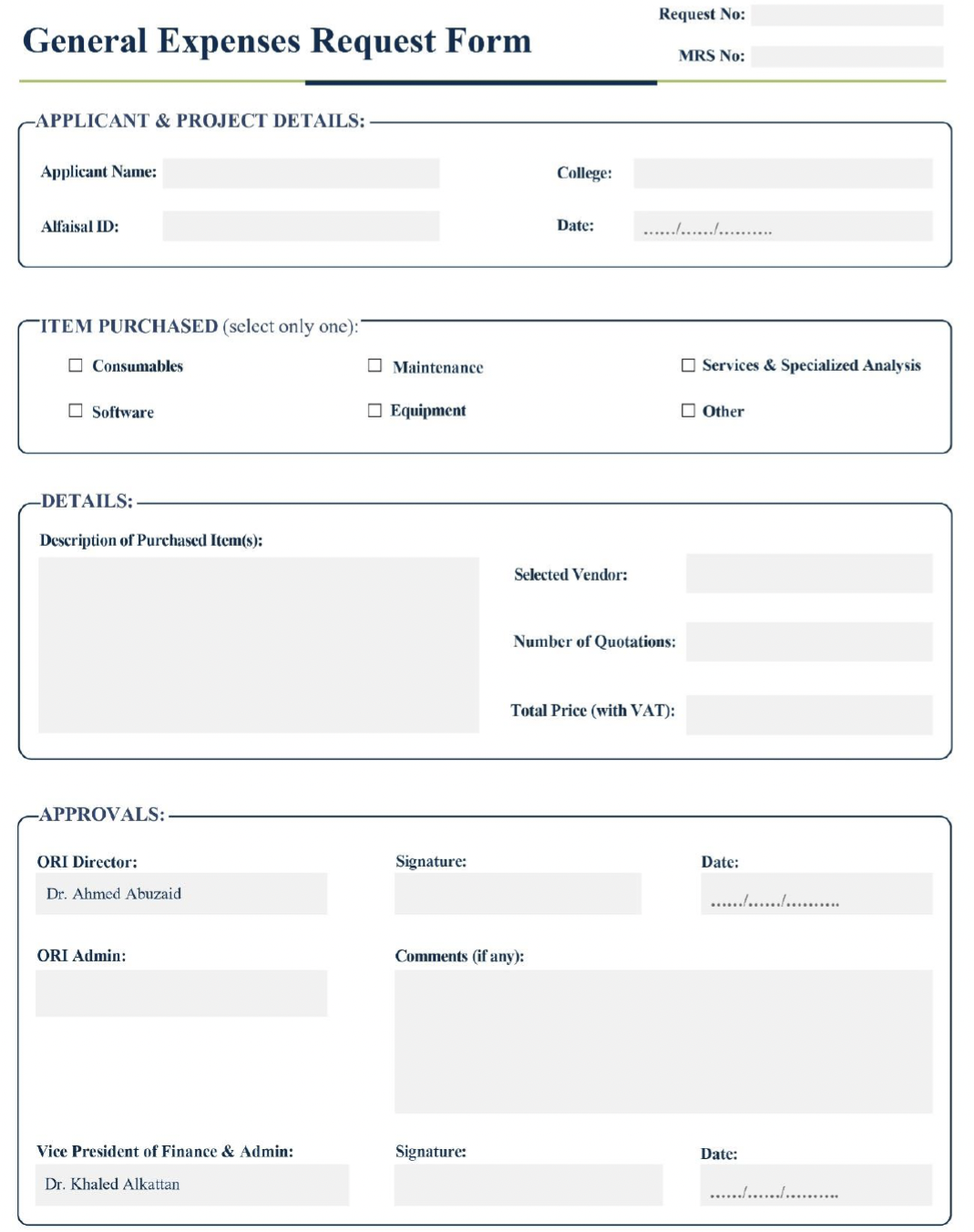
4.4 General Expense Request Policy
This policy governs general expense requests submitted by faculty members to the Office of Research & Innovation (ORI) that are not related to Internal Research Grants (IRGs) or any other awarded research funding. The purpose is to regulate discretionary, institutional, or research-support requests while ensuring transparency, consistency, and proper financial oversight.
4.4.1 Eligibility Criteria
Applicant Eligibility:
This policy applies to full-time faculty members of Alfaisal University. Applicants must submit requests for general expenses that support academic or research-related activities and are not funded through IRGs, publication funding, conference attendance funding, or external grants. Requests must demonstrate clear academic, research, or institutional justification aligned with the mission and activities of the ORI. Requests are considered subject to ORI priorities and budget availability and are not guaranteed. Approval of a request under this policy is discretionary and does not constitute a precedent or ongoing entitlement. Expenses incurred prior to formal approval are not eligible for coverage.
Eligible Expense Categories:
- Consumables: Items required for research-related academic activities or institutional research support.
- Software: Research, analysis, or academic software necessary for scholarly or institutional research purposes.
- Equipment: Research or academic equipment required for approved research-related activities.
- Services & Specialized Analyses: External services, technical analyses, or specialized support directly related to research or academic activities.
- Maintenance: Maintenance or servicing of research-related equipment previously approved or owned by university.
- Other: Research-support expenses not covered above, subject to ORI review and explicit justification.
All requested expenses must comply with university procurement and financial regulations. ORI reserves the right to reclassify, partially approve, or reject requests that do not clearly fall within an eligible category.
4.4.2 Review & Approval Process
Faculty members must submit a General Expense Request Form (attached in Appendix 11), to ORI prior to incurring any expenses. Upon receipt, ORI will review and evaluate the request for eligibility, justification, and budget availability. Requests may require endorsement or approval from Higher Management depending on their nature, scope, or financial implications. The applicant will be notified of the outcome in accordance with ORI priorities and applicable university regulations.
4.4.3 Processing Timeline
All general requests will be processed by ORI within 5–7 business days upon submission of complete documentation. Please note that this timeline covers ORI’s internal processing only. Additional time may be required by the Purchasing Department (if applicable), Finance Department, or other relevant departments to complete procurement, payment, or related administrative procedures.
4.4.4 Compliance & Accountability
Faculty members are responsible for ensuring that approved expenses are used strictly for their stated purpose. ORI reserves the right to request supporting documentation or clarification at any stage. Misuse or misrepresentation of expenses may result in rejection of future requests or further administrative action.
4.4.5 Communication & Contact Information:
All inquiries or requests for clarification related to this policy shall be directed to ORI designated contact person: Dr. Zinab Elbashir. Email: zelbashir@alfaisal.edu
5. Research Centers and Chairs
The University aims to establish Research Centers and Chairs that are specific to priority research topics. Centers and Chairs will be externally funded. Each Center will have its own budget, research priorities and advisory group. The Office of Research & Innovation is responsible for circulating news about Centers and availability of Chairs.
6. Facilities and Laboratories
The university has a total of 118 laboratories, workshops and studios to support research and teaching (data from Dec 2023). Many laboratories have a dual function of both research and teaching (https://corelabs.alfaisal.edu/). In addition to its own research laboratories, the University also utilizes facilities at affiliate institutions and organizations such as KFSHRC, KACST and KAUST. These facilities are designated for use by both the University and respective party’s faculty. Each facility has its own policies and criteria. The Office of Research and Innovation and College Deans are responsible for facilitating requests by Alfaisal faculty for the use of facilities and laboratories at collaborating institutions, and for making periodic announcements pertaining to availability. Oversight of laboratory usage is provided by a Laboratory Supervisory Committee which is chaired by the VP External Relations, and which has members from the colleges as well as Facilities Department (see section 6.1 for more details).
Research, teaching, and graduate education are major priorities of Alfaisal University that often require substantial infrastructure, including laboratory space. The space requirements for research activities can vary depending on the academic disciplines. Consequently, a university policy is required for colleges and departments to manage laboratory research and teaching space to make informed decisions regarding research space creation, allocation, renovation, or discontinuation. However, irrespective of the diverse needs of each academic discipline, some overarching principles regarding assignment of research space must be in place to help colleges and department to work under a central administration and to efficiently use the allocated laboratory space. Accordingly, the following guidelines were developed initially by an ad-hoc Alfaisal University Laboratory Policy and Structure Committee and then revised by the Laboratory Supervisory Committee which was established in 2023 to plan and assign research and teaching space and align these decisions with the campus wide regulatory practices. College and departments of Alfaisal University should refer to these guidelines when allocating or assigning both sponsored and non-sponsored research space.
6.1 Laboratory Supervisory Committee Guiding Principles
A Laboratory Supervisory Committee was formed on 2 Sept 2023 by an Administrative Decision from the University President. The Committee was tasked with ensuring the optimal utilization of Alfaisal University laboratories to cater to various purposes, including facilitating teaching for both undergraduate and graduate studies, supporting research initiatives, and fulfilling obligations related to contracted projects. Guiding principles included:
- Any research space belongs to the institution and is a valuable resource. The President is ultimately responsible for the allocation of research space to colleges and departments.
- Research and teaching space is allocated based on program requirements and priorities as determined by the Laboratory Supervisory Committee, in consultation with the VP GRI, College Deans, Laboratory Managers and faculty and staff members.
- Colleges and departments are required to develop quantitative measures to assist in periodic evaluation of research space utilization and determine how the current allocation of research space meets their stated program requirements and priorities.
- Research space assignments are not permanent, and each space is assigned to activities and not individuals. Accordingly, any laboratory space is subject to reassignment as activities change.
- Teaching space in laboratories is dependent on scheduling of courses and is assigned through the Student Affairs Scheduling system.
- Any designated space that is currently vacant or deemed underutilized should be reassigned or repurposed. College and departments should have a clearly defined plan to improve the utilization of an existing or newly released space.
- Colleges and departments may decide to subsidize certain research activities that do not generate sufficient indirect cost recovery to fully support the infrastructure and space usage operating costs, based on their operating budgets and research priorities. However, the rationale and period for the subsidy must be clearly defined.
- Optimal use of research space includes shared use of all available resources and facilities.
- Research space assignments should be based on Alfaisal University existing facilities, where possible, to ensure that current facilities are fully utilized before pursuing any major construction or renovations. Space renovations must follow the college and university approval processes to ensure that space utilization meets the strategic needs of the college.
- Research space, equipment, and materials must adhere to all health and safety policies and procedures.
- Research conducted in Alfaisal University facilities must primarily support the university interests and relationships, with all research conducted adhering to the university conflict of interest policies.
- Research space allocation must adhere to the university policies that prohibit discrimination.
7. Student Participation in Research
7.1 Annual Research Day Student Poster Competition
One of Alfaisal’s priorities is competence building by, for example, helping to develop a student’s intellectual abilities. Student involvement in focused research that addresses real community problems links academic programs to the actual workplace through partnerships with the public/private sectors. This will help to equip students with critical thinking and problem-solving skills and thus allow them to better meet the needs of the workplace and the community. To achieve these aims an Annual Research Day Student Poster Competition has been held at Alfaisal University since 2009. The 1st competition in 2009 for example had 20 posters while the 16th competition held in 2025 had over 400 posters. Student’s registered using an on-line application form (https://research.alfaisal.edu/poster-comp). The online system will automatically send a poster code to the email address of the corresponding student author. This code must be placed on the poster in the upper RHS in the place indicated. All posters must be physically put up in the Venue (i.e., 1st floor hallways) one week before the competition and only on the whiteboard containing the specific poster codes. Students may submit a research paper in one of the following four categories:
- Business, Management & Law
- Engineering & Technology
- Medicine, Pharmacy & Health Science
- Science & Humanities
Any undergraduate or graduate student currently enrolled at a university is eligible to apply. Judging is done by groups of faculty judges in the respective categories. Each group evaluates up to 20 posters. The latter is a mini competition awarding 1st, 2nd and 3rd prizes from within the group of up to 20 posters. Winning posters are recognized at an Annual Research Awards Ceremony (https://research.alfaisal.edu/researchawards) with a small trophy, cash awards and group photos with the Senior University Administration.
Finally, it is the responsibility of the Primary Investigator (PI) (i.e., faculty) to ensure that students who participate in research are made aware of the ethical policies and procedures and that compliance must be maintained. See Institutional Review Board (IRB) (https://irb.alfaisal.edu/). An account of student involvement must be detailed in the research protocol to ensure that all safety measures and necessary precautions have been taken. Endorsement forms for participation of students in research must be signed by the PI and student(s) involved. Principal Investigators must acknowledge the contribution of students to their scholarship and research in all forms including Intellectual Works, Property, and Patents (as per section on Intellectual Property).
7.2 Dimensions Startup Studios for Innovation & Design Thinking
Alfaisal University’s Startup Studios for Innovation & Design Thinking, Dimensions, is comprised of state-of-the art specialized services and programs that offer start-ups and early-stage businesses with the support and resources that young companies find difficult to access (https://dimensions.alfaisal.edu/). Assistance is provided with a complete ecosystem with full access to networks, investors and mentors, as well as co-working spaces alongside other businesses and experienced professionals.
Startup Studios provide specialized services and programs to help entrepreneurs turn their ideas into business success stories. The Studios give entrepreneurs access to dedicated resources like strategic partnerships and advice, market research and data analysis, and entry to specialized facilities and spaces. Entrepreneurs can also benefit from pitch and presentation preparation, regulatory guidance and compliance, access to potential customers through pilot programs and Demo Days, as well as technical advice and assistance. Startup Studios aim to provide entrepreneurs with the expertise, connections, and skills to take their ideas to the next level.
The Dimensions ecosystem is comprised of three state-of-the-art centers, the INVENT Center for Innovation and Design Thinking, SparkTank Incubation Startup Studios, and IMAGINARIUM Toys and Games Discovery Studios.
Services offered:
- Co-Working Space: A Space where students can make their dreams come true.
- Funding: Dimensions funds students to start developing their business.
- Mentorship: An expert answering questions.
- Networking: At Dimensions, networking is a major player to push start-ups.
- Training: Dimensions provides students with beneficial training.
Dimensions Startup Studios for Innovation & Design Thinking aims to create a vibrant innovation and technology ecosystem to deliver social and economic benefits to the Kingdom and its region; and connect stakeholders, facilitate knowledge transfer, and nurture talents to accelerate technological innovation and commercialization. To achieve this, the Startup Studio provides services to assist technology start-ups in their vulnerable inception stages, enabling them to grow and flourish. Advancing towards Vision 2030 with tangible goals, this business Startup Studios for Innovation and Design Thinking, offer entrepreneurs the capacity to take a multifaceted approach to crafting the future. Here, innovative concepts become investments, products, services and companies, spearheading a lively, technological setting to generate positive social and economic gains. What is more, with help, entrepreneurs have access to capital and the opportunity to team up with scholars.
Our Mission: Fuel startup ingenuity with design thinking and technology to forge transformative solutions.
Our Vision: Shape a future where creativity and technology drive meaningful everyday enhancements.
Main objectives include:
- Empower entrepreneurs in key sectors for innovative growth.
- Cultivate innovation and collaboration in business creation.
- Drive economic growth and societal impact through partnerships.
- Equip healthcare entrepreneurs for societal innovations.
- Enhance learning and talent in Industry 5.0 for future advancements.
- Develop a global innovation ecosystem for sustainable progress.
7.2.1 Experimental and Discovery Studios for Encouraging Creative Thinking & the Entrepreneurial Spirit
Three experimental and discovery studios encourage creative thinking and embody the entrepreneurial spirit. Together, these three Studios offer a complete suite of resources to help students turn their ideas into tangible products and services. This forms part of the larger umbrella of the Dimensions Startup Studios, which provides a suite of services to support aspiring entrepreneurs and enable their dreams to come true.
Starting with concept creation, the Startup Studios for Innovation and Design Thinking aid with the idea validation process up until the actual launch of the product or service. Mentorship and resources focus heavily on the development and growth of the business, including the formulation of business plans, fundraising, marketing, legal advice, and financial planning. With the launch of the business and getting it off the ground, the Startup Studios for Innovation and Design Thinking helps with finding VCs, rent-free offices and labs, and access to a vast network of potential customers and partners. Regular events, talks and workshops are held to share knowledge, experiences, and best practices in the field of innovation and entrepreneurship.
7.2.2 INVENT Studios for Innovation & Design Thinking
INVENT's mission is to equip our community with the skills needed to become leaders in innovation, design thinking, and technology. Its Vision is to create a vibrant, global community of innovators, where individuals from all walks of life can come together and share their unique perspectives and expertise.
INVENT studios aim to help students and professionals who want to be creative problem solvers by reducing the risk of failing to solve challenges and enabling the innate human creativity and imagination to invent solutions that advance careers and create new jobs, services, and inventions. The studios allow for high-calibre design thinking. Innovation experts train students and professionals to create new and innovative ideas and solve problems.
Two leading in-house or on-demand services are offered to achieve its mission and commit to its core values. There are course-based and program-based Design Thinking Certificates (IDEATE and CREATE Studios). The second consists of consultation services for all government and private sectors (GENERATE Studio).
7.2.3 SparkTank Incubation Startup Studios
The SparkTank goal is to provide a supportive environment for entrepreneurs to launch and grow their businesses with access to professional mentors, training programs, and resources. From early concept development to full scale business implementation, the Spark Tank team is committed to ensuring every entrepreneur has the tools they need to succeed. Custom-tailored support programs are offered to help each business achieve its goals and reach its full potential. In addition to providing business guidance, financial, technological, and emotional support are also provided for entrepreneurs throughout their journey.
Services offered include:
- Management training
- Advisory services
- Access to capital sources (loans, grants, network of potential investors)
- Assistance with core business operations (accounting, market research, marketing, legal compliance)
- Access to office space and other operating resources (necessary software, hardware)
- Access to Dimensions full innovation ecosystem.
- Access to the Advanced Manufacturing Center, specialized labs in major fields of study: medical, engineering, business, science, law and international relations, among many others.
7.2.4 IMAGINARIUM Toys and Games Discovery Studios
This Studio stands at the forefront of toy and game innovation, merging play with purpose for a transformative user experience. Its mission is to cultivate creativity and foster innovation in toy and game design, offering a platform where visionaries can bring their playful inventions to life. At IMAGINARIUM, play is a serious business that shapes minds, builds communities, and transcends boundaries.
Services offered include:
- Creative design workshops: These sessions equip participants with the skills to ideate, prototype, and refine innovative toys and games.
- Market readiness preparation: Guidance on branding, marketing, and the regulatory aspects of toy and game development to ensure successful market entry.
- Networking opportunities: Connections to industry leaders, potential collaborators, and markets to facilitate the growth and visibility of new products.
- Access to testing labs: Facilities to test and perfect physical-digital play products in real-world scenarios.
- Linkages within the Dimensions innovation ecosystem: Collaborations with Spark Tank Incubation Startup Studios and INVENT Studios for holistic product development and innovation support.
8. Intellectual Property
8.1 Definitions
This policy Words or expressions shall have the same meanings defined herein unless the context otherwise requires:
Advisory Committee: means, Advisory Committee of IP in Alfaisal University, and may be either permanent or ad hoc, i.e., for a specific project, its duties in accordance with (Annex B).
Assignment: Transfer of patent ownership and intellectual property rights.
AUCRCS: Alfaisal University Center for Research and Consultancy Studies.
Conception: The formation in the mind of the inventor of a definite and permanent idea of the complete and operative invention, as it is thereafter to be applied in practice.
Deductible Expenses” means all ALFAISAL UNIVERSITY’s out of pocket costs incurred for the assessment, legal protection, maintenance (including maintenance fees for patents in all jurisdictions, when applicable), marketing and commercialization (including start-ups, proof of concept, venture capital investment, expenses and legal costs associated with entity formation) of ALFAISAL UNIVERSITY Intellectual Property, and including, but not limited to, taxes, government fees and the costs of any legal proceedings by or against ALFAISAL UNIVERSITY (including any costs or damages assessed against ALFAISAL UNIVERSITY in any such proceedings).
Inventors and Authors: persons who have contributed to conception of the subject matter as described in at least one claim in the patent application, and members of the ALFAISAL UNIVERSITY Community - individuals or groups - who conceive, reduce to practice, author or create Intellectual Property, or who qualify as inventors and authors under the intellectual property laws of any country where ALFAISAL UNIVERSITY may file for legal protection of Intellectual Property.
Intellectual Property (IP): Refers to creations output of the human mind – everything from works of art to inventions, computer programs to trademarks and other commercial signs, it means for example, but not limited to all (1) inventions (whether patentable or unpatentable and whether or not reduced to practice), and all improvements thereto, (2) patents, patent applications, patent disclosures, utility models, utility model applications and utility model disclosures and industrial models; (3) trademarks, service marks, trade names, domain names and logos, and all goodwill associated therewith; (4) works of authorship, copyrights, whether registered or unregistered (including copyrights in software), “moral” rights and applications for copyright registrations; (5) confidential and proprietary information, or non-public processes, procedures, trade secrets, designs, drawings, specifications, technology, know-how, techniques, algorithms, databases and data collections, formulas, concepts, developments, improvements, marketing plans, ideas and technical data and information, and all software; (6) all moral and economic rights of authors and inventors, however denominated; (7) divisions, continuations, continuations-in-part, renewals, reissuances, and extensions of the foregoing (where applicable); and (8) any similar or equivalent rights to any of the foregoing, throughout the world.
King Faisal Foundation: means King Faisal Foundation established by royal decree that owns Alfaisal University.
Licensing When a patent is licensed, an agreement is made between the patent owner (or the licensor) and the person or company that wants to use and benefit from the patent (the licensee). The licensor legally permits the licensee to use the patent that belongs to the licensor under specific conditions.
Material Transfer Agreement (MTA) A contract that governs the transfer of tangible research materials between two organizations, when the recipient intends to use it for his or her own research purposes.
Member ALFAISAL UNIVERSITY Community: means all persons who shall be bound by this Policy, namely, all ALFAISAL UNIVERSITY personnel and employees (including faculty, staff, and research scientists), post-doctoral fellows, teaching assistants, students and other persons (such as visiting faculty, visiting scholars, visiting students, and visiting postdoctoral fellows) who intend or may participate in ALFAISAL UNIVERSITY research or utilize ALFAISAL UNIVERSITY funds, facilities or resources.
ORI: Office of Research and Innovation
Owner The entity who has authority to file patent applications and act in a pending application.
Patent An exclusive right granted by a governmental entity for an invention.
Reduction to Practice Developing the patent beyond conception and toward a viable proof-of-concept.
Tangible Research Property means all tangible items produced during research or other projects supported by Alfaisal University or external sponsors.
The University or Alfaisal University is Alfaisal University, a "non-profit university".
TTO Technology Transfer Office at Alfaisal University
8.2 Introduction
This policy Intellectual property (IP) plays an essential role in both the research and teaching functions of universities and PRIs. This includes IP created by universities and third-party IP that they use in their work.
An effective IP policy will:
- provide legal certainty, protecting the intellectual property rights of the university and the community of Alfaisal University.
- nurture an environment that supports and encourages innovation and development.
- encourage researchers to consider the possible opportunities for exploiting an invention to increase the potential flow of benefits to society.
- facilitate the creation of public-private partnerships to support economic development.
- encourage mutually beneficial relationships with other institutions.
- balance the various conflicting interests of the university, industry and society; and ensure compliance with applicable national laws and regulations.
- The university avoids intentional or spontaneous violations of the intellectual property rights of others.
This document aims to set out clear requirements for determining the rights and obligations of ALFAISAL UNIVERSITY, and ALFAISAL UNIVERSITY Community and third-party sponsors of research at ALFAISAL UNIVERSITY, as follow:
- Organizing the general basics of the intellectual property policy and define and describe the mandate of the Technology Transfer Office at Alfaisal University.
- specify the policy for the Technology and/or Intellectual Property ownership and management, as well as general approach for commercialization of technology and intellectual property.
- detail general framework for the University’s engagement with internal and external entities, and lists basic forms required.
- ownership of and right to use the IP
- procedures for identification, evaluation, protection and management of IP
- procedures for cooperation with third parties.
- Guidelines for profit-sharing resulting from successful exploitation.
In accordance with the above, unless otherwise noted, the terms Technology and Intellectual Property are interchangeable.
8.3 The Technology Transfer Office
This policy The Technology Transfer Office is the entity responsible for all aspects of technology and Intellectual Property (IP) creation, management, transfer and release at Alfaisal University.
Mandate: Scope of the TTO mandate are as follows
- Develop, maintain and update programs for technology and IP management and transfer.
- Identify, evaluate and commercialize disclosed technology and IP in a periodic
- manner.
- Maintain complete records of all disclosed IP and material transfer agreements.
- Educate and motivate members of Alfaisal University on Technology Transfer and IP aspects.
Values: In all its handlings, the TTO operation will be as follows:
- Aligned with efforts aimed at the realization of the Kingdom’s vision and aspirations.
- Abiding by the laws, regulations, and values of the Kingdom.
- Strategically evaluating, protecting, and licensing intellectual property rights of Alfaisal University and its members.
- Not including technology with any potential or apparent harm.
Composition: A Director will oversee and manage the operation of the TTO appointed by Alfaisal University and will report directly to the VP for Office of Research and Innovation (ORI).
The main TTO structure duties will include the following:
- Technology identification, assessment and filing (protection).
- Technology and IP record management and marketing.
- Technology marketing. (For more details, please see Section 8:30 Annex A. TTO)
Designated Authority. Alfaisal University is responsible for managing, executing the intellectual property policy at Alfaisal University and represents, the university in all the policy issues that affect the university's relations with the community of Alfaisal University, government, private entities and others. It has the right to manage this policy and to grant Delegations and Authorities.
Technology Transfer Office. Reporting to the ORI, the Director is charged with leading the Technology Transfer Office (TTO) with carrying out the responsibilities described below and elsewhere in this Policy: a) Develop and implement an Intellectual Property management and technology transfer program to help achieve ALFAISAL UNIVERSITY ’s economic development goals; b) Identify, evaluate and commercialize disclosed Intellectual Property and report periodically thereon to the ORI; c) File patent applications and other legal registrations as may be necessary to protect ALFAISAL UNIVERSITY Intellectual Property to be filed with the relevant authorities in a timely manner; d) Facilitate and integrate, in consultation with the Office of ORI, the negotiation and drafting of all Intellectual Property related agreements across ALFAISAL UNIVERSITY and its subsidiaries ; e) Report and account for Gross and Net Revenue derived from ALFAISAL UNIVERSITY Intellectual Property and report to the ORI and the Director of Finance and Director of Human Resources as directed; f) Ensure that ALFAISAL UNIVERSITY meets all Intellectual Property related commitments that are contained in research contracts, licenses and other agreements; g) Maintain complete records of all disclosed Intellectual Property and material transfer agreements; h) The Director is to serve as secretary of the ALFAISAL UNIVERSITY Intellectual Property Advisory Committee and deliver quarterly performance and accountability reports to the Committee; i) Educate the ALFAISAL UNIVERSITY Community, government and private entities in Saudi Arabia about intellectual asset management and innovation; j) Assure that all technology transfers and exchanges of information comply with import and export control laws; and, k) Perform other duties as may be assigned by the University and the ORI and the University.
Intellectual Property Advisory Committee. The ALFAISAL UNIVERSITY shall assist and advise the TTO and ORI with managing all aspects of Intellectual Property at ALFAISAL UNIVERSITY in accordance with its Charter, the university establishes a temporary or permanent advisory committee and determines its powers and term of membership in accordance with the indicative Annex (B) (Section 8:31).
Approvals and Signature Authority. All Intellectual Property terms and conditions in any University agreement and under the responsibility of the TTO shall be approved by the Director after review by a lawyer in the university if the IP terms in the agreement are materially different from the principles laid down in this Policy or those approved by the ORI or the TTO. An exception must be obtained from the advisory committee, except as to legal form, the various material transfers, non-disclosure agreements and, nonmonetary assignments, Intellectual Property registration and management documents, and all license, option, and related technology transfer agreements in accordance with the Schedule of Delegations and Authorities that need approval from the university.
Policy Application, Exceptions, and Limitations. This Policy applies to all members of the ALFAISAL UNIVERSITY Community, and shall be deemed a condition of: (i) employment for ALFAISAL UNIVERSITY personnel (including faculty, adjunct faculty, staff, and research scientists) and post-doctoral fellows (ii)enrollment by all students, and (iii) admittance by all others, including visitors, including those of faculty, adjunct faculty, research scientists, post-doctoral fellows, and scholars, who may or intend to participate in research at ALFAISAL UNIVERSITY or use of ALFAISAL UNIVERSITY funds, facilities or resources. This Policy shall not be interpreted to limit ALFAISAL UNIVERSITY ’s ability to meet its obligations under any contract or grant or other thirdparty agreement of any kind.
8.4 General Process for Technology Transfer
The general progression for Technology Transfer will proceed as follows, although steps may vary in sequence and timing:
Pre/Disclosure and Assignment – First steps involve the inventor disclosing the invention to the University and signing an assignment agreement to the University. In instances where research and/or innovation projects are undertaken, the inventor would indicate the potential of technology and/or IP generation within the project.
Assessment – Following disclosure, the inventor, a TTO representative and the advisory committee will review the invention disclosure, conduct patent searches, and analyze commercialization viability of the technology and/or IP. This stage also involves the verification of the resources and entities involved in the creation of the technology, and the verification of the University ownership (be it in part or full).
Protection – This stage involves taking steps towards the protection of the technology and/or IP, be it through local or international patent offices.
Marketing and/or Commercialization – This stage involves either the presentation of the patent publicly for possible licensing, or the establishment of a startup to oversee the commercialization of technology.
Patent and Revenue Management – This involves record-keeping and periodic assessment of the University owned technologies as well its equities and funding of ongoing startups or companies. Furthermore, this stage involves the management of any resulting revenue (whether through licensing or commercialization) once the University’s investment has been recovered. Through all the above, the TTO will act in an expedient matter that preserves the rights and potential gains ofthe University and its members.
8.5 Intellectual Property Policy
This policy recognizes Intellectual Property (IP) as an invention and/or material that may be protected under a patent, trademark, and/or copyright laws, or by a contract. The IP policy follows SAIP regulations, was sent to the university Lawyer through the Advancement Office and has been approved (2022). Considerations for IP concepts and/or “technology” includes, but is not limited to, the following:
- Inventions, whether patentable or unpatentable, and whether reduced to practice, and all improvements thereto.
- Patents, patent applications, patent disclosures, utility models, utility model applications, and utility model disclosures.
- Trademarks, service marks, trade names, domain names and logos, and industrial models, and all goodwill associated therewith.
- Works of authorship, copyrights, whether registered or unregistered (including copyrights in software and datasets), “moral” rights and applications for copyright registrations.
- Confidential and proprietary information, or nonpublic processes, procedures, trade secrets, designs, drawings, specifications, technology, know-how, techniques, algorithms, databases, data collections, datasets, formulas, concepts, developments, improvements, marketing plans, ideas, and technical data and information, and all software.
- All moral and economic rights of authors and inventors, however denominated.
- Divisions, continuations (in part or in whole), renewals, reissuances, and extensions of the foregoing (where applicable).
- Any similar or equivalent rights to any of the foregoing throughout the world.
8.6 Ownership
Unless otherwise noted, to the extent permitted by applicable law or any agreement, and without prejudice to the right of the inventor, all Technology and/or Intellectual Property conceived, first reduced to practice, authored or created, in whole or in part, by one or more members, sponsored affiliates, or commissioned entities, during their stated responsibility to Alfaisal University, and/or with more than incidental use of Alfaisal University facilities or resources, is the property of Alfaisal University.
Exception for Traditional Academic Works: Subject to any agreements with third-party sponsors and collaborators, members of the ALFAISAL UNIVERSITY Community shall own all rights to their Traditional Academic Works. However, ALFAISAL UNIVERSITY shall have a perpetual, non- exclusive, royalty free license to use such Works for research and educational purposes.
Copyright Notice: All published works of authorship shall bear a copyright notice composed and affixed in accordance with Saudi Arabian law and international copyright treaties to which Saudi Arabia is a signatory. ALFAISAL UNIVERSITY - owned materials shall bear the notice: ([year of publication]) Alfaisal University. All Rights Reserved; or such other notice, as may be required by law. No other academic division, research center or other name may be used in the copyright notice, although the name and address of ALFAISAL UNIVERSITY may be listed below the notice.
If any members of the university community accepts to join it, they agree that this policy will apply to them.
The TTO is responsible for all aspects of managing the University intellectual property. TTO&IP staff are always available to discuss the intellectual property implications of work and to provide guidance and answer questions with respect to the University Intellectual Property Policy, as well as the ins and outs of disclosure, evaluation, patenting and licensing.
Title to such Technology and/or Intellectual Property shall be assigned to Alfaisal University immediately upon conception, reduction to practice, or creation.
Alfaisal University ownership excludes prior work, e.g., Intellectual Property owned prior to joining Alfaisal or prior to engaging in work with Alfaisal University. However, where prior work is used towards work at Alfaisal University, funded or otherwise, the inventor must grant Alfaisal University, an irrevocable, perpetual, royalty-free, nonexclusive, worldwide right to the use of the Intellectual Property.
Towards this end, newly recruited members shall disclose all owned prior work to the TTO&IP within one month of joining Alfaisal University, regardless of expected use or further development while at Alfaisal University.
By law, Alfaisal University ownership further extends to any Intellectual Property conceived, first reduced to practice, authored or created, in whole or in part, by one or more members of its members, sponsored affiliates, two years after departing Alfaisal University. Towards this end, a departing member shall disclose any pending work as part of any exit procedures.
Whereby the Intellectual Property was developed by an employee without the support of Alfaisal University, and where the development is not made during the employee’s working hours at Alfaisal University, the Intellectual Property becomes the property of the employee. In such cases, the employee may seek Alfaisal University’s support to fund the protection and/or the commercialization of the Intellectual Property, and the Intellectual Property will be subject to assessment by Alfaisal University.
After assessment, if Alfaisal University decides not to pursue protection, commercialization or support of an invention, and where the interests of a third party are not infringed upon, Alfaisal University’s interests shall be released to the inventor provided that the university has the right and authority subject to an irrevocable, perpetual, royalty-free, nonexclusive, worldwide right to the use of the Intellectual Property.
Further elaborations on ownerships are discussed in the section on Framework for Engagement with Third Parties.
8.7 Students
Intellectual Property developed by a student at Alfaisal University, whether as part of course work, senior (capstone project), thesis and/or dissertation; and made using Alfaisal University facilities and/or funds, is the property of Alfaisal University.
Where student work is funded, in part or in whole, by a sponsor external to Alfaisal University, ownership will be subject to assessment and review of terms of agreement with the external sponsor.
In all cases, a student shall initially disclose to the TTO any resulting Intellectual Property, and must grant Alfaisal University an irrevocable, perpetual, royaltyfree, nonexclusive, worldwide right to the use of the Intellectual Property.
For graduate students, an embargo shall be enacted on all thesis and/or dissertation until an assessment is made of the thesis work for possible patenting. Such an embargo supersedes the student’s during the assessment period. Accordingly, such assessments will be expedient, and shall weigh the tradeoffs between prolonging the embargo, protection expenses, and/or gains from reporting findings in typical research venues. Where assessment determines possibility of patenting, the graduate student will be asked to submit a formal disclosure to the TTO.
Whereby the Intellectual Property was developed by a student without the support of Alfaisal University, and where the development is not made during the student’s working hours at Alfaisal University, the Intellectual Property becomes the property of the student. In such cases, the student may seek Alfaisal University’s support to fund the protection and/or the commercialization of the Intellectual Property, and the Intellectual Property will be subject to assessment.
Where upon assessment Alfaisal University does not want to pursue protection or commercialization or support of an invention, and where the interests of a third party are not infringed upon, provided that the University shall have the worldwide irrevocable, perpetual, royalty-free right and authority, nonexclusively towards the use of intellectual property.
Students involved in an effort leading to the development of Intellectual Property shall be, in all relevant aspects, treated by the TTO and Alfaisal University in the same manner as non-students involved.
8.8 Exceptions
At the university’s discretion, and with its interests and its members fully minded, Alfaisal University may establish exemptions to the ownership policies set out in this policy.
8.9 Duty to Disclose
An inventor member at Alfaisal University is obliged to promptly disclose the development or the viability of development of an Intellectual Property to the TTO&IP. Unless otherwise noted or agreed upon, such Intellectual Property shall be assigned solely to the University. Whereby the Intellectual Property was the result of funding external to Alfaisal University or made through an Alfaisal University partnership with a third part, ownership will be determined through review of prior agreements through assessment. In all cases, however, the obligation to disclose to the TTO stands.
Whereby the Intellectual Property was developed by an employee or a student without the support of Alfaisal University, and where the development is not made during the employee’s or student’s working hours at Alfaisal University, and where the University upon assessment agrees to management the Intellectual Property, the obligation to disclose to the TTO stands. Alfaisal University’s support, minding its interests, shall be at its discretion. Where Alfaisal University accepts the management of such Intellectual Property, the obligation to disclose to the TTO stands, and the property shall be assigned to the University.
8.10 Confidentiality and Conflict of Interest
Where any patentable Intellectual Property is involved, and to ensure the success of the protection and commercialization stages, Alfaisal University, its members, the TTO and the inventor shall exercise confidentiality at all stages of technology transfer. Throughout the technology transfer process, the inventor is further obliged to disclose any nominal, emerging and potential conflicts of interest deemed relevant to the Intellectual Property at hand.
8.11 Disclosure and Evaluation of Intellectual Property
8.11.1 Mandatory Disclosure
All Intellectual Property made by members of the ALFAISAL UNIVERSITY Community must be disclosed to the TTO Director in a signed written document in an approved format (“Invention Disclosure Form”), even those believed by the Inventors or Authors to be unrelated to their ALFAISAL UNIVERSITY duties and not involving the use of ALFAISAL UNIVERSITY funds, resources or facilities. Disclosure must be made as soon as practicable and must comply with any applicable others agreement. Disclosures shall completely and accurately convey all relevant information in a thorough and timely manner and shall be signed by all Inventors and Authors. At the time of disclosure, and continuing thereafter, Inventors and Authors shall promptly: (1) disclose all potential conflicts of interest in accordance with the ALFAISAL UNIVERSITY Faculty and Staff Member Conflict of Interest and Conflict of Commitment Policy; and (2) disclose to the TTO Director any known information, including prior art reference(s), that may be reasonably expected to be material in the examination of a patent, utility model, design, or trademark application, directed to his or her invention, work or creation, or to be material to a determination of originality of a work to be protected by copyright.
8.11.2 Disclosure of Intellectual Property Upon Exit
The University departing member shall disclose any pending work upon as part of exit procedures.
8.11.3 Stance on Public Disclosures
TTO mandate is to advise and support the commercialization of technology and Intellectual Property, especially where benefits can be identified to Alfaisal University, the inventor, and the society. The inventors’ right to freely publish their creations and findings shall hence neither be limited nor restricted. Alfaisal University further acknowledges and supports the role of all forms of open or public copyright and/or licenses, and inventors’ right to allow such access remains at the inventor’s full discretion. Notwithstanding, inventors are advised to consult the TTO prior to such public disclosures, especially in cases of high potential for commercialization. Where an invention has been disclosed to Alfaisal University, and the University has agreed to manage the Intellectual Property, the decision to publicly disclose the technology will be solely at the University’s discretion.
8.12 Other Categories of Intellectual Property
8.12.1 Trademarks
ALFAISAL UNIVERSITY shall have sole ownership and right to register, use and display trademarks and domain names incorporating any trade designation, word, device, or logo, or industrial models, or any variant thereof of ALFAISAL UNIVERSITY or any other ALFAISAL UNIVERSITY Trademark Intellectual Property. Filing of any application or adoption by use of any other Trademark, similar or related to any trade designation, trademark, word, name, device or logo of ALFAISAL UNIVERSITY, according to ALFAISAL UNIVERSITY ’s Name, Logo and Trademark Policy, by any person seeking possible protection through trademark registration, business name registration, or use must submit the request for approval with an appropriate justification. No member of the ALFAISAL UNIVERSITY Community may use or alter ALFAISAL UNIVERSITY ’s name, trade designations, word marks, devices, trademarks or logos to designate or endorse any goods or services, without the prior written approval of the university. The TTO Director may register and manage trademarks that are developed to commercialize or license Intellectual Property.
8.12.2 ALFAISAL UNIVERSITY Confidential Information
ALFAISAL UNIVERSITY Intellectual Property disclosures, legal documents, research results and certain proprietary business information may have commercial or legal value when held confidentially (“Confidential Information”). Proprietary information arising out of ALFAISAL UNIVERSITY work, including, but not limited to, terms of research agreements, financial arrangements or confidential business information shall be retained in confidence to the extent required to effectively conduct business. Confidential Information should be disclosed to third parties only under the terms of a non-disclosure agreement or as otherwise may be approved by the TTO Director or the University. The ALFAISAL UNIVERSITY Community shall adhere to the following when handling Confidential Information: a) Research in progress, unpublished research results and proprietary information received from others shall be treated with care and with due regard for potential patentability and the confidentiality obligations attached thereto. Written records must be kept of the date, the identity of the recipient and the extent of disclosure of any of the foregoing information. b) Information received by ALFAISAL UNIVERSITY from others under a confidentiality agreement may only be disclosed within ALFAISAL UNIVERSITY to persons having a need to know such information. c) In limited circumstances and in furtherance of ALFAISAL UNIVERSITY ’s strategic interest, the TTO Director and ORI may, hold and commercialize unpublished information as a trade secret in countries where trade secrets are legally protected.
8.13 Commercialization
The TTO&IP may pursue commercialization of Alfaisal University technology through viable means, including but not limited to technology or Intellectual Property licensing, assignment, and/or establishing an affiliate to the University. At the TTO’s discretion and through assessment, the TTO may also be sought to commercialize technology not owned by Alfaisal University.
Where Alfaisal University technology and Intellectual Property is involved, the University shall be the sole responsible entity responsible for handling all legal agreements, including license and or assignment, be it exclusive or non-exclusive, and creating affiliate companies. In all cases, the TTO’s decision to commercialize a technology is independent from the decision to own or protect, and neither decision should be understood to imply the other.
8.14 Licensing and Assignment
All Technology and Intellectual Property owned by Alfaisal University shall undergo a continuous, periodic assessment of potential. The TTO shall work to publicize and promote technology owned by the University. This can be made through self-contained descriptions on the TTO website, or through dedicated portfolios and/or brochures.
The decision as to whether to license or to assign a technology shall bear in mind the interests of the University and the technology inventors. This includes moral, legal, and financial considerations, in addition to considerations for potential harm or hazard.
If the TTO decides that it will longer maintain the protection for a technology or an Intellectual Property, nor consider it for commercialization, it shall release the technology to its inventors. In such instances, the release will be subject to an irrevocable, perpetual, royalty-free, nonexclusive, worldwide right to the use of the Intellectual Property by Alfaisal University.
8.15 Startups
The university has discretion in the creation of a startup. However, the TTO may be sought to support the creation of the startup, or, upon assessment, extend an offer to support the creation of the startup. TTO’s assessment for creating or supporting the formation of a startup shall bear in mind the strategic interests of the TTO or Alfaisal University and shall decide on whether Alfaisal will invest in the formation, and whether this investment will be made towards equity. Notwithstanding, the decision, extent and type of support remains at the University full discretion. At university discretion, the TTO may accept an equity in a startup it created in exchange for costs incurred in protection and management of the technology or Intellectual Property. At university discretion, the TTO may also base the startup on one or more technologies owned by Alfaisal University. Where the startup involves technology not owned by Alfaisal University, the TTO shall work to satisfy the necessary moral, legal and financial obligations.
8.16 Inventor Role
An inventor shall support the highest success for all efforts made in protecting, managing or commercializing the inventor’s technology or Intellectual Property.
These obligations include but are not limited to:
- Not interfering with or jeopardizing TTO’s efforts.
- Observe necessary confidentiality measures.
- Disclose consequent technology and/or conflicts of interests.
- Avoid legal disputes adversely affecting TTO’s efforts.
- Refrain from acting on behalf of Alfaisal University or the TTO in any agreements, access to facilities, or acquiring technology or Intellectual Property.
Meanwhile, the inventor’s role prior, during, and after the creation of a startup based on the inventor’s technology, as well as any considerations for compensation and/or title position, shall not impact the inventor’s core duties and/or obligations at Alfaisal University. It is a good practice to have the University Community sign a written agreement that clearly addresses the duties and the issue of ownership of rights in such cases.
8.17 Revenue Considerations
The TTO shall act to identify, calculate and distribute any revenue resulting from its commercialization activity in an accurate and expedient manner. Prior to any revenue distribution, the TTO shall recover all costs incurred by Alfaisal University at all stages of technology transfer, including but not limited to pre-disclosure funding, management, protection, promotion, and/or startup support. Such costs span direct monetary expenditure as well as in-kind, i.e., supplies, use of facilities, or staff support.
The revenue to be distributed is hence the net revenue (or net income), i.e., gross revenue (or income) less all costs incurred by Alfaisal University. Where a third party has supported an aspect or more of the development or the transfer of the technology, or where the technology has been the outcome of work commissioned by the TTO or Alfaisal University, revenue considerations shall be bound by initial agreements, as discussed in the section on Framework for Engagement with Third Parties. Finally, all financial aspects of the TTO shall be liable to audit and governance by Alfaisal University.
8.18 Net Revenue Shares
The net revenue shall be distributed in the manner described in Table 2.
Table 2. Net Reve nue Distribution
| Net Revenue (SAR) | 0 to 200,000 | 200,001 to 400,000 | Above 400,000 |
|---|---|---|---|
| TTO Administrative Fee | 15% | 15% | 15% |
| Alfaisal University | 15% | 25% | 35% |
| Inventor | 70% | 60% | 50% |
Where multiple inventors are involved, the TTO shall default to distributing the “Inventor” share equally among the inventors. Where a student is involved in the invention, the student shall be regarded as equal to all other inventors. Where all inventors agree to a non-equal distribution, or where all inventors agree to recognize a non-inventor in the distribution of the net revenue, such agreement must be overseen and documented by the TTO.
8.19 Intellectual Property Transactions and Revenues
8.19.1 Authorized Transactions
The TTO Director is responsible for protecting, managing and commercializing Intellectual Property owned by ALFAISAL UNIVERSITY or in which ALFAISAL UNIVERSITY has a beneficial interest, and ensuring that technology transfer practices further and advance ALFAISAL UNIVERSITY’s economic development mission. The Director, in consultation with ALFAISAL UNIVERSITY, is to use reasonable professional care in discharging these responsibilities. Due to changing laws, markets, and the nature of new technology itself, the Director is authorized, after obtaining written approval from the university and after appropriate due diligence, to exercise discretion and flexibility to implement such practices and negotiate such agreements as may be required to achieve the purposes of this Policy. For example, the Director may grant to third parties various rights to research results, Tangible Research Property and Intellectual Property for appropriate compensation and under other terms as may be prudent to further ALFAISAL UNIVERSITY’s economic development mission, including assignment of ALFAISAL UNIVERSITY Intellectual Property rights in whole or in part to third parties subject to approval by the ALFAISAL UNIVERSITY.
8.19.2 Payments to Inventors and Authors
It is the intent of ALFAISAL UNIVERSITY through this Policy to incentivize Inventors, Authors and other stakeholders to participate in technology transfer and economic development by sharing with them Net Revenues, obtained by ALFAISAL UNIVERSITY from the commercialization of Intellectual Property. Individual Inventors and Authors shall receive a percentage of the Net Revenue that was received and obtained by ALFAISAL UNIVERSITY from the transfer of rights in the respective Intellectual Property they individually created. Any remaining Net Revenue shall be dispersed to the University and used at the discretion of the university. Where there is more than one Inventor or Author, the percentage of Net Revenue allocated for payment to the Inventors or Authors shall be divided equally among the various Inventors or Authors unless the participants have unanimously agreed otherwise in writing.
8.19.3 Payment Terms
Payments shall be subject to all laws of the Kingdom of Saudi Arabia and other countries when applicable and in accordance with other agreements. ALFAISAL UNIVERSITY shall not be responsible for accounting for or reporting such payments for tax purposes. Compliance with all tax laws and any liability under such laws shall be the responsibility of persons receiving payments (The Beneficiary). In the event of the death of a payee, such payments shall continue to their successors in interest, estates or heirs to the extent permitted under the laws of Saudi Arabia.
8.20 Institutional Responsibility
The TTO Director shall always act in ALFAISAL UNIVERSITY ’s strategic interest to ensure that Intellectual Property attains the maximum benefit to ALFAISAL UNIVERSITY and the Kingdom of Saudi Arabia. The King Faisal Foundation shall have sole discretion within the constraints of this Policy and available resources to determine which Intellectual Property shall be patented, registered or otherwise legally protected and, when appropriate, how it may best be maintained and transferred. In any case of Intellectual Property disclosed under this Policy, ALFAISAL UNIVERSITY shall not be obligated to any individual Inventors (members) and Authors to seek legal protection for any Intellectual Property, e.g., by filing a patent application, waive or transfer the rights to the Intellectual Property, seek any financial terms or to institute or defend any legal proceedings.
8.21 Framework for Engagement with Third Parties
The TTO is solely responsible within Alfaisal University to oversee all agreements involving the development and/or transfer of technology or intellectual property. In doing so, the TTO is bound by the elements of its mandate and adheres to the values set out above. Furthermore, in all its handling, the TTO shall be mindful and protective of the interests of Alfaisal University and its members and affiliates. Towards this, all TTO agreements, in template or in final, shall be subject to review by either Alfaisal University’s Legal Department.
Where in any interaction with a third party a member of Alfaisal University contributes to the development of a technology or Intellectual Property, the University becomes the default owner, unless otherwise stipulated in the agreement.
8.22 Non-Disclosure Agreement (NDA)
Prior to any engagement with a third party whereby technology development or transfer is discussed, the TTO shall establish and document a Non-Disclosure Agreement (NDA). This requirement extends to TTO’s designates or those acting, upon permission, on the TTO’s behalf.
TTO’s engagement in a NDA shall identify the following, among other things.
- The parties involved
- The starting date and duration of the agreement
- The parameters of disclosure, such as,
- o Extent of access
- o Extent of use
- o Extent of further development
- o Extent of replication
- Individuals involved in the disclosure
- Consequences of disclosure during the term of agreement
- Consequences of disclosure after the term of agreement concludes
- Governing law(s) and/or jurisdiction(s)
8.23 Material Transfer Agreement (MTA)
Prior to any engagement with a third party whereby material (elaborated upon below) is transferred either to or from Alfaisal University property and/or ownership.
The reference to material herein includes but is not limited to
- Consumables
- Equipment
- Compounds
- Prototypes
- Model
- Designs
- Data
TTO&IP’s engagement in an MTA shall identify the following, among other things.
- The parties involved,
- The starting date and duration of the agreement
- A sufficiently detailed listing of the material transferred
- An identification of the material ownership
- The cost of the material transferred (where applicable)
- The permitted use(s) of the materials
- Considerations for the results of use including but not limited to
- Ownership
- Licensing
- Revenue
- Consequences of breach during the term of agreement
- Consequences of breach after the term of agreement
- Governing law(s) and/or jurisdiction(s).
Where TTO’s identifies the need to emphasize confidentiality over the material transferred, the MTA shall be coupled with and linked to an NDA.
8.24 External Funding
Whereby third-party funds the development of a technology or Intellectual Property by members of Alfaisal University, the TTO shall work to identify and enforce mutually acceptable terms for the ownership, licensing and/or commercialization of the technology.
8.25 Consultancy
Consultancy agreements shall be overseen by Alfaisal University Center for Research and Consultancy Studies. By the center policy, a member of Alfaisal University shall not engage in any consultancy activity without prior consideration and approval of the center.
In general, a consultancy agreement shall not impede with the consulting member core duties and/or obligations at Alfaisal University, nor be at conflict of Alfaisal University’s interests.
TTO’s role in consultancy agreements is to enforce Alfaisal University’s policy regarding the development and management of technology and/or Intellectual. Property. Where the Alfaisal Center for Research and Consultancy Studies identifies a possibility for the development of a technology and/or Intellectual Property, the consultancy agreement shall be reviewed by the university.
A consultancy agreement overseen by the TTO shall identify the following, among other things:
- The parties involved
- The nature of the parties involved (government, nonprofit, for profit, etc.)
- The starting date and duration of the agreement
- The nature of activity
- Terms of compensation, if any
- Considerations for the results of consultancy including but not limited to:
- Ownership
- Licensing
- Revenue
- Consequences of breach during the term of agreement
- Consequences of breach after the term of agreement
- Governing law(s) and/or jurisdiction(s).
Where compensation is involved in the consultancy agreement, the Alfaisal University standing policy on overhead applies.
Prior, during, and after the term of agreement, the consulting member shall be mindful and protective of the interests of Alfaisal University and its members and affiliates.
8.26 Use of Facilities
All agreements involving the access and/or use of facilities, whether or not toward the development or transfer of technology, shall be overseen by the TTO. Considerations include but are not limited to investigation, testing, or assessment of technology, as well as the involvement of the time and/or expertise of members of Alfaisal University.
The reference to material herein includes but is not limited to
- Space
- Consumables
- Equipment
- Compounds
- Prototypes
- Model
- Designs
- Data
A “Use of Facilities Agreement” overseen by the TTO shall identify the following, among other things.
- The parties involved,
- The starting date and duration of the agreement
- A sufficiently detailed listing of the facilities used
- The cost for the use of facilities
- The permitted use(s) of the facilities
- A listing of the third-party members involved in the use
- A listing of members of Alfaisal University involved in the use
- Considerations for compensations of the Alfaisal University members involved
- Considerations for the results of use including but not limited to
- Ownership
- Licensing
- Revenue
- Consequences of breach during the term of agreement
- Consequences of breach after the term of agreement
- Governing law(s) and/or jurisdiction(s)
8.27 Collaborations and Partnership
At the university discretion, the TTO may seek or be sought for collaboration and/or partnership in the development or transfer of technology, or the funding thereof. Towards this, the TTO shall identify and enforce the relevant parameters of the agreement, especially with regards to ownership, licensing and revenue.
Where third-party funds all direct and indirect costs, as well as any premiums stipulated by Alfaisal University, the third party may be entitled to ownership of technology and/or Intellectual Property developed. Where a member of Alfaisal University contributes to the development of technology and/or Intellectual Property during collaboration and/or partnership, the university may allow for joint ownership.
Clauses to the effect of the above shall be stipulated in initial agreements struck prior to commencing the collaboration and/or partnership.
8.28 Commissioned Work
Prior to Where the TTO sees fit to commission the development of IP or a technology, Alfaisal University becomes the owner of the IP rights for the developed technology.
8.29 Dispute Resolution and Appeal
Notice of Dispute. If one or more of (members) Inventors or Authors (“Claimant”) objects to ALFAISAL UNIVERSITY ’s ownership of Intellectual Property or any other interpretations of this Policy, he or she may file a notice of claim in writing with the TTO Director. The Claimant shall provide all information and documentation that may be helpful to a full and fair resolution of the issues, including: (i) the circumstances under which the Intellectual Property originated; (ii) the scope of the Claimant’s employment duties at the time it originated; and (iii) any other documentary evidence supporting the claim. The Claimant shall bear the burden of proving his or her ownership or rights to the Intellectual Property in question. The TTO Director shall respond to Claimant in writing within Thirty (30) calendar days after receiving the written notice of claim.
Appeal. In the case of an adverse decision by the TTO Director, Claimant may, within fifteen (15) calendar days after being notified in writing of the Director’s decision, make a written appeal to the ALFAISAL UNIVERSITY. The ALFAISAL UNIVERSITY shall reasonably consider all materials submitted by the Claimant and conduct such review and investigation as it deems reasonably necessary. The committee shall promptly render a decision in the matter in writing to the Claimant.
Exceptions and Amendments. Exceptions to this Policy. In an individual case, the King Faisal Foundation (KFF) may make an exception to this Policy where to do so would be fair and equitable to the ALFAISAL UNIVERSITY Community or in the strategic interests of ALFAISAL UNIVERSITY. KFF may, upon notice to the UNIVERSITY, make such amendments to this Policy as he deems to be in the interest of ALFAISAL UNIVERSITY.
8.30 The Technology Transfer Office
The University shall form a Technology Transfer Office (TTO) that is to function with autonomy and with independence from other offices or units in the University impacted by this policy. The TTO’s mandate is to oversee all matters related to Intellectual Property in the University and in accordance with this policy.
8.31 Guidelines for Establishment of Advisory Board
The University shall form an advisory council for Intellectual Property on either a temporary (ad hoc) or permanent basis. The University shall stipulate its mandate, scope and authority such that it serves the University’s IP policies and procedures.
A possible formation of the advisory council can be as follows:
- Vice President for Research and Innovation. Chair
- Director of the Finance Department. Member
- Director of the Legal Affairs Department. Member
- Associate Vice President for Research and Innovation Member
- Technology Transfer Manager Member
- Faculty Member, Member
- Faculty Member, Member
- Researcher Member
Role of the Advisory Board
In addition to the powers and duties assigned to the Advisory Board in this policy, the Board shall undertake the following tasks.
- Advising university on matters related to inventions and Intellectual Property.
- Reviewing complaints and grievances related to this policy and its scope and offering opinions or recommendations.
- Reviewing the annual report of the TTO and any other related reports and offering an opinion on them.
- Reviewing any recommendations regarding the amendment of this policy and the rules, procedures, and plans based on it, and offering an opinion on them.
- Reviewing the feasibility of acquiring any strategic technologies of the university-owned by others through Intellectual Property rights, whether by purchasing or licensing them, and offering recommendations in this regard.
- Recommending the distribution of the revenues of any Intellectual Property waived or licensed to third parties to inventors as suggested by this policy.
- Recommending the disbursement of incentive rewards to innovators and owners of scientific achievements from university employees, according to the regulations proposed by the Intellectual Property Management Office.
- Any other tasks assigned by university concerning Intellectual Property
9. Appendixes
9.1 Appendix 1 Conference Attendance Application Form
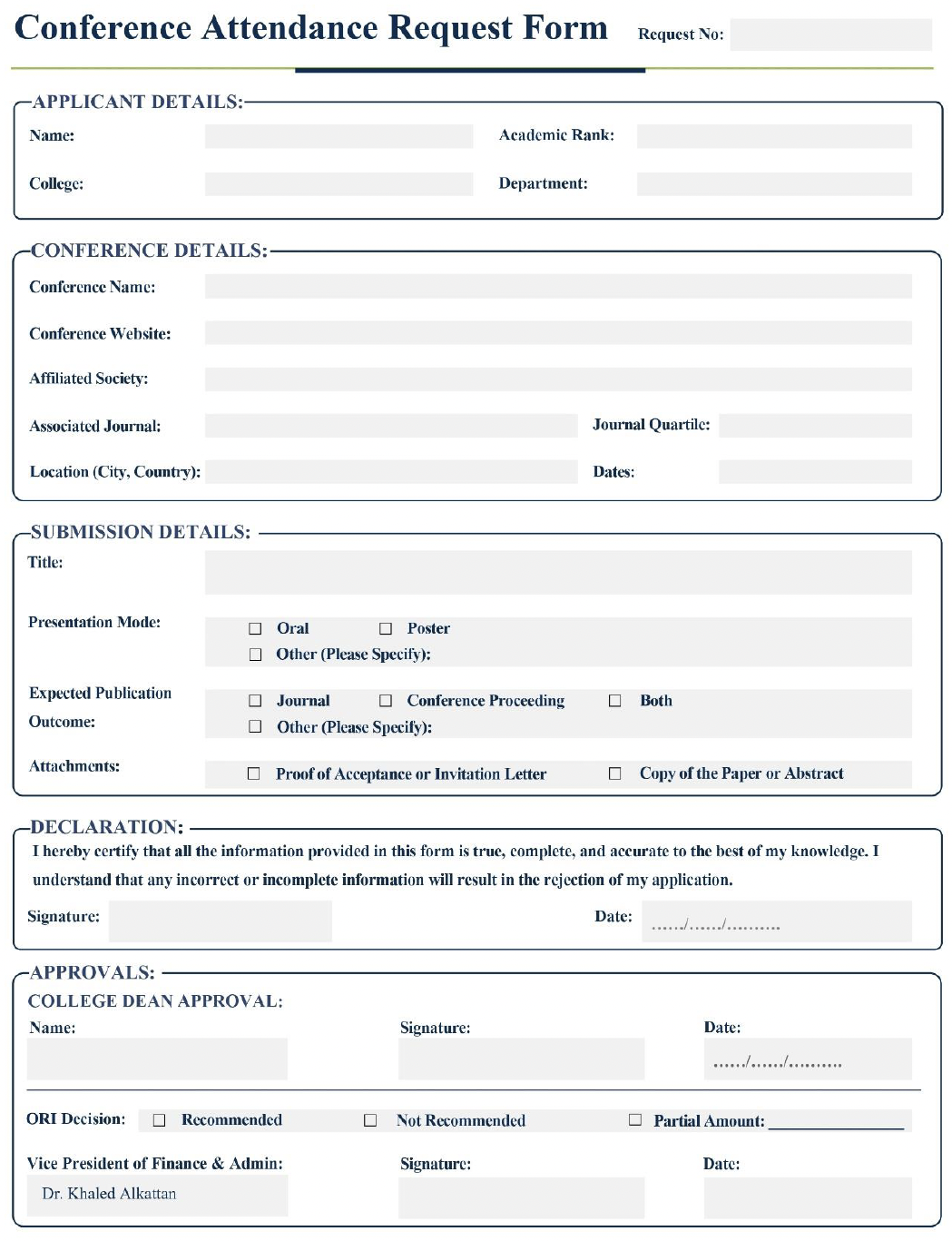
9.2 Appendix 2 Publication Fee Support Form
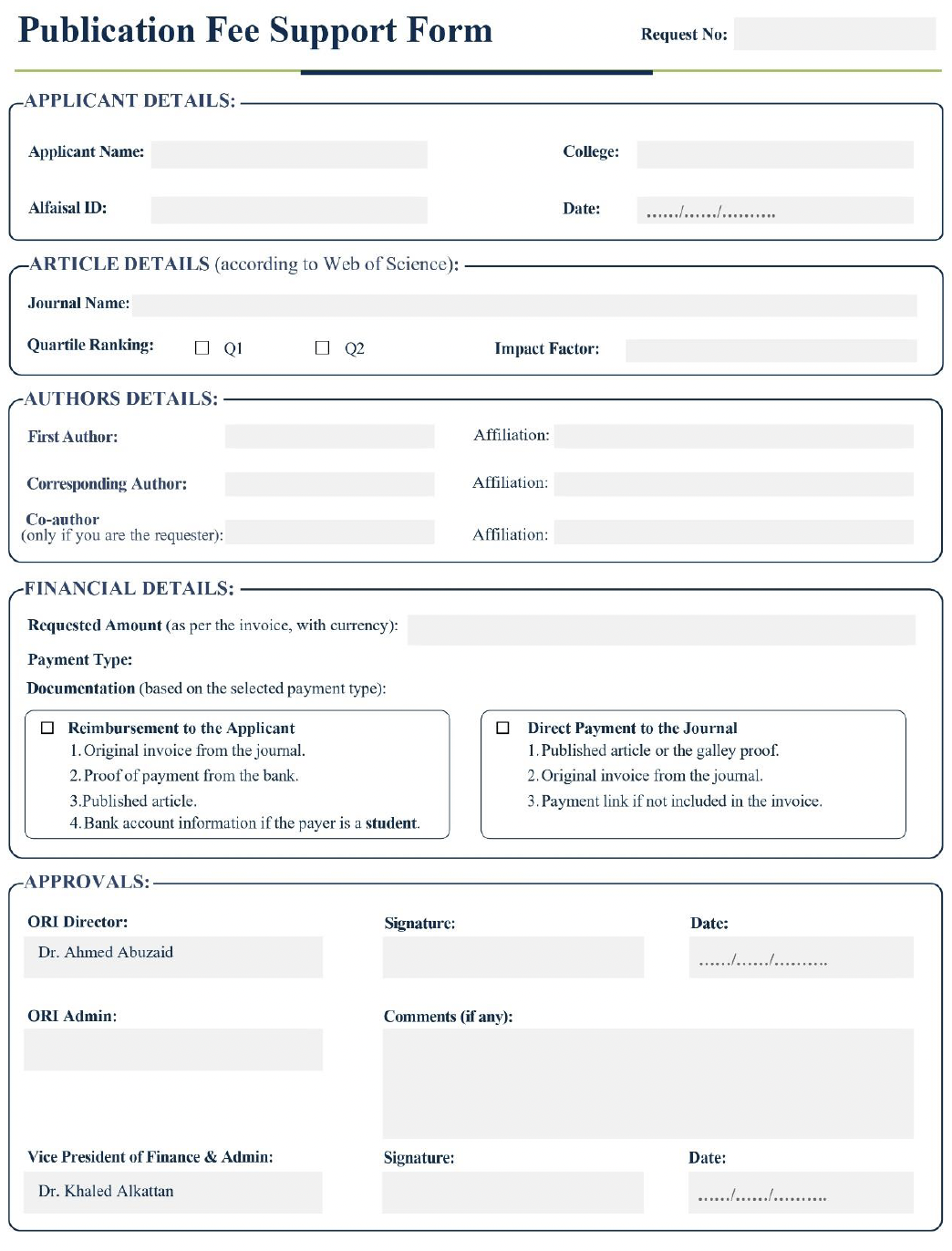
9.3 Appendix 3 IRG Proposal Evaluation Form
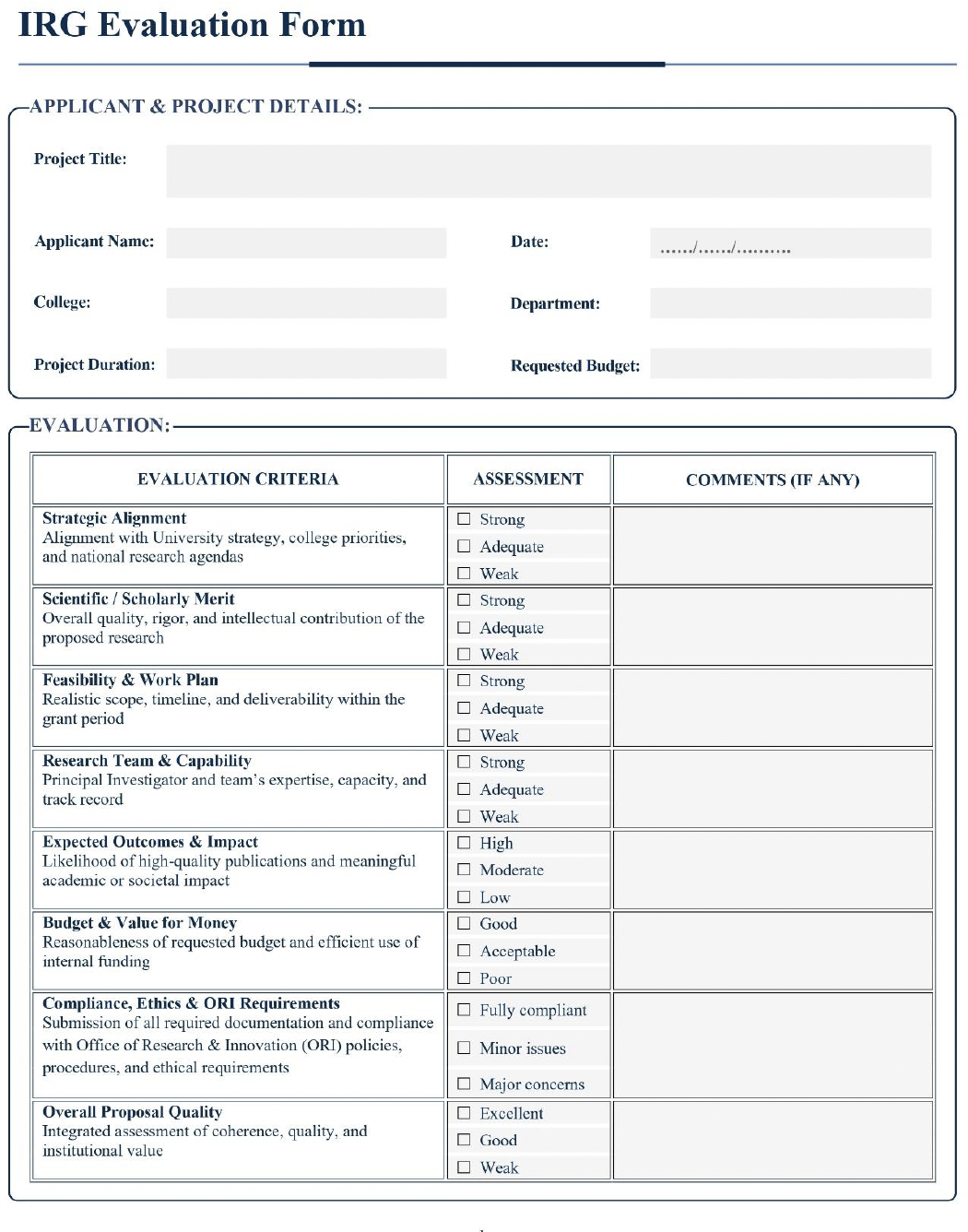
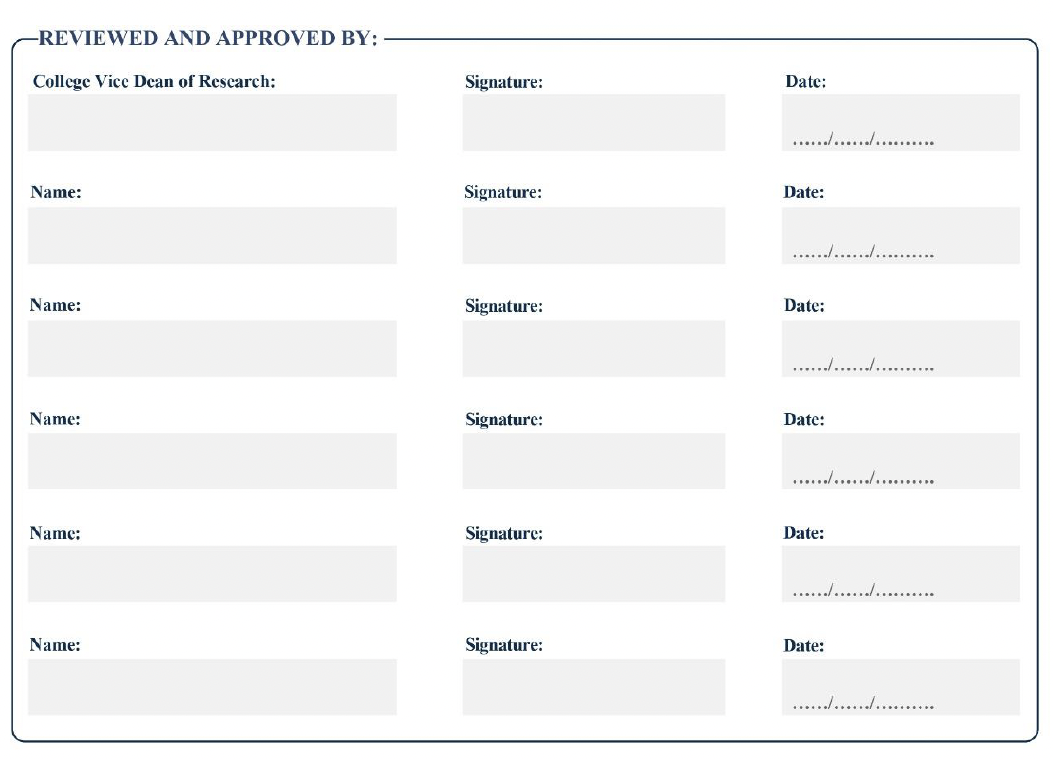
9.4 Appendix 4 Research Themes & Priorities
| Theme | Sub-Theme | Sub-Theme | ||
|---|---|---|---|---|
| 1. Energy Systems | Advanced energy production and management technologies | 1.1 | Technologies for smart- and microgrid | 1.2 |
| Innovations in circular economy | 1.3 | |||
| 2. Food and Environment | Advances in water desalination and management | 2.1 | Innovations in sustainable design | 2.2 |
| Technologies for food management and processing | 2.3 | |||
| 3. Advanced Manufacturing and High-Value Materials | Agile prototyping and manufacturing | 3.1 | Drug manufacturing and delivery systems | 3.2 |
| Materials modeling, synthesis, and analysis | 3.3 | Modeling, assessment, and deployment in Industry 4.0 | 3.4 | |
4. Health and Pharmaceuticals | Advanced cancer diagnostics and treatments | 4.1 | Outreach and impact in public health | 4.2 |
| Advances in drug design and discovery | 4.3 | Disease prevention and treatment | 4.4 | |
| AI and data science in healthcare | 4.5 | Transplants | 4.6 | |
| Biotechnology | 4.7 | Infectious diseases | 4.8 | |
| Genetics | 4.9 | Chronic diseases | 4.10 | |
| 5. Digital Technologies | Advanced connectivity, sensing, and actuation | 5.1 | Cybersecurity and blockchain | 5.2 |
| Applications of AI and data science | 5.3 | Robotics and x-Reality | 5.4 | |
| 6. Urban and Logistics | Advances in logistics and supply chains | 6.1 | E-commerce and integrated logistics | 6.2 |
| Optimizing transportation operations in Saudi Arabia | 6.3 | Smart cities transport and logistics | 6.4 | |
| Transport sustainability | 6.5 | Building resilient logistics networks | 6.6 | |
| 7. Human Capital | Enhancing skills and values of human capital | 7.1 | Studies in job market equity and accessibility | 7.2 |
| Studies in heritage and culture | 7.3 | |||
| 8. Economy and Privatization | Economies of healthcare systems | 8.1 | Localized economic development | 8.2 |
| Innovation and entrepreneurship studies | 8.3 |
9.5 Appendix 5 IRG Application Form
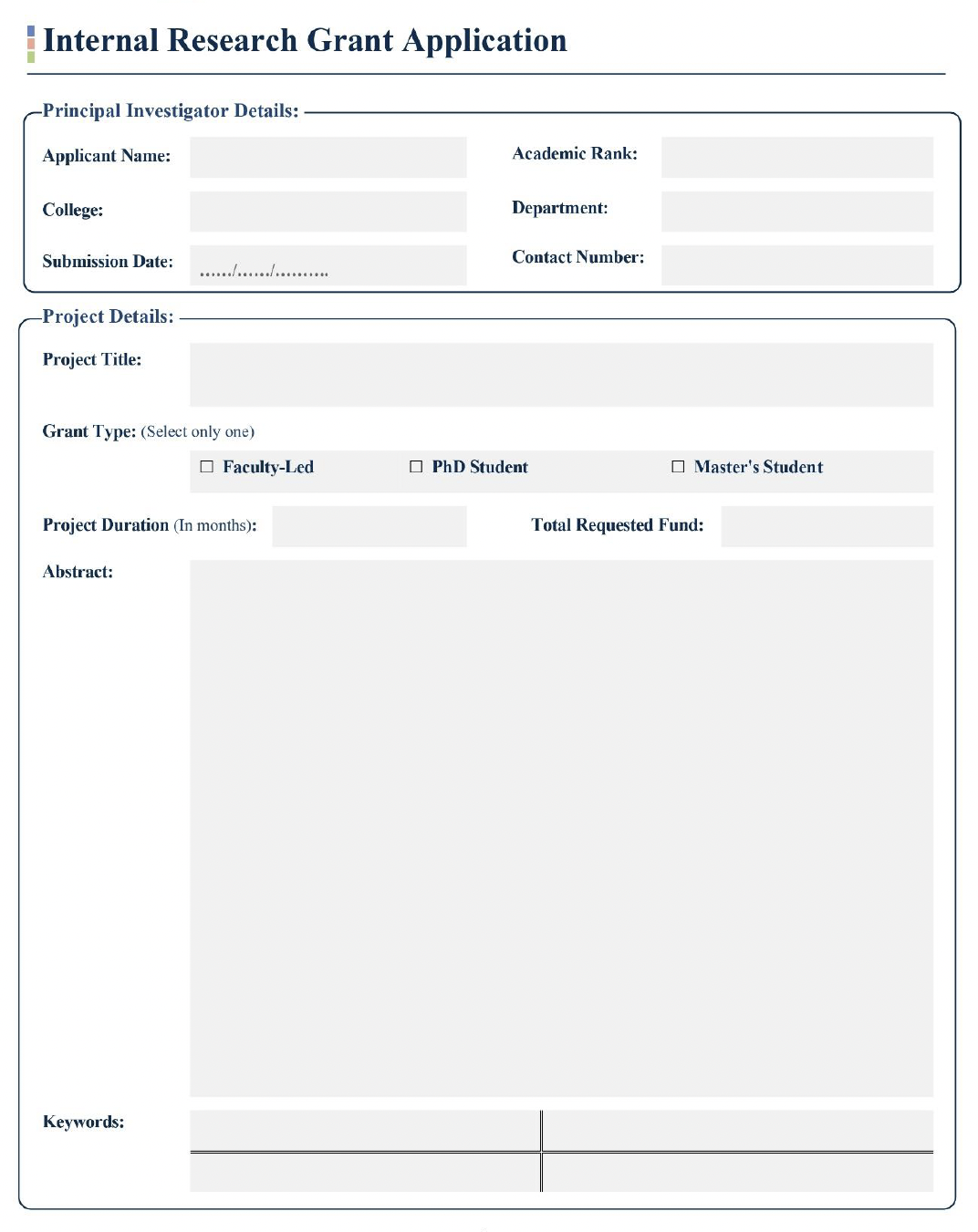
9.6 Appendix 6 IRG Contract
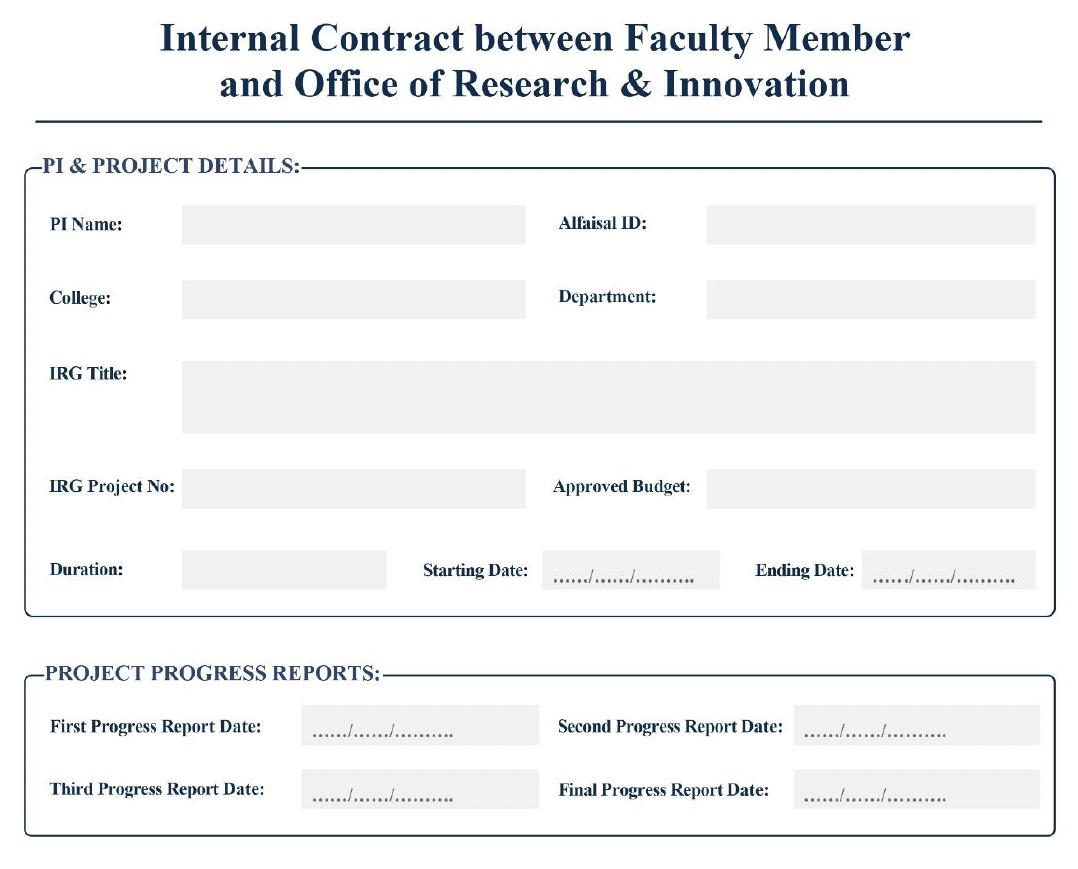
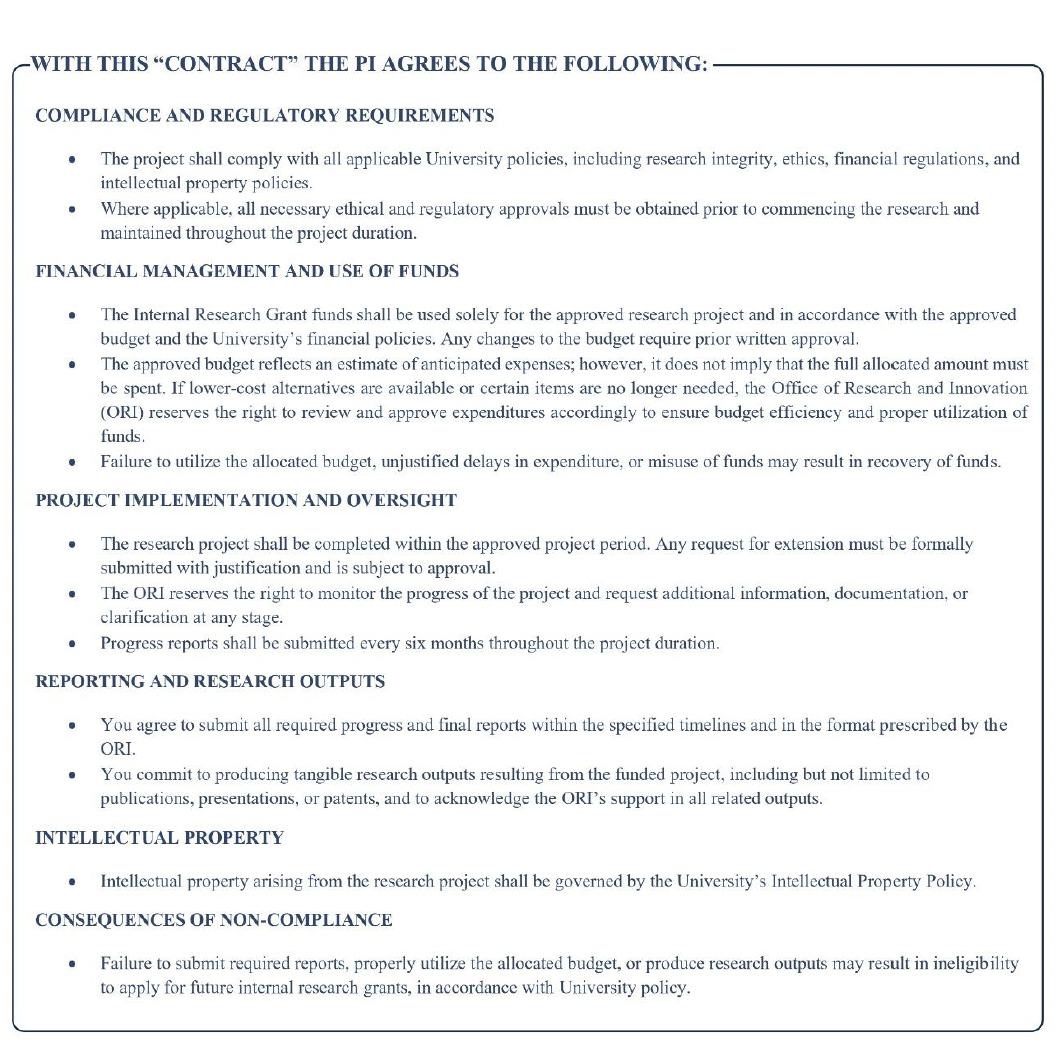
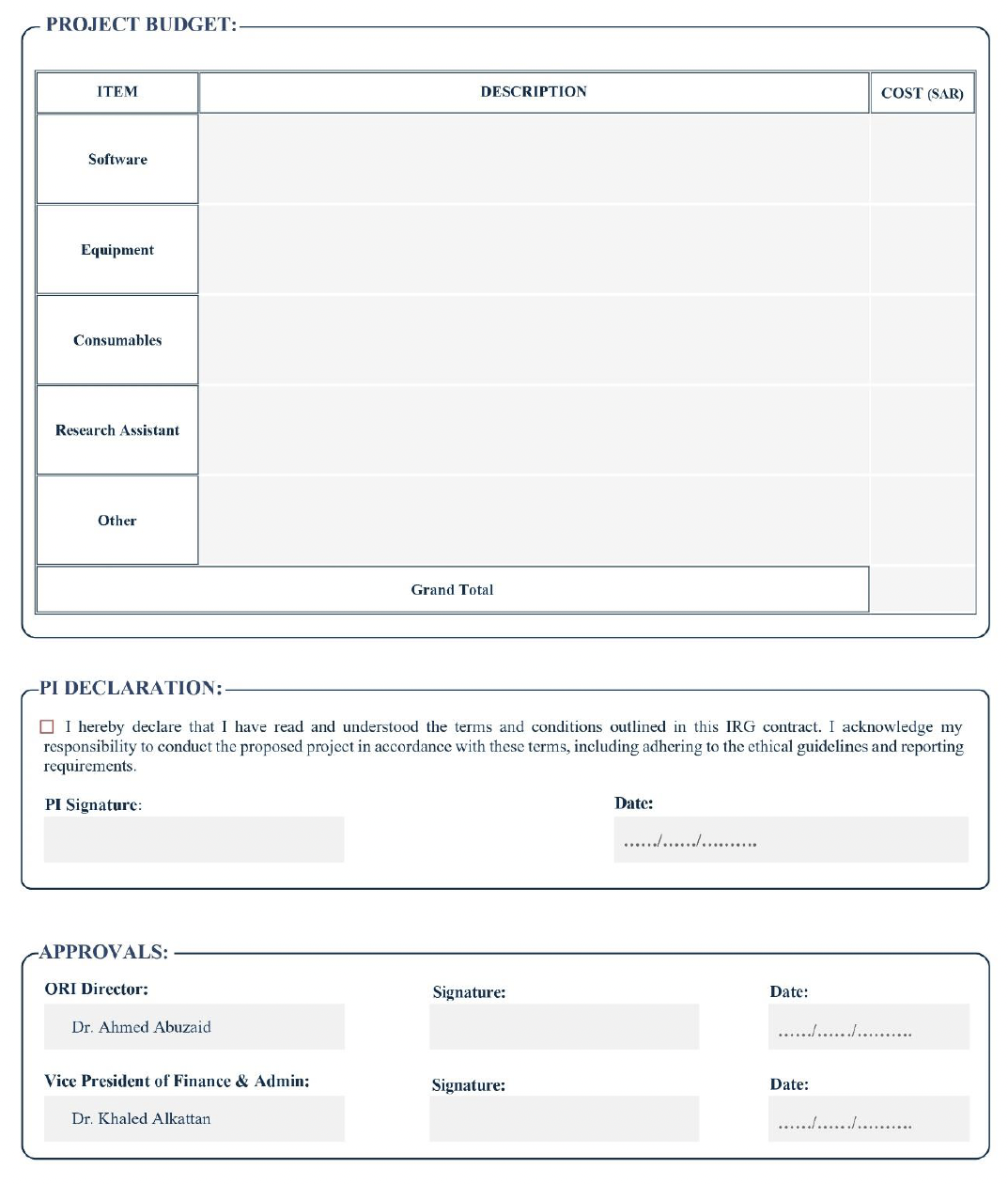
9.7 Appendix 7 Budget Reallocation Form
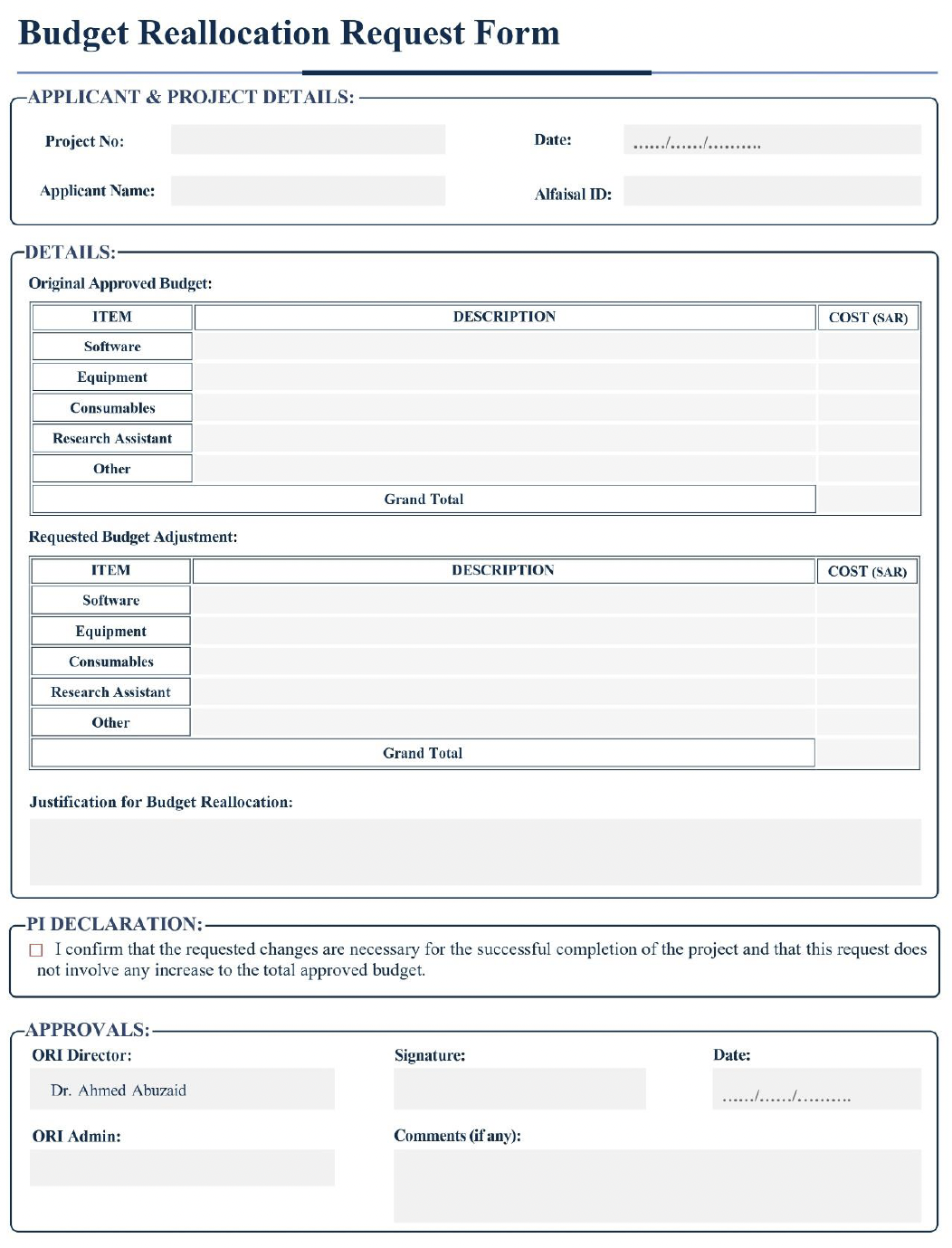
9.8 Appendix 8 Research Expense Form
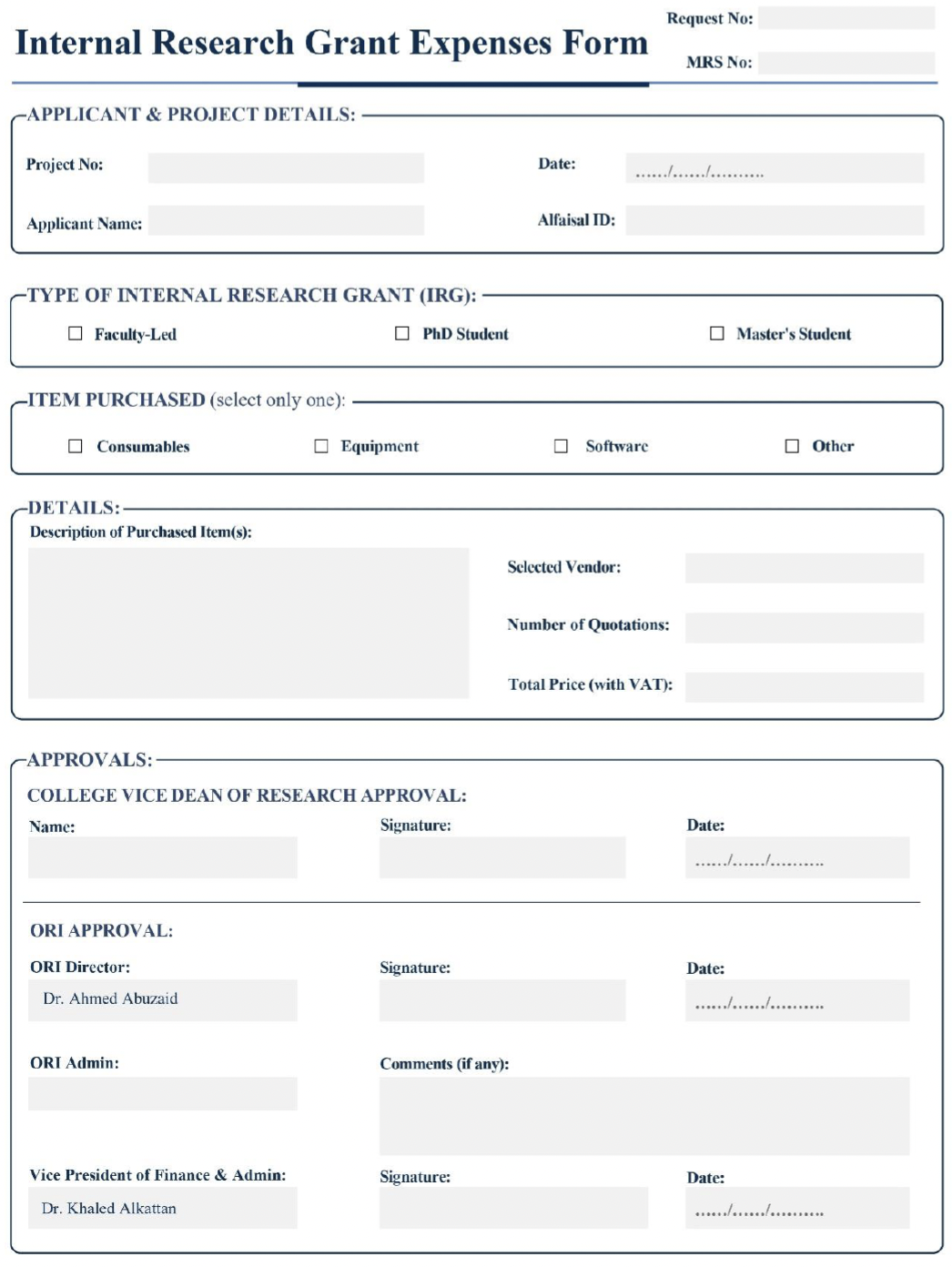
9.9 Appendix 9 Project Extension Form
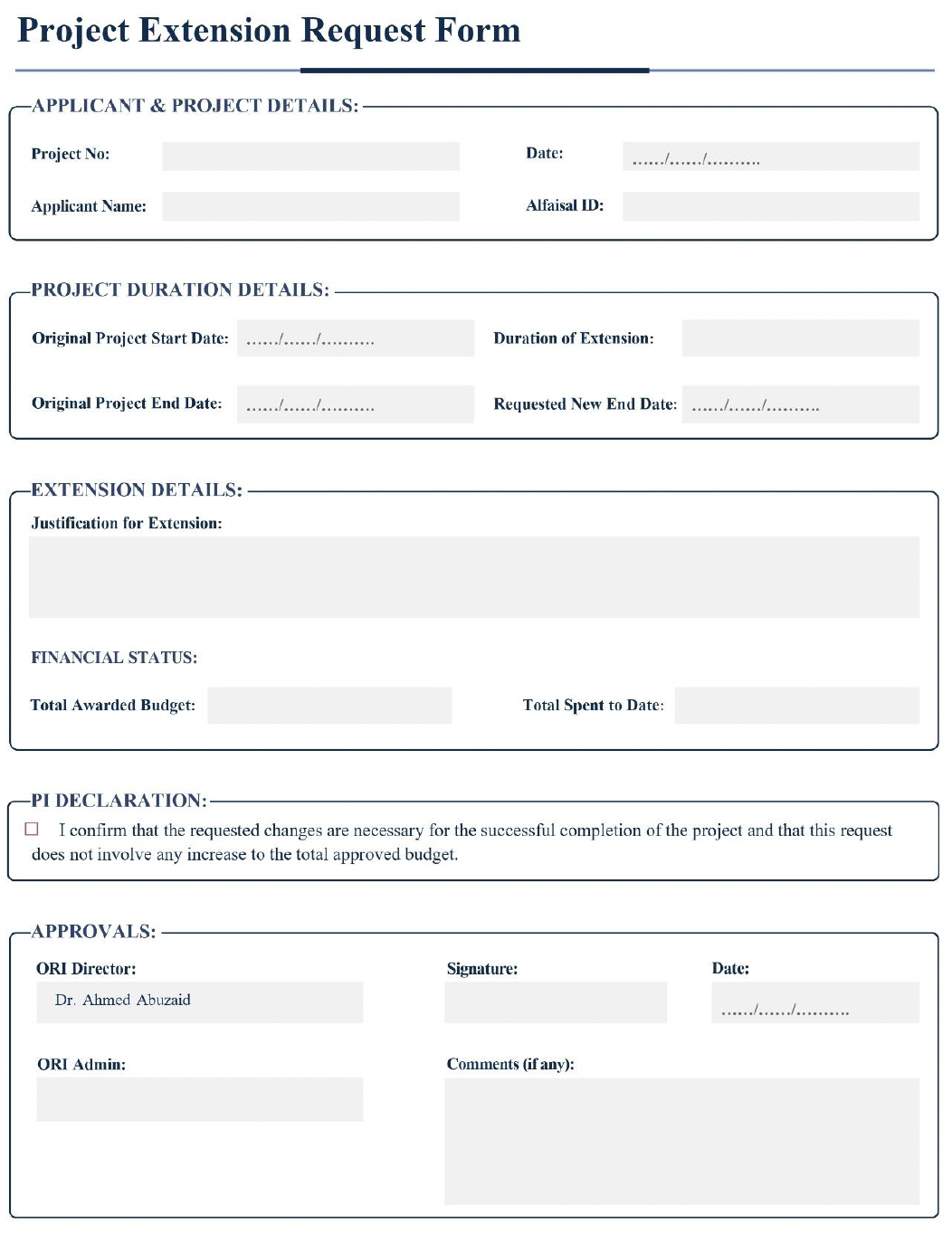
9.10 Appendix 10 Progress Report Form
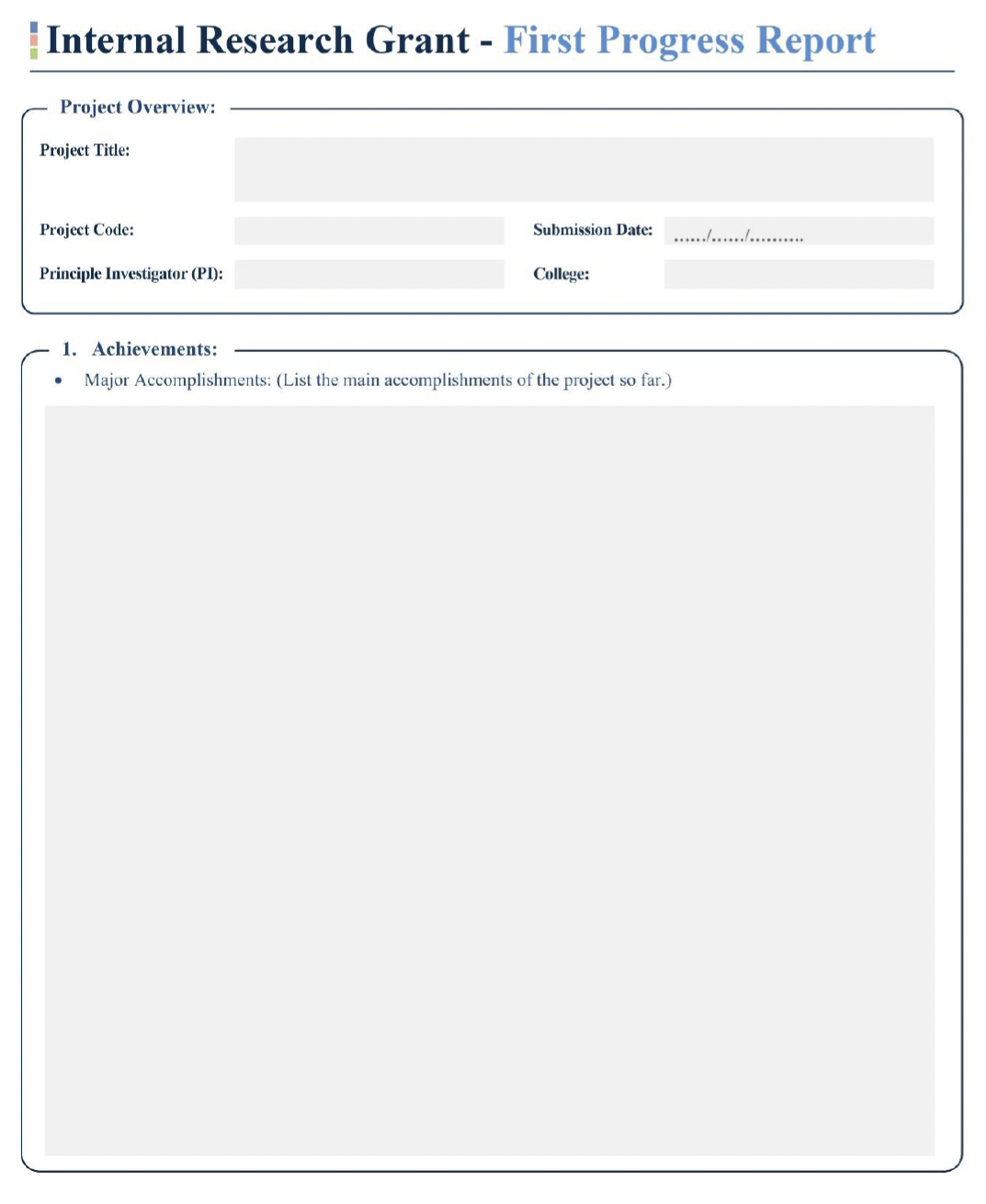
9.11 Appendix 11 General Expense Request Form