
Jump to section
- 1. Contents
- 2. Preamble
- 2.1 Vision
- 2.2 Mission
- 3. Definitions
- 4. Governance Structure
- 4.1 Bylaws Amendment Procedure
- 4.2 The Board of Trustees
- 4.3 Principal Committees of the Board of Trustees
- 4.4 Advisory Boards
- 4.5 Councils and Committees
- 4.6 Organizational Structure
- 4.7 Executive Officers of The University
- 4.8 College Vice Deans, Department Chairs, and Program Directors
- 4.9 Faculty and Staff Classification
- 5. Intellectual Property
- 5.1 Ownership of Intellectual Property
- 5.2 Intellectual Property reporting, evaluation, protection, and commercialization
- 5.3 Intellectual Property Revenue
- 6. Consulting and Conflict of Interest
- 6.1 Consulting: Limitations and Reporting Requirements
- 6.2 Conflicts of Commitment
- 6.3 Conflict of Interest
- 7. Grievances and Employment Issues
- 7.1 Retirement
- 7.2 Termination Prior to End of Contract
- 7.3 Grievances
- 8. HR Policies and Regulations
- 8.1 HR Principles
- 8.2 Obligations
- 9. Research Misconduct
1. Contents
This policy details Bylaw definitions, governance structure, intellectual property, conflicts of interest, grievances/employment issues, HR policies/regulations, and research misconduct.
2. Preamble
Founded in 2002, Alfaisal University is an NCAAA-accredited institution of higher education situated on the historic grounds of the palace of His Majesty the Late King Faisal in Riyadh, Saudi Arabia. The University is dedicated to excellence in education, research, and community service, aligning its mission with the aspirations of Saudi Vision 2030.
Alfaisal University encompasses six colleges—Business, Engineering & Advanced Computing, Medicine, Science & General Studies, Pharmacy, and Law & International Relations—offering diverse undergraduate and postgraduate programs designed to prepare students for global leadership and innovation. The University’s distinguished faculty foster academic rigor, research excellence, and mentorship, equipping students with the skills to thrive in an ever-evolving world.
Committed to a student-centered and research-focused approach, Alfaisal University provides unparalleled opportunities for collaborative research, international exchange, and personal development. Strategic partnerships with King Faisal Specialist Hospital, international universities, and leading corporations—such as Boeing, BAE Systems, Thales, and Shell—underscore the University’s pursuit of innovation and global impact.
Since its first cohort in 2008, Alfaisal University has emerged as a leading academic institution in the Kingdom, guided by the unwavering support of its Founders, Board of Trustees, and valued partners. Together, they drive the University's mission to contribute meaningfully to the nation and beyond, fostering a legacy of lifelong learning, service, and global citizenship.
2.1 Vision
A nonprofit research university that aspires to be a world-class institution and a pioneer in innovation and knowledge applications.
2.2 Mission
Alfaisal is a student-centered university creating and disseminating knowledge through world-class academic programs, research, and services that benefits humanity.
3. Definitions
Advisory Boards: A group of people chosen to give expert and unbiased strategic advice and guidance to the Colleges.
Bylaws: Bylaws are the regulations of an organization and contain the basic rules for the conduct of the entity’s business and affairs. The bylaws may contain any provision for managing the university and regulating its’ affairs.
Board of Trustees: A group of people who are responsible for making rules and financial decisions on behalf of a not-for-profit organization (Alfaisal university). The body entrusted with the governance and the oversight of the university’s academic, administrative and financial performance in accordance with the law.
University Council: The body entrusted with the governance and oversight of the university’s academic, educational, administrative, and financial performance, in accordance with the law.
College: A constituent part of a collegiate university.
An academic establishment composed of academic departments falling under a general field of study.
College Council: The body entrusted with the college’s academic affairs, in accordance with the law.
Department Council: The body entrusted with managing the department’s academic affairs.
Department: An academic unit representing academic specialization.
Committee: A small group of people representing the larger organization appointed to consider, investigate, act or report on some specific matter or area of the business.
Graduate Studies: A stage of education above the bachelor’s, such as a graduate certificate, master’s degree, or doctorate.
Joint Program: An academic program in which more than one department or college from within the university, or from the educational institutions or research institutions inside or outside the Kingdom participate; and it has specific learning outcomes.
Conflict of Interest: A conflict of interest exists when two or more contradictory interests relate to an activity by an individual or an institution or, a situation in which someone cannot make a fair decision because they will be affected by the result.
Dean: Chair of a college within the university.
Faculty: The teaching and administrative staff and those members of the administration having academic rank in an educational institution (Alfaisal university).
Governance: The act or process of governing or overseeing the control and direction of the university.
Intellectual Property: Intellectual property (IP) is a category of property that includes intangible creations of human intellect. There are many types of intellectual property, such as patents, copyrights and trademarks.
Techno genesis: The co-evolution between technical expertise and animate matter. Techno genesis is the way in which the interactions between technology and biology impact on our understanding of how nature exists.
4. Governance Structure
4.1 Bylaws Amendment Procedure
The Board of Trustees may, subject to approval by the Founders Board and King Faisal Foundation, amend this Charter and Bylaws at any regular meeting of the Board of Trustees, previous notice of the nature of any proposed amendment having been given to all members of the Board of Trustees at least thirty days before action thereon shall be taken, by a majority vote of those present, one-half the Trustees in office being required to constitute a quorum for this purpose.
4.2 The Board of Trustees
- The Board of Trustees shall convene a minimum of once every four months during the academic year. The Chairman has the authority to call for additional meetings as necessary. A meeting cannot proceed unless at least two thirds of the members are present, including the Chairman or Vice Chairman, as well as the representative of the secretariat or their appointed representative. Decisions are made based on a majority vote among the attendees. In the event of a tie, the Chairman' s vote determines the outcome.
- Whenever in the judgment of the presiding officer, a meeting of the Board, or of any committees thereof, cannot be convened soon enough to consider and act in a timely manner upon any matter of business that such presiding officer deems urgent, such a meeting may be duly called and held with some or all members participating by telephone conference call, or other electronic means that similarly permit the mutual exchange of information and the individual views of the participants. The regular quorum requirements shall apply to any such meeting, but those participating by telephone or other electronic means shall be included in the quorum count. Voting by proxy shall not be permitted at any Board or committee meeting of any kind. If a timely meeting of the Board or of a committee cannot be arranged, not even by telephone conference call or other electronic means, then in lieu of a meeting, on any matter the Presiding officer deems urgent, he or she may direct that all members be polled individually by telephone and/or mail ballot, the outcome of such polling to be subject to subsequent ratification at a meeting.
- Subject to the Law as well as the rules and regulations issued by the Council of University Affairs, the university board of trustees is responsible for the following tasks and duties:
- Approving and modifying the Basic System to ensure compliance with the systems and statutes in the Kingdom of Saudi Arabia.
- Planning administrative, financial, and academic policies.
- Governing the university, approving its vision, mission, and goals, and ensuring their achievement.
- Approving developmental plans.
- Nominating the President of the university and appointing Vice Presidents, Deans of colleges, and supporting Deanships.
- Nominating the Dean (in the independent college) and appointing the Vice Deans.
- Approving the statutes and internal regulations that govern academic, administrative, and financial affairs.
- Approving regulations that govern scholarships, training of teaching staff, and similar matters.
- Approving regulations that govern support for scientific research, innovation, authoring books, translation, and publication.
- Approving regulations that govern consultation and academic services.
- Approving investment and endowment policies, accepting donations, grants, and gifts that align with the goals of the higher education institution and comply with relevant regulations.
- Recommending the approval of study programs for scientific degrees granted by the higher education institution and submitting them to the General Secretariat.
- Approving financial compensation for study programs.
- Approving the formation of the Scientific Council.
- Recommending the approval of establishing colleges, institutes, scientific departments, and research centers, merging them, canceling them, or modifying their names, and submitting them to the General Secretariat.
- Approving the establishment of the Scientific Chairs
- Approving the establishment of advisory boards, identifying their specialties, and setting rules for their work.
- Approving cooperation agreements, scientific and technical agreements, and memoranda of understanding.
- Approving the social responsibility plan.
- Appointing one or more external auditors for the accounts of the higher education institution.
- Approving the annual report of the higher education institution and providing a copy to the owner and General Secretariat.
- Approving the final account of the higher education institution and submitting it to the owner.
- Recommending the approval of the annual budget for the higher education institution and submitting it to the owner.
- Reviewing matters referred to the Board of Trustees by its Chairman or any suggestion recommended by any of its members.
- The Board of Trustees has the authority to delegate some of its responsibilities to its Chairman, who can form permanent or temporary committees from Board members or external to it.
- The board of trustees shall, in coordination with the university president, select a university employee to serve as the board’s secretary. The secretary does not have the right to vote within the Board of Trustees and is not included in the count of attendees.
- If the position of the chairman of the board of trustees, his deputy, or any board member becomes vacant, a replacement shall be appointed for the remainder of the term, in accordance with applicable procedures.
4.3 Principal Committees of the Board of Trustees
- The Board may establish the following Principal Committees to assist the Board in the proper conduct of the business of the Board of Trustees, prescribe their powers, duties and responsibilities, the manner of appointing or electing their members, the term of their office, and bylaws governing the functioning and organization of said Committees. These are:
4.3.1 Executive Committee
- The Executive Committee shall consist of the Chairman of the Board (or his designee from among members of the Board of Trustees), the President of the University, and two additional members of the Board appointed by the Chairman.
- The Committee shall have authority to act on behalf of the Board of Trustees on all matters between Board meetings, except for those matters listed below, which shall be reserved for the Board. The Committee may, however, review and endorse measures on such matters for action by the Board. The matters reserved for the Board are:
- Presidential selection and termination.
- Amendments to the Charter or Bylaws.
- Election of Trustees, Officers, and Principal Committees.
- Determination of the University Mission and Objectives.
- Adding or discontinuing degrees, research, training, and technology commercialization programs.
- Faculty actions involving the award of contracts in the rank of professor.
- Incurring long-term indebtedness.
- Transfers and spending rates from endowment and similar funds.
- Capital projects over five million Saudi Riyals (SR 5,000,000).
- Conferral of degrees.
- Subject to the final and overriding authority of the Board of Trustees, the Executive Committee shall have responsibility for reviewing and approving the annual budget, and for monitoring the financial performance of the University under the budget.
- It shall receive reports from such other committees as may be constituted from time to time, and, on occasion, reports of the other Principal Committees, although they also report directly to the Board. The central purpose of the Executive Committee is to strengthen the Board's performance by helping it to function efficiently. The Committee shall oversee the Board's support of the President.
- At meetings of the Executive Committee, a majority of the members shall constitute a quorum for the transaction of business. The Committee shall normally meet three to five times each year. The Executive Committee shall provide each Trustee, at or before each meeting of the Board, with a written report of actions taken since the prior Board meeting, for formal ratification by the Board.
4.3.2 Investment Committee
- The Investment Committee shall consist of the Chairman of the. Board (or his designee from among members of the Board of Trustees), a Vice Chairman of the Board and the President of the University, and two additional members of the Board appointed by the Chairman.
- The Committee shall be responsible for the investment and reinvestment of securities and other financial assets, if any, of the University; and it shall set guidelines for the management by the Treasurer of the current funds. The committee may engage one or more investment managers and/or advisors whose performance the Committee shall regularly monitor, and it may change such managers and/or advisors from time to time. It may also invest in suitable investment partnerships and in similar investment pools.
- The Committee shall be diligent in seeking to provide for long-range preservation and growth of the funds under its care, and for appropriate return for the operating and capital expenditures of the University.
- The Committee, assisted by the Treasurer, shall provide each Trustee, at or before each meeting of the Board, with a report of its actions taken since the prior meeting of the Board, including a summary statement of the funds under its care, and the performance of such investment managers and/or advisors as may have been under contract during such a period.
- At meetings of the Investment Committee, a majority of the members shall constitute a quorum for the transaction of business. The Committee shall meet at least once each quarter.
- At the call of the Chairman of the Board, the Executive and Investment Committees may meet jointly to consider and act on any matter that involves the responsibilities of both Committees. When so convened as a Joint Committee, six (6) members shall constitute a quorum for the transaction of business, provided that each Committee is represented by at least (3) members.
4.3.3 Audit Committee
- The Audit Committee shall consist of the Chairman of the Board (or his designee from among members of the Board of Trustees), and four additional members of the Board appointed by the Chairman.
- The Committee shall annually recommend to the Board of Trustees a firm of Certified Public Accountants for appointment as the University's Auditor for the fiscal year then in progress.
- The Committee shall meet at least twice in each fiscal year with the Auditor and, as appropriate, the Treasurer and other University employees, to review the findings and recommendations of the Auditor. The Committee shall annually review the report of the Auditor on the financial condition and procedures of the University, as soon as may be convenient after the closing of the prior fiscal year and the completion of such an Auditor’s report, and the Committee shall report thereon to the Board of Trustees at its next meeting.
- At meetings of the Audit Committee, a majority of the members shall constitute a quorum for the transaction of business.
4.4 Advisory Boards
4.4.1 International Advisory Board
An international advisory board may be formed at the university pursuant to a decision by the board of trustees. The board of trustees shall determine the powers and work procedures of the international advisory board.
4.4.2 Student Advisory Board
A student advisory board shall be formed at the university pursuant to a decision by the university council, to be chaired by one of the university vice-presidents. The university council shall determine the powers and work procedures of the student advisory board.
4.4.3 Faculty Advisory Board
A faculty advisory board shall be formed at the university pursuant to a decision by the university council, to be chaired by the university president or his designee. The university council shall determine the powers and work procedures of the faculty advisory board.
4.4.4 College Advisory Board
A College Advisory Board shall consist of 5-10 members representing academia, industry, and society stakeholders. The board will provide advice to college’s administrative officials about the currency and quality of the academic programs, facilitate the placement of graduates, and help enhance the reputation of the college and its programs. The board shall express opinions and recommendations on program improvement, establishment of new tracks/programs, strategic directions of the college, and forging partnerships and agreements with other institutions.
- The Chairman of the College Advisory Board is the Dean of the college and may appoint a Vice Dean or one of the Program Chairpersons to act as a Secretary of the Advisory Board.
- The College Advisory Board should meet at least once per academic year.
- All College Advisory Board meetings should be documented, and the meeting minutes need to be approved.
- Special meetings may be called by the Secretary upon request of the Chairman of the Board.
- The College Advisory Board shall concern itself with class size distribution, faculty development, industry-based management curricula, and delivery systems, use of technology, industrial ties for internships, and supportive infrastructures in research to create an environment of Techno genesis in their respective colleges.
- Concentration areas shall include strategies, business plans, funding, external recognition, and industrial outreach through research centers, institutes, and cooperative education.
- The Committee shall oversee the progress of their college, including faculty performance metrics, standards for hiring, and promotion, faculty contributions to competitive strategies, research contracts, graduate enrollment, and synergies with the other colleges of the University.
- The Committee shall oversee mechanisms and systems to obtain and maintain the Ministry of Higher Education and other national and international accreditations.
- The term of membership in the Advisory Board shall be two academic years, renewable thereafter.
4.5 Councils and Committees
4.5.1 The University Council
- The University shall have a University Council with the following membership:
- University President (Chairman).
- The university's vice presidents, with the most senior among them as the vice chairman.
- Deans of colleges and supportive deanships.
- Three experienced, efficient, and specialized faculty members who possess expertise in university education. These individuals are nominated by the University Council, and their appointment decision is issued by the Board of Trustees for a period of three years, which can be renewed.
- Subject to compliance with the Universities’ Regulation from the Council of University Affairs and decisions of the Board of Trustees, the University Council shall have the right to manage and coordinate the university’s academic programs and shall undertake the following tasks:
- Recommending the vision, mission, and goals, as well as the administrative, financial, and academic policies of the higher education institution and submitting them to the Board of Trustees.
- Approving the recruitment of faculty members.
- Approving admission policies, and standards, and determining student numbers based on available capacity.
- Recommending the approval of regulations governing faculty member scholarships, training, and their equivalents, and submitting them to the Board of Trustees.
- Recommending the approval of regulations governing scientific research support, innovation, authoring , translation, and publication, and submitting them to the Board of Trustees.
- Granting diplomas to graduating students.
- Recommending the approval of study programs for different degrees offered by the higher education institution and submitting them to the Board of Trustees.
- Approving the academic calendar details within the framework that sets the start and end of the academic year in Saudi Arabia.
- Suggesting financial compensation for study programs and submitting it to the Board of Trustees.
- Recommending the approval of the formation of the Scientific Council and submitting it to the Board of Trustees.
- Suggesting the establishment, merging, cancellation, or modification of colleges, institutes, scientific departments, and centers, and submitting it to the Board of Trustees.
- Approving the establishment of scientific chairs and submitting to the Board of Trustees.
- Recommending the approval of advisory councils, determining their specialties, and establishing their working regulations, and submitting them to the Board of Trustees.
- Recommending the approval of scientific and technical cooperation, memoranda of understanding between the higher education institution and local and international institutions, and submitting them to the Board of Trustees.
- Recommending the approval of the social responsibility plan.
- Approving the provision of services for faculty members in the private and public sectors and civil community institutions through sponsorship or recruitment
- Approving sabbatical and scientific communication for faculty members.
- Approving scientific promotions for faculty members based on the recommendation of the Scientific Council.
- Approving the issuance of journals and periodicals.
- Approving students' activities plans.
- Recommending the approval of the annual report for the higher education institution and submitting it to the Board of Trustees.
- Recommending the approval of the final account for the higher education institution and submitting it to the Board of Trustees.
- Suggesting the annual budget and submitting it to the Board of Trustees.
- Reviewing matters referred by the Chairman or suggested by any of its members for discussion.
- The Board of Trustees is authorized to delegate certain powers to its Chairman or the university council. However, it is a prerequisite that the university council remains informed about any decisions made under this delegation. The university council has the flexibility to establish both permanent and temporary committees, consisting of members from within or outside the university council, to thoroughly examine and address any assigned tasks.
- The university council convenes at least once a month during the academic year, as called by its Chairman. The Chairman has the authority to call for a meeting when necessary, or if a written request is submitted by one-third of the members. For a meeting to be considered valid, it is required that at least one-third of the members, including either the Chairman or the Vice Chairman, are present. Decisions are made based on a majority vote among the attendees. In the event of a tie, the side that the Chairman votes with shall prevail.
- The university council has the authority to appoint a Secretary from its members. This decision is made by the Council based on a nomination put forth by the Chairman of the Council. The appointed secretary serves for a period of three years, with the possibility of renewal.
- The Secretary of the Council is responsible for various tasks related to the Council's meetings. These include preparing the agenda for each meeting, notifying the members about upcoming meetings, overseeing the recording of meeting minutes, and maintaining proper documentation of the minutes. Additionally, the Secretary sends the meeting agenda to the members in advance and receives their suggestions for the agenda items.
4.5.2 The Scientific Council
- The formation of a scientific council at the university is contingent upon obtaining approval from the Board of Trustees.
- The scientific council is established for a duration of three years, and its composition is as follows:
- The chairman of the council is responsible for overseeing scientific research at the university.
- Each college is represented by a member who holds a rank of at least associate professor.
- Three associate professors from external academic institutions or organizations are appointed as members of the council. These individuals are chosen from faculty members who are not affiliated with the university.
- The board of trustees may approve adding two professors or associate professors for the university’s faculty members, and who have enough experience in scientific research. The representation for each college should not exceed two members.
- The scientific council has a secretary who is selected from the university’s faculty members. The nomination for the secretary position is made by the chairman of the scientific council. The appointment of the secretary is approved by the President of the university and is valid for a period of three years, with the possibility of renewal. The secretary does not possess the right to vote during the council meetings and their presence does not contribute to meeting the attendance quorum.
- The primary responsibilities of the Scientific Council include overseeing various aspects of the faculty members' scientific, research, study, and publication affairs. The Council places particular emphasis on the following areas:
- Recommending the approval of faculty member recruitment at the university.
- Recommending the approval of promotions for faculty members.
- Recommending the approval of sabbatical leaves, scientific communication, and academic participation of faculty members outside the university.
- Providing suggestions for regulations that govern scholarships, training opportunities, and similar programs for faculty members.
- Offering suggestions for policies that foster scientific research, innovation, authorship, translation, and publication.
- Studying matters referred to it by the University Council.
- The Council has the authority to establish Committees composed of its own members or individuals from outside the Council to assist in carrying out its tasks and responsibilities.
- The Scientific Council convenes at the discretion of its Chairman or any member representing the Chairman. Meetings are held when there is a need, upon a written request from at least one-third of the members, or if the President specifically requests it. The President has the authority to include additional topics on the meeting agenda and assumes the role of Chairman of the Council if present.
- For a meeting to proceed, it is required that at least two-thirds of the Council members are in attendance, including either the chairman or a representative designated by the Chairman.
- Decisions within the Scientific Council are reached through a voting process, with the majority of votes from the attendees determining the outcome. In the event of a tie, the side that the chairman votes with shall prevail.
- Once decisions are reached, they are considered valid and enforceable unless the President of the university raises an objection within a twenty-day period from the date of receipt. If an objection is received, the President returns the decisions to the Chairman of the Scientific Council, accompanied by their viewpoint, for further review.
- In situations where a higher education institution does not have its own Scientific Council, it may seek assistance from a Scientific Council located within another university inside the Kingdom. This arrangement is made possible through an agreement between the two parties involved.
- In situations where a higher education institution does not have its own Scientific Council, it may seek assistance from a Scientific Council located within another university inside the Kingdom. This arrangement is made possible through an agreement between the two parties involved.
4.5.3 College Councils
- The Chairman of the Council is the Dean of the college and the Council consists of the following members:
- Vice Deans, with one of them serving as the Secretary of the Council.
- Heads of scientific departments within the college or institute.
- The President of the university has the authority to appoint up to three faculty members from within the college or institute to serve on the Council.
- The President may appoint up to two external individuals from outside the college, provided that they possess sufficient expertise in the relevant fields of study within the college. The nominations for these external members should be put forth by the Council of the respective college. The term for these members is two years, with the possibility of renewal.
- The Council of the college also has the option to invite suitable students to attend Council sessions and participate in discussions related to students' affairs.
- The primary responsibility of the college council is to oversee the scientific and administrative affairs within the college. The Council has the authority to delegate some of its powers to the Chairman of the Council.
- The Council has the ability to establish Committees composed of its own members or individuals from outside the Council to look into tasks assigned by the Council.
- The Council convenes regularly, at least once a month during the academic year, based on the Chairman's call. For a meeting to proceed, a minimum of one-third of the Council members, including the Chairman or their designated representative, must be in attendance. Decisions are reached through a voting process, with the majority of votes from the attendees determining the outcome. In the event of a tie, the side that the Chairman votes with shall prevail.
- The decisions made by the Council are considered valid and enforceable unless the President of the university raises an objection within a twenty-day period from the date of receipt. If an objection is raised, the President returns the decisions to the Chairman of the Scientific Council, along with their viewpoint, for further review. If the Council members persist in their opinion, the disputed decisions are referred to the university's Council for discussion during the next regular or exceptional session. The Council of the university has the authority to approve, modify, or cancel these decisions, and its decision will be final.
- The College Council will advise the dean on the educational and administrative affairs of the college.
4.5.4 Department Councils
- Each scientific department is required to have its own Council, which includes a chairman (head) who serves as the Chairman of the Council. The members of the Council are comprised of the faculty members within that specific department.
- In certain circumstances, the President of the university has the authority to add additional faculty members from other departments. These additions are made based on the nominations provided by the Dean of the college.
- The department Council has a specialized role in managing the scientific and administrative affairs specific to the department it represents. The Council is responsible for forming committees from its members or others to look into matters assigned to them by the council.
- The Council convenes regularly, at least once a month during the academic year, based on the chairman's call. For a meeting to proceed, a minimum of one-third of the Council members, including the chairman or their designated representative, must be in attendance. Decisions are reached through a voting process, with the majority of votes from the attendees determining the outcome. In the event of a tie, the side that the chairman votes with shall prevail.
- The decisions made by the Council are considered valid and enforceable unless the Dean of the college raises an objection within a seven-day period from the date of receipt. If an objection is raised, the chairman returns the decisions to the Chairman of the Scientific Council, along with their viewpoint, for further review. If the council maintains its position, the disputed decisions are referred to the Council of the respective college or the University Council for a final decision.
- The department/council chair shall determine the authority and breadth of responsibility of the department council and the manner of its performance.
- Subject to compliance with the Universities’ Regulation from the Council of University Affairs and decisions of the Board of Trustees, the University Council and the relevant College Council, the department/council chair may convene a department council to consider:
- Appointment of faculty, staff, and assistants.
- Adjustments to academic plans.
- Curricula, textbooks, and reference books.
- Research issues including the publication of research results.
- Student issues of departmental nature.
- Faculty sabbatical-leave proposals.
- Proposals from faculty to attend professional conferences.
- Dealing with faculty development issues.
4.5.5 Research & Graduate Studies Council
- The Research & Graduate Studies Council (RGC), which is chaired by the Vice President for Research & Graduate Studies, is responsible for safeguarding the excellence of research and graduate education. The Office of Research & Graduate Studies (ORG) is the administrative arm of the Council and is empowered on its behalf to enforce its regulations and policies. The Council membership consists of two faculty members from each of the different colleges nominated by their respective Deans within the institution. The duties and functions of the RGC consist of the following:
- The Research & Graduate Studies Council sets the policies and standards for graduate admission, and degrees in coordination with the Colleges.
- The Council reviews established degree programs and proposals for new fields of study or degrees; establishes qualifications and policies for Graduate Student Teaching Assistants and Graduate Student Research Assistants; responds to issues referred to it by the Vice President, the President’s Office, and the Deans, and participates in reviews of existing graduate programs.
- Propose internal regulations, in coordination with academic departments and Student Affairs, for the organization of graduate studies.
- Propose, implement and supervise admission criteria into graduate studies.
- Study and recommend new programs for endorsement and coordinate them with current ones.
- Recommend graduate courses for approval, amendment and modification.
- Recommend titles of graduate degrees in both Arabic and English on recommendation of colleges’ councils.
- Periodically assess graduate programs at the university through specialized committees from inside or outside the university.
- Study matters forwarded to it for consultation by the University Council, the Council of Deans or President’s Office and offer suggestions and advice.
4.5.6 Committee on Promotions
- This Committee is chaired by the President or his designate, and composed of four full professors, one elected by each College, and two additional faculty members appointed by the President at the rank of associate professor or higher. It evaluates candidates for promotion who have been approved by the various college departments and deans.
4.5.7 Standing Committee for Graduate Studies
- This committee is chaired by the Vice-President for Research and Graduate Studies with the following membership:
- Five deans of university colleges that offer graduate programs, considering the diversity of colleges’ specializations.
- Dean of Development and Quality at the university.
- Dean, director, or head of Graduate Studies, who shall be the secretary of the committee.
- Three members who are experienced and specialized in graduate studies from inside or outside the university.
- The members specified in Clauses (1) and (4) above are appointed by a decision of the University Council upon the University President’s nomination for a two-year term that is renewable.
- Without prejudice to the provisions of the Regulation on Graduate Studies Issued by the Council of Universities’ Affairs, the Standing Committee shall undertake the following tasks:
- Proposing the general policy for graduate studies at the university and supervising its implementation after approval by the University Council.
- Recommending the approval of the admission requirements for graduate studies programs and updating them upon the request of the councils of competent departments and colleges.
- Supervising joint graduate programs.
- Recommending the approval and amendment of graduate studies programs, after studying and refereeing, to the University Council based on a proposal from the Department Council, and endorsement of the proposal by the College Council.
- Recommending the approval of study plans and detailed standards to the University Council, based on a proposal from the Department Council and endorsement by the College Council in accordance with international benchmarks and comparisons.
- Proposing standards for graduate studies programs for approval by the University Council.
- Proposing the rules regulating the evaluation of graduate studies programs for approval by the University Council.
- Supervising the evaluation of graduate studies programs at the university on a regular basis, through specialized committees or bodies inside or outside the university.
- Reviewing the comprehensive report prepared by the Office of Graduate Studies on the graduate studies programs at the university and the results of evaluating those programs and submitting them to the University Council.
- Recommending the approval of the college councils’ proposals regarding graduate studies programs that are compatible with the community’s needs, the Kingdom’s plans and visions, and global trends, for approval by the University Council.
- Supporting proposals for determining academic degrees and certificates and their names in both Arabic and English, based on the proposals of Department and College Councils.
- Recommending the numbers of students who can be accepted each academic year in the graduate studies programs to the University Council, based on a proposal from the councils of the competent departments and the approval of the College Councils.
- Suggesting the guidelines for forming supervisory committees and thesis defense committees.
- Setting general frameworks and standards for comprehensive exam and graduation research.
- Setting the overall framework for research plans and the rules governing writing, printing, producing, and submitting thesis; preparing forms for the thesis defense committee reports; and evaluating thesis.
- Studying periodic reports related to graduate studies that are submitted by the academic departments at the university.
- Proposing the offering of graduate studies programs outside the university premises and submitting this to the University Council to take what it deems appropriate.
- Recommending the approval of the colleges’ proposals regarding development initiatives related to graduate studies in order to develop the university’s financial resources.
- Recommending the determination of the fees for applying to graduate programs, the tuition fees for the programs, and the fees for support services related to graduate studies, based on the proposals of the Department and College Councils.
- Recommending the allocation of scholarships for students, in full or in part, in accordance with the regulations approved by the University Council.
- Recommending the termination or suspension of graduate studies programs that do not comply with quality standards or with the university’s strategy.
- Reviewing the referrals made by the Chair of the Standing Committee, the University President, or the University Council in order to provide its opinion. The Committee may delegate some of its authorities to its Chair, and it may also form standing or temporary committees from among its members or others to study what they are asked to do.
- The Standing Committee shall meet upon a call by its Chair at least once a month, and the meeting shall only be valid if attended by at least two-thirds of its members, including the Chair or whomever he deputizes from among the members of the Committee. The Committee’s decisions are issued by a majority vote of the members present. In case of a tie, the Chair of the meeting shall have the casting vote. The decisions of the Standing Committee shall be effective unless contested by the University President within fifteen days from the date of receipt. If contested, they shall be returned with the University President’s comments to the Standing Committee. If the Standing Committee maintains its position, the disputed decisions shall be referred to the University Council to be decided in its first ordinary or extraordinary meeting. The University Council may ratify, amend, or cancel the decisions. The decision of the University Council on this is final. The Chair of the Standing Committee may invite whomever he deems necessary to attend some of the Standing Committee meetings in a non-voting capacity.
4.5.8 Awards Committee
- This is a committee of senior faculty members, with one member elected by each College. It advises the President on the Distinguished Awards for Teaching, Research, and Advising. The Committee will establish its own procedures for receiving nominations from the colleges.
4.5.9 University Hiring Committee
- The University Hiring Committee was established to advise the President on issues relating to faculty hiring and retention. Its membership includes:
- Vice President for Academic Affairs or President’s Representative (Chairman).
- Vice President for Research and Graduate Studies or Representative.
- The Dean of Student Affairs.
- Director of Accreditation and Quality Assurance.
- At the President discretion, other members may be involved in the UHC deliberations.
- Representatives of the Colleges and other experts will be invited as required.
- To maintain the Alfaisal competitive edge in the education market, it is necessary to continually review hiring policies to ensure that the university has the best faculty that are available. Therefore, the Committee is charged with the following duties:
- To continually carry out comparisons of Alfaisal University employment and remuneration polices with those existing in other universities both in Saudi Arabia and abroad.
- To review current faculty qualifications and teaching experience in view of the findings of the comparative study.
- To advise the President on policies that, within medium term, might remedy any deficiencies revealed by the study.
- To maintain a recruitment policy that will enhance the quality of faculty at Alfaisal University.
- To review proposed faculty appointments by colleges.
4.5.10 Undergraduate Curriculum Committee
- The Undergraduate Curriculum Committee is the central curriculum committee of the University responsible for the development of academic policies and the review and approval of programs. The Committee reports its findings to the President and the University Council. Its membership includes:
- Vice President for Academic Affairs or President’s Representative (Chairman).
- Vice President for Research and Graduate Studies or Representative.
- Director of Accreditation and Quality Assurance
- One representative from each College
- The Committee is responsible for:
- The development and review of academic policies
- Approval of academic programs
- To review published guidelines for students and faculty members which detail the University’s information on programs and courses, degrees offered and graduation requirements, admission requirements and procedures, costs and refund policies, and rules and regulations directly affecting students.
4.5.11 University Facilities Committee
- The University Facilities Committee shall oversee all aspects of maintenance, new construction and renovation from planning to completion.
- Concentration areas shall include ongoing refurbishing, space utilization and maintenance.
- Other focus areas shall include tracking costs and timetables of all new construction and renovation projects; improved performance for on-time and on-budget campus projects; annual review/update of a capital projects list and capital projects completed; integration of the campus; and oversight of the condition of plant, parking facilities, athletic fields and campus landscaping.
4.5.12 University Digital Committee
- The University Digital Committee will oversee the following:
- Develop and implement the university’s long-term digital transformation strategy, ensuring alignment with the institution’s vision and goals.
- Evaluate and recommend the adoption of new technologies for academic, administrative, and research purposes ensuring they enhance teaching, learning, and operational efficiency
- Monitor and enforce cybersecurity policies and data privacy standards to safeguard the university’s digital assets and sensitive information.
- Review and guide decisions regarding the university's IT infrastructure, including networking, cloud services, and hardware upgrades, ensuring it meets the growing needs of the institution.
4.6 Organizational Structure
An organization Structure is a chart describing the reporting relationships and the formal arrangement of work positions within an organization. It identifies and shows divisions of work, supervisory relationships, communication channels, major subunits, and levels of management who make up the University.
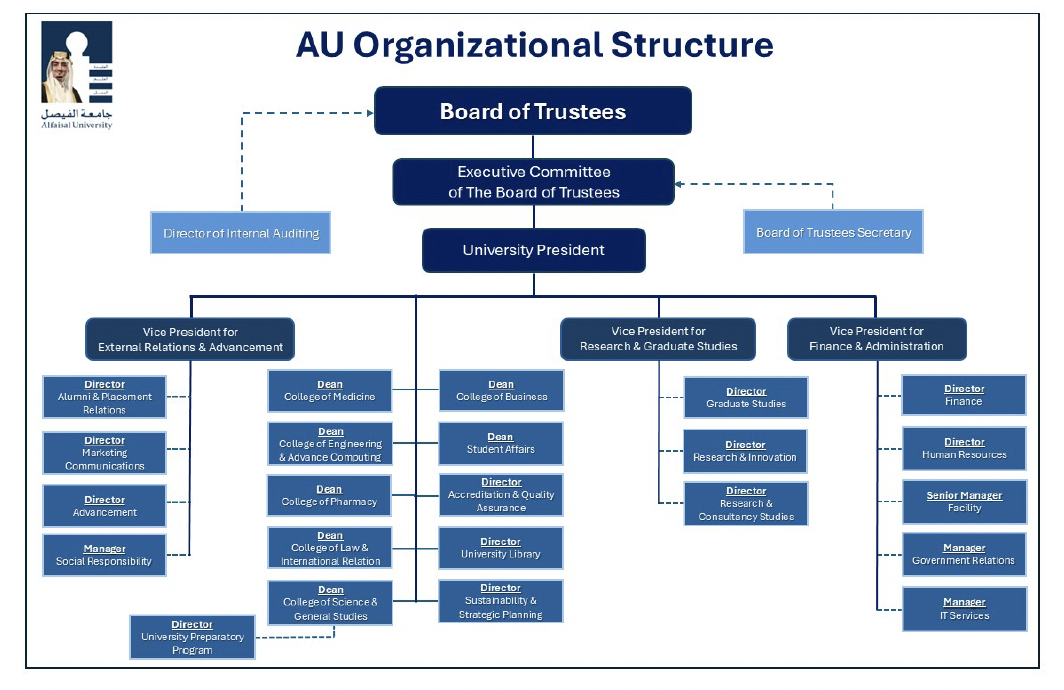
4.7 Executive Officers of The University
4.7.1 President
- The appointment of the President of the university is made through a decision by the Chairman of the university's Board of Trustees and approved by the Minister.
- The appointed President of the university should meet the following criteria:
- Possess appropriate scientific qualifications and expertise.
- Have prior experience in academic, administrative, and leadership roles.
- Be fully committed and dedicated to the position without any other conflicting commitments.
- Not have any ownership stake in the university.
- Considering the roles and responsibilities of the Board of Trustees and University Council, the President of the university holds the following key accountabilities:
- Overseeing the university's academic, financial, and administrative affairs.
- Ensuring compliance with the university's Statutes, rules, and decisions made by the Board of Trustees and other University Councils.
- Presenting an annual report on the university's performance to the Board of Trustees after discussion at the University Council. This report includes key performance indicators (KPIs), scientific research outcomes, and the university's community service and other activities.
- Nominating Vice Presidents, Deans of colleges, and Deans of supporting Deanships.
- Representing the university in interactions with external institutions.
- Appointing Vice-Deans for colleges and supporting Deanships, department heads, and directors of scientific and research centers.
- Raise funds for the endowment and for building programs of the University.
- Execute such other duties and responsibilities as may be delegated by the Board of Trustees to the President.
- The President has the authority to delegate some of their responsibilities to Vice Presidents or appropriate university employees, based on their areas of expertise. Delegation should be done in writing, specifying a defined timeframe. The President has the discretion to establish Committees as necessary.
- The President of the university is responsible for appointing one or more Vice Presidents, with their specific number determined by a decision from the Board of Trustees. The appointment is initially for a three-year term and can be renewed.
- The Vice President(s) should possess the following qualifications:
- Sufficient academic experience.
- Previous roles in academic, administrative, and leadership positions.
- Full commitment and dedication to the Vice President position without any conflicting commitments.
- Not being one of the owners of the university.
- The Vice Presidents assist the President of the University in managing its affairs, and the most senior of them replaces the President of the University in the event of his absence or vacancy.
4.7.2 Vice President for Finance and Administration
- The Vice President for Finance and Administration is appointed by and reports directly to the President and performs duties assigned by the President.
- He is the Chief Financial Officer of the University.
- His responsibilities include serving as Treasurer of the Board of Trustees.
- The Departments of Human Resources, Finance and Accounting, Information Technology, Government Relations, and Facilities report to the Vice President for Finance and Administration.
4.7.3 Vice President for External Relations
- The Vice President for External Relations is a member of the executive management team and reports directly to the President. The Vice President has responsibility for the strategic planning and management of the University’s marketing, public relations, branding, publications, media relations, fundraising, advocacy, and outreach.
- The Departments of Public Relations and Marketing, Alumni and Placement Relations, and Advancement report to The Vice President for External Relations
4.7.4 Vice President of Research and Graduate Studies
- The Vice President for Research and Graduate Studies chairs the Office of Research and oversees the development of graduate studies in the various Colleges.
- Reporting to the President, he is responsible for the management and promotion of research activities that are carried out by the academic departments through external or internal funding.
- In addition, he is responsible for the Business Accelerator (Dimensions), the Technology Transfer Office (TTO), and the Business Center, and chairs the University Scientific Council and Research and Graduate Council.
4.7.5 Dean of Student Affairs
- The Dean for Student Affairs chairs the Offices of Undergraduate Admissions, Enrolment Services, Scholarships, and Student Activities. Reporting to the President, he has responsibility for recruiting, admitting, providing financial aid for undergraduates, registering students, recording grades, maintaining permanent student records, transcript evaluation of transfer students, and maintenance of a database and permanent files of students.
- Student Affairs also is responsible for extra-curricular activities, student counseling and advising, cooperative and summer training programs, and student housing.
4.7.6 Director of the Library
- The Director of the Library chairs the University Libraries and reports to the President.
- He is responsible for providing leadership in the development and fulfilment of the library mission and vision, as well as strategic goals and objectives, which support and extend those of the university.
- Serves on various university governance bodies, including the University Council and other standing and university-wide committees.
4.7.7 Director of Accreditation and Quality Assurance
- The Director of Accreditation and Quality Assurance is a member of the executive management team and reports directly to the President.
- He chairs the Department of Accreditation and Quality Assurance and oversees the development of accreditation planning and implementation.
- The director is responsible for obtaining and maintaining institutional accreditation.
- He also assists all colleges and their respective programs in obtaining national and international accreditation.
4.7.8 College Deans
- Each college, at the university must have a dean who is a full-time faculty member appointed by the Board of Trustees, based on the nomination of the university President. The initial appointment is for a period of two years and can be renewed.
- The appointed Dean should meet the following criteria:
- Possess sufficient academic experience.
- Be available and dedicated exclusively to the position of Dean.
- Not be one of the owners.
- The Academic Deans report directly to the President.
- The Dean undertakes managing the scientific, educational and administrative affairs of the college according to this Statute and the decisions made by the Board of Trustees.
- The dean of each college is responsible for the development and quality of the instructional and research programs within the college and its departments, centers, and institutes.
- The Dean chairs the College Council and may convene an advisory group to assist in carrying out decanal responsibilities.
- Deans oversee all the activities of the departments in their respective colleges.
- Deans shall, at the end of each academic year, submit a college annual report to the University President, providing an overview of the college’s activities and accomplishments throughout the year.
4.8 College Vice Deans, Department Chairs, and Program Directors
Each college or deanship at the university should have at least one Vice Dean who is selected from the faculty members. The appointment of the Vice Dean is initially for a period of two years and can be renewed. The Vice Dean assists the Dean in their duties. In the absence of the Dean or in the event o f a vacant position, the most senior Vice Dean assumes the role of the Dean.
4.8.1 Vice Dean for Academic Affairs
- The Vice Dean of Academic Affairs oversees the academic programs at the college.
- The main tasks include:
- Coordination with different stakeholders, including students, to finalize the semester schedule and allocation of faculty to courses
- Implementation of the academic policies relevant to the undergraduate programs and internship (e.g. attendance, probations, academic integrity make-up exams, etc.)
- Playing an active role in student advising and taking initiatives that improve the learning experience of students; process student appeals (grade appeal, academic misconduct, and student complaints).
- Working with the college’s leadership to assess the relevance and currency of the undergraduate curriculum and identify areas of improvement as aspired by the college and University mission.
4.8.2 Vice Dean for Research & Graduate Studies
- The Vice Dean for Research & Graduate Studies oversees academic programs at the graduate level of the college, as well as the overall research portfolio.
- In graduate programs, on the strategic side, deals with the curriculum, its revisions, benchmarking, and establishing new graduate programs.
- On the operational side, the main tasks include coordination with different stakeholders, including students, finalizing semester schedules and exams, as well as allocation of faculty to courses, and implementation of the academic policies relevant to graduate programs and research.
4.8.3 Vice Dean for Accreditation and Quality Assurance
- The Vice Dean for Accreditation and Quality Assurance oversees, manages, and fosters accreditation and quality assurance operations at the college level.
- They are responsible for ensuring the quality of educational programs within the college and acquiring and upholding program accreditation.
- The Vice Dean works with all departments to collect and maintain data and information related to accreditation and quality assurance at the college level.
- They also coordinate with the Office of Accreditation and Quality Assurance at the university level to ensure compliance with accreditation standards and to maintain the quality of education across the institution.
- This position requires strong leadership, organizational skills, and an understanding of accreditation processes and quality assurance principles.
4.8.4 Department Chair
- The position of the Chair of Department should be filled by an exceptional faculty member known for their scientific and administrative capabilities. The appointment is made by the university President upon the recommendation of college dean for a period of two years, renewable thereafter. In the event of a vacancy in the position of Chair of Department, the Dean of the college assumes the responsibilities temporarily until a new Chair is appointed. The appointment of a new Chair of Department should be completed within a maximum period of four months.
- The Chair of the Department is responsible for overseeing the strategic and operational aspects of the department overseeing and managing the department's scientific, research, administrative, and educational affairs in accordance with the established rules and regulations, as well as the decisions made by the College Council and the University Council.
- The Chair’s primary duties include developing and implementing teaching plans, establishing a conducive research environment, meeting degree program requirements, encouraging professional growth, and aligning resources with faculty expertise.
- The chair plays a pivotal role in ensuring departmental decisions support the broader goals of the Department, College, and University.
- Additionally, the chair is required to submit an annual report to the Dean, providing an overview of the department's activities and accomplishments throughout the year.
4.8.5 Program Director
- The Program Director is a faculty member assigned by the Dean to oversee the administrative aspects of the program within the college. The Chair of Department may act as the Program Director.
- Program Director provides leadership to the program and oversees all aspects of the program development, curriculum, evaluation, and scheduling.
- In departments with one program, the Chair of Department can serve as the Program Director.
- The Program Director is also responsible for student recruitment and retention, and in fostering relationships with the community to promote program growth.
- In concert with department chairs, the director is responsible for the management of the program faculty, ensuring adequate coverage for course offerings, conducting faculty search; and providing feedback on tenure/promotion/rank decisions when appropriate.
4.9 Faculty and Staff Classification
- Faculty members shall consist of:
- Professors.
- Associate professors.
- Assistant professors.
- The qualifications of the faculty shall be determined by the President, with the approval of the Board of Trustees.
- When necessary, and by the decision of the College Dean, the Affiliate/Adjunct Faculty may be appointed for a limited period based on the proposal of the Department Council.
- Other teaching staff include the following:
- Senior Lecturers
- Lecturers
- Instructors.
- Teaching and Research Assistants.
5. Intellectual Property
- The Intellectual Property Policy of Alfaisal University encourages inventors to innovate by guaranteeing them a share in the benefits resulting from the Intellectual Property that they develop. At the same time, it also promotes research and education activities at Alfaisal by allowing the University to retain a share of the benefits flowing from all Intellectual Property developed under its auspices.
- The primary categories of Intellectual Property are patent, copyright, trademark, and integrated circuit mask work protection, though from time-to-time other types of protection and other bodies of law may also fall under the broad chairing of Intellectual Property. Intellectual Property rights govern the ownership, licensing, distribution, and commercialization of Intellectual Property.
- This policy describes the rights and responsibilities of all the members of the Alfaisal community—faculty, students, and staff--in all Intellectual Property developments, as well as the rights and responsibilities of the University itself. Specifically, it describes policies concerning the ownership, licensing, distribution, and commercial development of Intellectual Property that inventors conceive, invent, develop, or use.
5.1 Ownership of Intellectual Property
5.1.1 Inventor-Owned Intellectual Property
- Inventors retain full ownership rights to Intellectual Property provided that the following two conditions are met:
- Intellectual Property is not subject to sponsored research or other agreements requiring ownership to reside in some other party including Alfaisal University.
- Intellectual Property was not conceived, created, developed, or first reduced to practice with significant use of Alfaisal University support, and as a direct result of the inventor’s duties at the University.
- Inventors may choose to use inventor-owned Intellectual Property in their research work at Alfaisal University. An inventor who chooses to do so, however, must grant Alfaisal a free, permanent, irrevocable license for use of that Intellectual Property for the University’s educational and research activities.
5.1.2 University-Owned Intellectual Property
- Alfaisal University retains full ownership rights to:
- Intellectual Property subject to the terms of sponsored research or other agreement that grants Alfaisal rights of ownership; or
- Intellectual Property whose conception, creation, development or first reduction to practice involved significant use of university support directly resulted from the inventor’s University duties.
5.1.3 Ownership of Instructional Works
- For purposes of this policy, the term “Instructional Works” covers all materials developed for pedagogical purposes, including Course Materials, Courses, Courseware or any combination thereof.
- Course Materials include copyrightable fixed expressions of ideas, resources, content, and/or information-like works that may be used as the basis of a course. In keeping with academic tradition and without regard to the medium of expression, Alfaisal treats Course Materials as exempted scholarly works, which are presumed to be owned by the author. As such, unless the work is subject to contractual restrictions or is a “work made for hire,” Alfaisal does not claim copyright ownership of course materials.
- A Course is a comprehensive set of works that has been developed and combined to create a presentable program of study. Courses often transcend a single faculty member’s design, to engage institutional authority. As such, Alfaisal owns all courses developed for teaching at the University. The use within a course of course materials or other exempted scholarly works, standing alone, shall not deprive inventors of their ownership of such materials.
- Courseware includes works that can act as tools or devices in the task of creating, managing, presenting and/or publishing course materials to produce a Course. Courseware may be patentable, non-patentable, copyrightable or otherwise protectable.
5.1.4 Ownership of Textbooks, Theses, and Other Exempted Scholarly Works
- In keeping with longstanding academic tradition, Alfaisal will grant to the inventor all of the rights in such scholarly or artistic works that copyright law would otherwise give Alfaisal unless a written agreement provides otherwise.
5.1.5 Ownership of Intellectual Property Financed By Outside Sponsors
- Alfaisal will retain title to all Alfaisal-owned Intellectual Property including, but not limited to, that which is conceived, created, developed or first reduced to practice in the course of Alfaisal research or other sponsored activities funded by third parties, including private persons, businesses, non-profit entities, and governmental agencies unless there is a written agreement between Alfaisal and the inventor to the contrary.
5.1.6 Intellectual Property and Conflict of Interest
- Alfaisal University personnel engaged in consulting work with third parties are responsible for ensuring that their consulting agreements do not conflict with these Intellectual Property policies.
5.1.7 Ownership, Control, and Transfer of Tangible Research Property
- Alfaisal shall own any and all tangible research property that an inventor conceives, creates, makes, develops, or first reduces to practice, in whole or in part, during or pursuant to his or her employment, participation in Alfaisal programs, or significant use of Alfaisal support. Any transfer of such materials to outside parties, or any transfer from outside parties to Alfaisal facilities must have the advance approval of the Office of Research.
5.2 Intellectual Property reporting, evaluation, protection, and commercialization
5.2.1 Disclosures
- The inventor should carefully evaluate the Intellectual Property that he/she has created at Alfaisal to determine whether or not that Intellectual Property has commercial or other value. If it does, for the protection of the interests of the inventor and Alfaisal, every inventor is obligated to disclose all Intellectual Property that he/she has created at Alfaisal. All individuals, faculty, staff, and students who participated in the creation of the Intellectual Property should be identified, and all such inventors have the right to share in the inventor portion of any revenues or rights that are returned by the university.
- The Office of Research is the primary contact for the inventor about disclosure of Intellectual Property; it is responsible for protecting, marketing, negotiating and licensing Alfaisal Intellectual Property. The inventor must submit a complete disclosure form to the Office of Research within 60 days of the creation/invention and before notifying outside parties, including sponsors. The Office will then determine whether the technology is appropriate for commercialization and/or protection. The decision to protect, develop, market and/or commercialize any Alfaisal Intellectual Property is at Alfaisals’ sole discretion.
5.2.2 Commercialization of Inventor-Owned Intellectual Property
- Inventors may request that Alfaisal pursue the commercial development of Intellectual Property owned by the inventor. The Office of Research will evaluate the commercial potential of any Intellectual Property and determine whether Alfaisal will accept it for licensing. If Alfaisal decides to pursue commercialization, the inventor will be required to assign his/her ownership of the Intellectual Property to Alfaisal. The terms of such an assignment will be negotiated between the University and the inventor.
5.2.3 Transfer of University-owned Intellectual Property to Inventors
- If Alfaisal chooses to waive its rights in disclosed Intellectual Property, and to grant those rights to the inventor, the inventor may protect the Intellectual Property as he, she, or they may wish. If external funds supported the work leading to the Intellectual Property, this waiver is subject to any provisions in the sponsoring agreement. For example, under current U.S. federal law, if Alfaisal waives its rights in Intellectual Property conceived or reduced to practice with federal funding, the federal funding agency, rather than the inventor, becomes the assignee. The inventor may then petition the agency for the license rights in such cases.
5.3 Intellectual Property Revenue
5.3.1 Distribution of Income from Intellectual Property
- The Office of Research will calculate and distribute the net adjusted income from each Intellectual Property license or licensing related transaction according to the formula “Net Adjusted Income = gross revenue, minus current and reasonable projected expenses that Alfaisal deems necessary to defend or maintain the Intellectual Property.” Net Adjusted Income shall be distributed as follows:
- Inventor - 50%
- Inventor’s Department and/or Center – 15%
- Inventor’s College - 10%
- University - 25%
- Distribution of net adjusted income will occur on a semi-annual basis.
5.3.2 Distribution of Net Equity Income Received from Intellectual Property
- Alfaisal may elect to accept equity in lieu of cash payments, licensing fees, royalties, or other considerations. The decision whether to accept equity and, if so, precisely when to liquidate such equity, is at the sole discretion of Alfaisal.
5.3.3 Revenue from Instructional Works
- Inventors involved in the development of Instructional Works will share, when appropriate, Intellectual Property revenue generated from external use and distribution via licensing, assignment, and licensing-related transactions of such materials.
6. Consulting and Conflict of Interest
6.1 Consulting: Limitations and Reporting Requirements
- Consulting and other services to outside organizations, including industry and government, often constitute very desirable activities for the faculty. These services can provide a mechanism for enriching the professional experience of faculty members, thereby broadening their backgrounds for teaching and scholarly research. The University also has a responsibility to help in the transformation of results of research into products, services, and processes that will become available in the marketplace. In many instances, affecting such a transfer requires active participation of faculty members as advisors or consultants.
- Faculty members who wish to engage in consulting or other service to outside organizations must report this in advance to the chair of the department and the dean of their respective college and obtain their approval. The report should describe the nature and terms of the outside employment. Such requests for approval of outside employment must be made on an annual basis and will not be unreasonable withheld.
6.2 Conflicts of Commitment
- Conflicts of commitment may arise when there are competing demands upon the time and energy of a faculty member as a result of outside activities and interests. These outside activities could interfere with the faculty member’s ability to meet his responsibilities to the University. Alfaisal University expects that faculty members’ outside activities and interests will not interfere with their ability to meet their primary obligations to the University.
- Specific universal standards for defining the proper balance are not feasible, but experience indicates that full-time faculty members have difficulty meeting their primary obligations if they spend more than the equivalent of one day a week on outside activities.
6.3 Conflict of Interest
- Conflicts of interest may arise when a faculty member’s personal interests interfere with his/her responsibility to the University.
- The key factors in avoiding ethical and legal conflict of interest are personal responsibility and integrity.
- Alfaisal University expects all faculty members to conduct their outside professional activities in a manner that reflects well on themselves, their profession, and the University.
- The principal means for managing potential conflicts of interest involves prior disclosure and a dialog between a faculty member and the department chair and college dean.
- Special guidelines apply to faculty members who are involved in purchasing supplies, services, and equipment for the University.
- Faculty members with the authority to commit University funds must disclose whether any potential conflict of interest exists when they request signature authority for the commitment of funds.
- Only in special cases may University equipment or facilities be used for services to an outside organization, including those controlled by faculty members, and then only with the explicit written approval of the department chair and Dean or the applicable Vice President.
7. Grievances and Employment Issues
7.1 Retirement
- In accordance with the labor laws of the Kingdom of Saudi Arabia, the normal retirement age at Alfaisal University is 60. However, if there is a significant need for his/her services, the President can extend a faculty member’s service until age 65.
- Saudi nationals on the faculty may apply for early retirement after 20 years of service at the University. Retirement benefits for Saudi faculty members are governed by the Saudi Labor law.
7.2 Termination Prior to End of Contract
- The University may terminate the appointment of a member of the faculty for cause without notice or payment in lieu thereof:
- If the faculty member is guilty of dishonesty, gross personal or professional misconduct, or willful neglect of duty.
- If the faculty member shows disrespect for the local culture.
- If the faculty member is convicted of a criminal offense.
- If- after adequate warning notice has been issued – the faculty member fails to attend diligently to his duties as determined by the department chair.
- If the faculty member is absent without authorization for more than one week immediately following home leave.
- If a faculty member starts his/her contract in the middle of a semester and resigns before completing all academic requirements pertaining to courses in his/her primary contract or in the middle of a semester, the university is not obliged to pay salaries and benefits for the remaining portion of the contractual year but just for the semester he/she completes. The university is also not obliged to pay for complete repatriation costs and salary payments during the summer months. The university will in this circumstance only pay a one-way ticket to the home country to the faculty member and official dependents as per university policies and procedures.
- For any continued material breach of the terms of appointment.
7.3 Grievances
7.3.1 Definitions and Coverage
- Grievance:
A grievance is a complaint in writing made to an administrative officer of the University concerning a decision, made by a person or group of persons acting in an official University capacity that directly or adversely affects the grievant as an individual in his or her professional academic capacity. Grievance does not include dissatisfaction with a University policy of general application challenged on the ground that the policy is unfair or inadvisable. - Coverage:
A grievance may be filed and any member of the Faculty or Academic Staff-Teaching or Academic Staff-Research at Alfaisal University hereunder may utilize the appeal procedure. - Absence of President:
In the absence of a duly appointed President at Alfaisal University, the Chairman of the Faculty Development Committee of the Board of Trustees of the University shall act in the capacity of the President under these Grievance Procedures.
7.3.2 Grievance Structure
- The Grievance Structure consists of an Administrative Structure.
- The Administrative Structure includes, in order and as applicable, the following administrative officers of the University: chair of the administrative unit; department chair; dean of school, and President.
- The President shall devise a set of standing rules of procedure which will govern proceedings for the filing and appeal of grievances in the Administrative Structure, provided that:
- The set of standing rules of procedure, and any amendments thereof, shall be valid upon promulgation.
- The rules shall provide that any communication or material solicited and received with the understanding that it would be kept in confidence shall be kept confidential and shall not be revealed to any person, including the grievant, who was not a party to the confidential communication or material, except that such communication or material may be revealed to any person(s) consulted by the administrative officer for guidance on that grievance.
8. HR Policies and Regulations
8.1 HR Principles
- Fairness and respect: treating faculty and staff with respect and fairness.
- Employer of choice: including the proper ingredients of pay, benefits, and financial benefits.
- Shared responsibility: with everyone having some authority and accountability.
- Stability: job security and organizational loyalty.
- Supportive environment: including encouragement and resource availability.
- Orientation: a planned orientation for all employees.
- Performance culture: performance is much more important than entitlement.
- Team processes: to make key personnel decisions to ensure fairness.
- People appreciation: invest in and care for all people at Alfaisal University.
- Live the principles: all staff, faculty, researchers, and administrators live these people principles.
8.2 Obligations
8.2.1 University Obligations
- Treat its employees with dignity, respect and fairness at all times.
- Provide its employees with a safe, healthy and comfortable work environment.
- Provide its employees with all the resources and tools required for successful performance of their assigned work responsibilities.
- Provide employees with promotion and development opportunities based on staff members' interests and capabilities and University’s business plans and objectives.
- Be fair, ethical, and honest in all business operations.
- Provide open and positive communication of University’s policies, guidelines, benefits, and employment practices.
- Provide training and development opportunities to its employees to enhance their skills and competencies to maximize their performance.
8.2.2 Staff Obligations
- Conduct oneself in accordance with the generally accepted customs of his one’s profession.
- Abide by the laws, policies, regulations and traditions of the Kingdom of Saudi Arabia as long as he lives within it. While living in the kingdom.
- Maintain the highest standards of courtesy and service.
- Fulfil their work obligations to the best of their abilities.
- Behave towards colleagues, superiors and subordinates with courtesy and consideration, in accordance with the Alfaisal University’s values, code of conduct illustrated in this handbook.
- Take all required and reasonable steps to protect their own safety, the safety of colleagues, students, customers and members of the public, and the safety and security of university property and facilities.
- Decline any material outside gifts or benefits in the course of their work offered by suppliers or partners. Token gifts of appreciation are acceptable.
9. Research Misconduct
This section outlines the conditions that protect and encourage the faculty in its scholarly pursuits.
- The University requires that those engaged in scholarship work to be dedicated to the highest ethical standards. Misconduct in scholarship by any member of the university community threatens the university as well as the individual. The policies set forth here apply to all faculty members and provide for an objective examination of pertinent facts, protection of individual rights, and integration with other relevant review procedures, all under the general supervision of the President/President as the senior academic administrator.
- Scholarly misconduct includes fabrication, falsification, plagiarism, inappropriate allocation of authorship credit, or other serious deviation from accepted practices in proposing, carrying out, or reporting technical results and expenditure of funds from research, educational or other scholarly activities; or retaliation of any kind against a person who has not acted in bad faith and who reported or provided information about suspected or alleged misconduct; or failure to comply with regulatory requirements affecting specific aspects of the conduct of research, e.g., the protection of human subjects and the welfare of laboratory animals.
- Scholarly Misconduct does not include honest errors or honest differences in interpretations or judgments of scholarly matters. If the alleged misconduct is not substantiated, the University will undertake diligent efforts to restore the reputation of those under investigation. Should either the inquiry or the investigation shows that the allegations of misconduct were not made in good faith, those making the allegations will themselves be subject to disciplinary action.
- Decisions regarding alleged misconduct procedures should yield a just decision based on the best and most complete information available. Any decisions should be based on the expert judgment of individuals qualified in the respective scientific field, using scientific interpretations and standards of proof, with a minimum of procedural complications. At the same time, however, the process must be fair and afford all parties an equal chance to present their best arguments. The confidentiality of all parties in a dispute must be preserved to an extent consistent with the University’s obligations to research sponsors and to the scientific community. Acrimony and recrimination are undesirable, so adversarial interactions should be avoided. The process should move speedily, yet haste and error must be avoided.
- Guided by these principles, Alfaisal University has established a policy with four procedural stages. In the screening stage an accusation of research misconduct is brought to the Vice President for Research & Graduate Studies who will examine the charges to ensure they are potential violations of the misconduct policy and, if so, to pass the case along to an Inquiry Panel. The inquiry stage evaluates the merits of the case, determining whether there is sufficient evidence of misconduct to merit a full investigation. The investigation stage entails a detailed examination of the case to resolve the facts ("Was this or was this not an instance of misconduct?"). Ascertaining whether or not misconduct occurred is a judgment about collegial conduct that should be resolved on its merits. If at any stage in the process it becomes evident that there was no misconduct, vigorous efforts must be made to minimize and remedy any adverse consequences for the respondent’s career and reputation. If misconduct is established, then the case is referred to the disciplinary stage.