
Program Overview
The Architectural Engineering program provides students with a comprehensive education that integrates architectural design with the technical and engineering aspects of the built environment. The program aims to develop students’ creative, analytical, and problem-solving skills while building a strong understanding of building systems, construction technologies, sustainability, and professional practice.
Throughout the four-year program, students engage with a broad range of subjects that connect design thinking with engineering knowledge and practical applications. The curriculum emphasizes effective communication, teamwork, technical competence, and the ability to respond to contemporary challenges in the built environment. Students are encouraged to develop innovative and responsible solutions that consider environmental, social, and local contexts.
The program prepares graduates with the knowledge and skills needed to contribute effectively to the architectural engineering profession and pursue further academic and professional development.
Study Plan
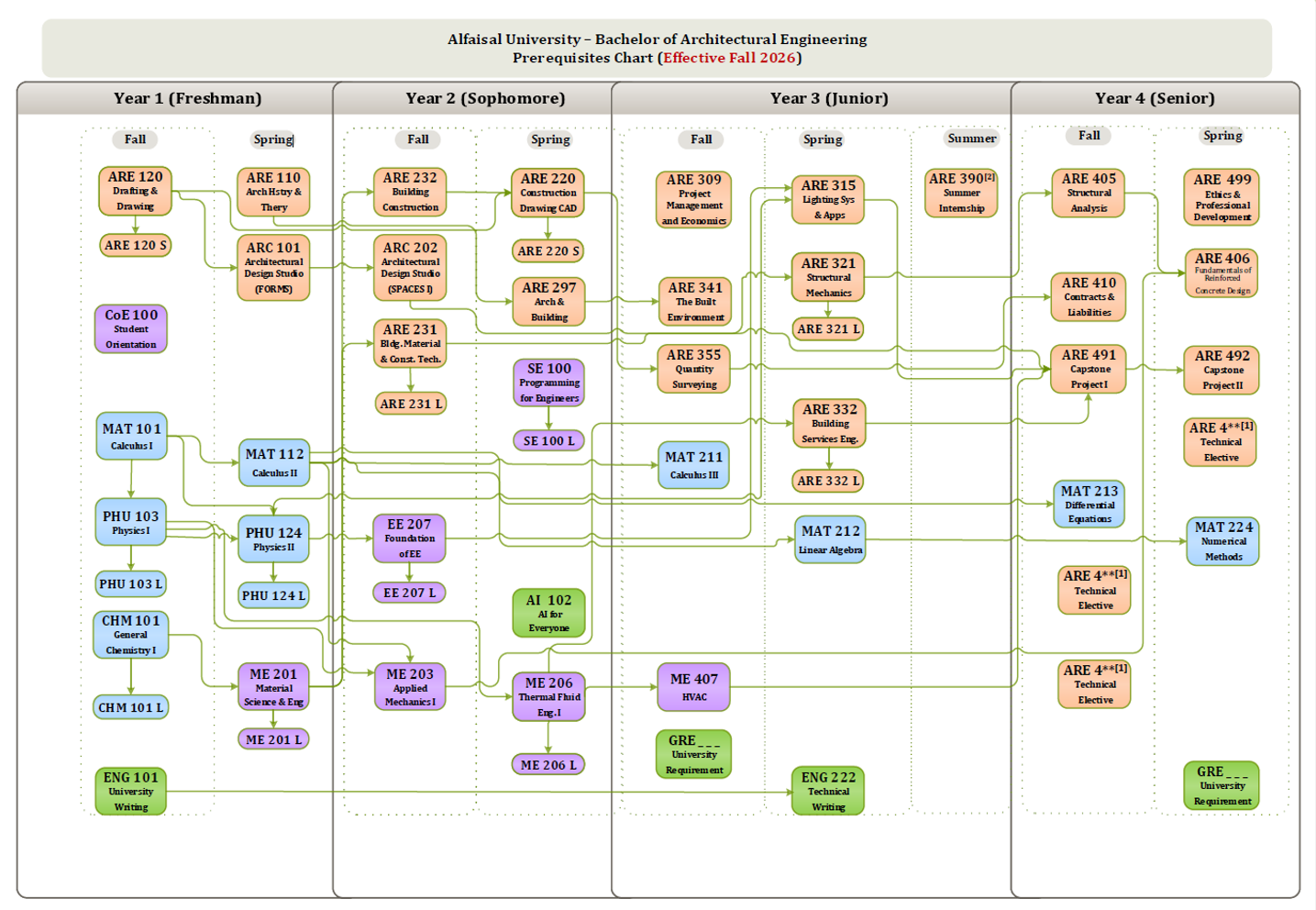
The Bachelor of Architectural Engineering curriculum is composed of 141 Credit Hours divided as follows:
University General Education Requirements (19 CRHs)
Arts & Humanities (9 CRHs)
Social Sciences (3 CRHs)
Sciences (7 CRHs)
College Requirements (49 CRHs)
Mathematics and Statistics (14 CRHs)
Basic Sciences (12 CRHs)
Engineering requirements (23 CRHs)
Major Requirements (73 CRHs)
Core Major Requirements (55 CRHs)
Technical Electives (9 CRHs)
Track electives (9 CRHs)
4. Internship (0 CRHs)
Reducing building energy consumption through adaptative and sustainable design has become a basic criterion of architectural practice. The aim of this track is to deepen students’ understanding and knowledge about basic principles and best practices of sustainability and high-performance buildings. Through this track, students will be able to develop problem-solving skills and market-driven solutions, which will help them become leaders in sustainable design and better serve their society. Emphasis will be placed on the analysis of the environmental impacts of buildings, and how we can mitigate these impacts through various and innovative design solutions/practices.
Through three electives students will be equipped with knowledge related to creating sustainable building structures and using processes and systems that are environmentally responsible and resource efficient. These courses will address a full range of issues associated with sustainable building including energy and water efficiency, materials, waste and stormwater management, and the building operational efficiency in relation to the use of advanced and smart technologies. There will be also a focus on principles of smart (IoT) and green building systems, and how the components of these two systems can integrate and interact with one another.
Track Course Requirements (12 CRHs):
In addition to completing the core course ARE 341 – The Built Environment, students should complete the following three technical electives courses:
- ARE 455 Sustainable Buildings. (Pre-requisite: ARE 341)
- ARE 475 Building Energy Management. (Pre-requisite: ARE 315)
- ARE 477 Smart Buildings. (Pre-requisite: ARE 341)
Construction management is primarily concerned with getting the project completed on time, budget and to the desired and stated specification. The course teaches the students how to manage and lead a construction project, using technical and leadership skills, within a multi-organizational team that work on a project’s lifecycle. Construction Management looks at engineering management as a cohesive process, examining projects from initiation through to completion, directing, planning and scheduling and communication which are key for the project success. Students get grips with a wide range of project management tools and techniques that are commonly used in the industry. Students who successfully complete the course will have gained practical experience with project management, allowing them to excel within their current role or in the next job. The construction management course offers:
- Get a critical understanding of the social, economic and environmental issues commonly affecting construction problems and the practical means to address them. Practical case studies will be presented to examine how project sites are equipped, manned and managed. Site visits will also be part of the teaching activities.
- Gain experience with important project management tools, techniques and software.
- Become contractually familiar with laws surrounding construction, particularly construction contract law.
- Examine case studies and develop appropriate project management processes and strategies.
- Gain an understanding of financial planning (planned and earned values).
Track Course Requirements (12 CRHs):
In addition to completing the core course ARE 309 – Project Management and Economics, students should complete the following three technical electives courses:
- ARE 480 Construction Economics and Finance. (Pre-requisite: ARE 355)
- ARE 482 Operation Analysis in Building Construction. (Pre-requisite: ARE 355)
- ARE 484 Construction Professional Practice. (Pre-requisite: ARE 309)