
Program Overview
The Bachelor of Industrial Engineering program at Alfaisal University provides students with a broad and rigorous education that integrates engineering, technology, and management. The program focuses on the design, analysis, improvement, and optimization of complex systems involving people, materials, information, equipment, energy, and financial resources.
Industrial engineers improve the efficiency, productivity, quality, safety, and sustainability of organizations. Their work extends beyond manufacturing to a wide range of sectors, including supply chain and logistics, healthcare, transportation, banking and financial services, information technology, government, and emerging industries.
The curriculum develops strong analytical, technical, and decision-making skills through coursework in operations research, production and service systems, quality engineering, simulation, engineering economy, human factors, supply chain management, and data-driven optimization. Students apply their knowledge through practical learning experiences, including an internship and a year-long capstone design project.
Students may broaden their academic experience through technical electives, minors, or a double major. They may also pursue the Digital Design and Manufacturing track, which provides focused preparation in Industry 4.0 technologies and modern product design and manufacturing systems.
Graduates are prepared for careers in areas such as industrial engineering, manufacturing, quality, process improvement, supply chain and logistics, operations management, human factors, and systems analysis. They are also well prepared to pursue advanced study in industrial engineering, engineering management, and related disciplines.
The Bachelor of Industrial Engineering program is accredited by the Engineering Accreditation Commission of ABET, reflecting its alignment with internationally recognized standards for engineering education.
Study Plan
The Bachelor of Industrial Engineering curriculum is composed of 132 Credit Hours divided as follows:
University General Education Requirements (18 CRHs)
Arts & Humanities (9 CRHs)
Social Sciences (6 CRHs)
Sciences (3 CRHs)
College Requirements (66 CRHs)
Mathematics and Statistics (21 CRHs)
Basic Sciences (12 CRHs)
Engineering requirements (33 CRHs)
Major Requirements (48 CRHs)
Core Major Requirements (39 CRHs)
Technical Electives (9 CRHs)
Internship (0 CRHs)
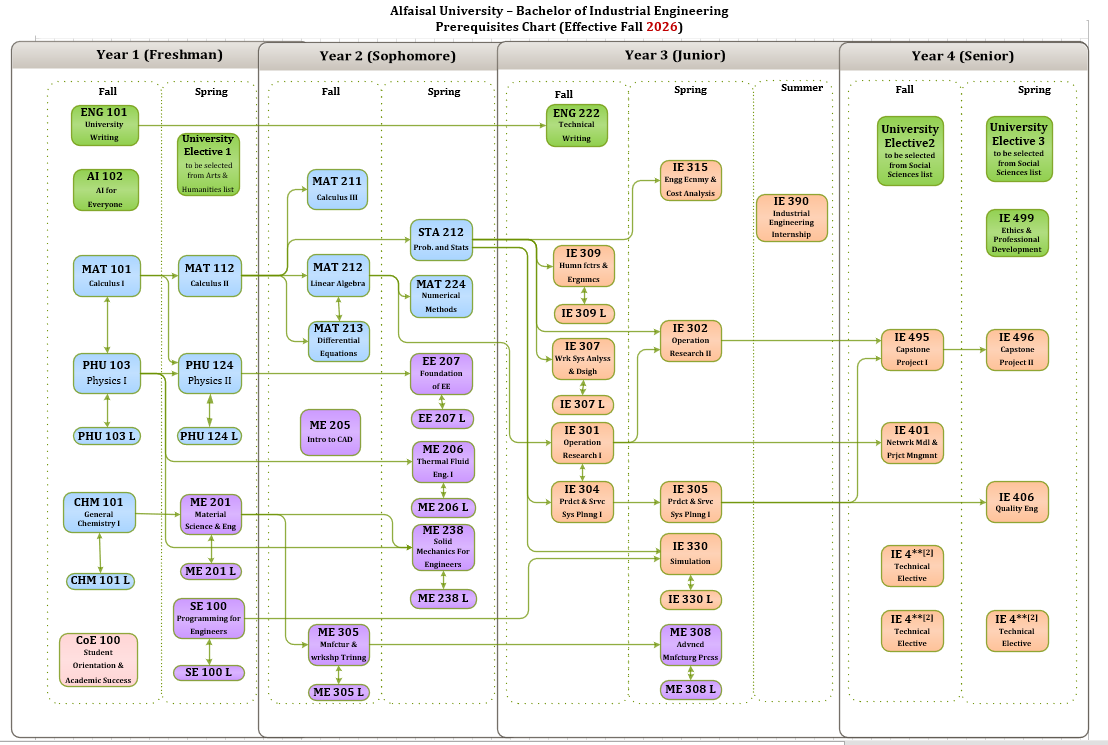
Additional 15 Credit Hours
Required Courses (6 CRHs)
• ME 308 Advanced Manufacturing Processes
• IE 315 Engineering Economy and Cost Analysis
Select ANY 3 courses from the list:
Optional Courses (select 9 CRHs)
In addition, students will need to complete three courses (9 CRH) from the list below:
• ME 419 Product Design and Development
• ME 420 Advanced Visualization and Simulation
• IE 455 Data Mining and Application in Engineering
• IE 460 Industrial IoT
Additional 15 Credit Hours
Required Courses (6 CRHs)
IE 301 Operations Research I (3 CRHs).
IE 304 Production and Service Systems Planning I (3 CRHs)
Optional Courses (select 9 CRHs)
IE 302 Operations Research II (3 CRHs).
IE 305 Production and Service Systems Planning II (3 CRHs).
IE 307 Work System Analysis & Design (3 CRHs).
IE 307 L Work System Analysis & Design Lab (1 CRHs).
IE 315 Engineering Economy and Cost Analysis (3 CRHs).
IE 330 Simulation (3 CRHs).
IE 330 L Simulation Lab (1 CHR).
IE 401 Network Models and Project Management (3 CRHs).
IE 406 Quality Engineering (3 CRHs)
Students from other colleges must also complete the following pre-requisite courses or their equivalent where needed.
STA 212 Probability and Statistics
MAT 212 Linear Algebra
Additional 15 Credit Hours
Required Courses (6 CRHs)
IE 315 Engineering Economy and Cost (3 CRHs)
EE 481 Innovations and Entrepreneurship in Engineering (3 CRHs)
OR BME 422 Medical Device Innovation and Entrepreneurship (3 CRHs)
OR ME 419 Product Design and Development
Optional Courses (select 9 CRHs)
IE 401 Network Models and Project Management (3 CRHs).
IE 404 Quantitative Methods for Engineering Decision Making (3 CRHs).
IE 406 Quality Engineering (3 CRHs).
IE 450 Management for Engineers (3 CRHs).
IE 460 Industrial Internet of Things (3 CRHs).
EE 410 Cyber Physical Systems (3 CRHs)
MGT 375: Introduction to Entrepreneurship Analysis (3 CRHs).
Additional 24 Credit Hours
Required Courses (9 CRHs)
IE 301 Operations Research I (3 CRHs).
IE 304 Production and Service Systems Planning I (3 CRHs).
IE 401 Network Models and Project Management (3 CRHs).
Optional Courses (select 15 CRHs)
- IE 302 Operations Research II (3 CRHs).
- IE 305 Production and Service Systems Planning II (3 CRHs).
- IE 307 Work System Analysis &Design (3 CRHs).
IE 307 L Work System Analysis & Design Lab (1 CRH).
IE 315 Engineering Economy and Cost Analysis (3 CRHs).
IE 330 Simulation (3 CRHs).
IE 330 L Simulation Lab (1 CRH).
IE 406 Quality Engineering (3 CRHs).
Students from other colleges must also complete the following pre-requisite courses or their equivalent where needed.
STA 212 Probability and Statistics
MAT 212 Linear Algebra
- The double major, minor, or track must be an approved academic specialization offered by Alfaisal University.
- Enrollment in a double major, minor, or track is optional and may only take place after admission to the student's primary major.
- Academic advising is required before enrolling in any additional academic pathway to ensure proper academic planning and timely degree completion.
- Students may register for courses in both their primary major and their secondary major, minor, or track concurrently, subject to university regulations governing academic load and prerequisite requirements.
- Graduation from the University requires the successful completion of all requirements of the primary major. Completion of a double major, minor, or track is optional, and withdrawal from an additional academic pathway will not affect eligibility for graduation from the primary major.
- A student may discontinue a double major, minor, or track with the approval of the relevant academic department(s), provided that all University policies and procedures are followed.
Academic Pathway Eligibility and Requirements
- Students may select a combination of academic pathways from the University's approved list of double majors, minors, and tracks.
- Academic advising is required prior to applying for any additional academic pathway.
- Students must have completed a minimum of 60 credit hours in their primary major before applying.
- A minimum cumulative GPA of 3.50/4.00 is required for a Double Major, while a minimum cumulative GPA of 3.00/4.00 is required for a Minor or Track.
- Careful academic planning is essential, as course sequencing and the completion of all prerequisite requirements must be observed.
- Students pursuing a Double Major may require up to two additional semesters beyond the normal study duration, while students pursuing a Minor may require up to one additional semester, depending on their academic plan and course scheduling.