
Program Preview
Mechanical Engineering is concerned with the design, development, manufacturing, and maintenance of machines, mechanical parts, and components based on the principles of engineering, physics, and materials science. It is one of the oldest and broadest engineering disciplines.
Mechanical Engineering overlaps with several other engineering fields, including aerospace, architectural, biomedical, civil, chemical, computer, electrical, electronics and communications, industrial, instrumentation, materials, metallurgical, nuclear, and petroleum engineering.
The field requires an understanding of core concepts such as mechanics, kinematics, thermodynamics, materials science, structural analysis, and power. Mechanical engineers apply these principles using tools such as computer-aided engineering and product lifecycle management to design and analyze manufacturing plants, industrial equipment and machinery, heating and cooling systems, transportation systems, aircraft, watercraft, robotics, medical devices, military equipment, and other mechanical systems.
Competitive Edge
The Mechanical Engineering program at Alfaisal University emphasizes up-to-date technologies, practical applications, and current industrial needs. The program focuses on producing highly qualified graduates and preparing them to address challenges in the industry.
The program covers three major areas: Thermofluids, Manufacturing, and Design. These areas cover energy conversion, power plant technology, air conditioning, renewable energy systems, energy efficiency, the design and manufacturing of machines and components, and materials.
Students may broaden their academic experience through technical electives, minors, or a double major. They may also pursue the Digital Design and Manufacturing track, which provides focused preparation in Industry 4.0 technologies and modern product design and manufacturing systems. Students may also take elective courses related to aerospace and automotive industries in their final year.
The program’s faculty members hold degrees from internationally recognized universities and contribute to high-quality research in both established and emerging disciplines. In addition, small class sizes provide students with opportunities for individualized learning.
The Bachelor of Mechanical Engineering program is accredited by the Engineering Accreditation Commission of ABET, reflecting its alignment with internationally recognized standards for engineering education.
Study Plan
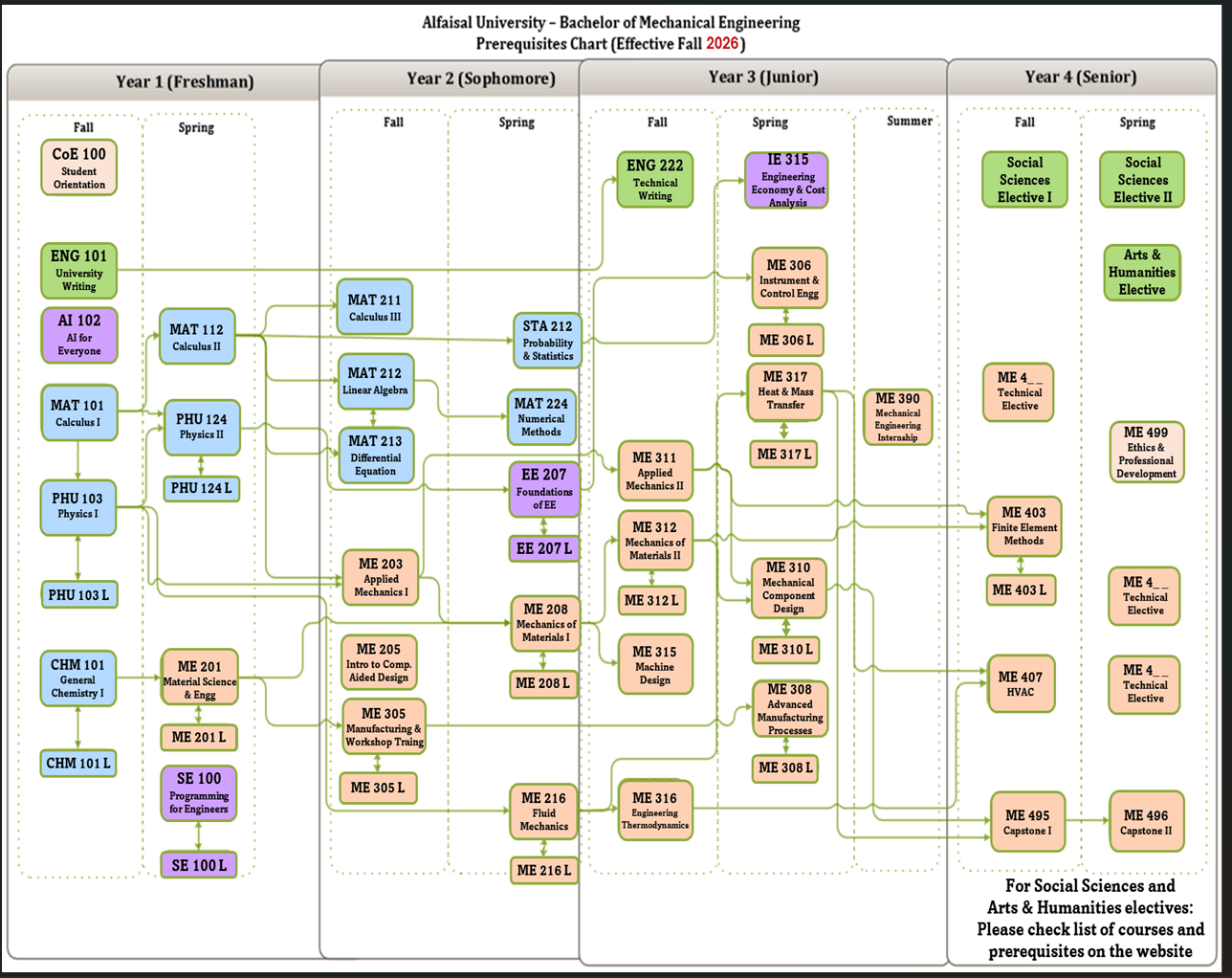
The Bachelor of Mechanical Engineering curriculum is composed of 137 Credit Hours (CRHs) divided as follows:
University General Education Requirements (18 CRHs)
Arts & Humanities (9 CRHs)
Social Sciences (6 CRHs)
Sciences (3 CRHs)
College Requirements (45 CRHs)
Mathematics and Statistics (21 CRHs)
Basic Sciences (12 CRHs)
Engineering requirements (12 CRHs)
Major Requirements (74 CRHs)
Core Major Requirements (65 CRHs)
Technical Electives (9 CRHs)
Internship (0 CRHs)
* ME 435 requires department chair approval, a minimum 3.0 GPA, and a signed research contract.
Additional 15 Credit Hours
Required Courses: (6 CRHs):
- ME 308 Advanced Manufacturing Processes (3 CRHs).
- IE 315 Engineering Economy and Cost Analysis (3 CRHs).
Optional Courses: select 3 courses (9 CRH) from the list below:
- ME 419 Product Design and Development (3 CRHs).
- ME 420 Advanced Visualization and Simulation (3 CRHs).
- IE 455 Data Mining and Application in Engineering (3 CRHs).
- IE 460 Industrial IoT (3 CRHs).
Additional 15 Credit Hours
Required Courses (7 CRHs):
- ME 311 Applied Mechanics II: Dynamics
- ME 312 Mechanics of Materials II
- ME 312 L Mechanics of Materials II Lab
Optional Courses (Select 8 CRHs)
- ME 315 Machine Design
- ME 316 Engineering Thermodynamics
- ME 317 Heat and Mass Transfer
- ME 317 L Heat and Mass Transfer Lab
- ME 310 Mechanical Component Design
- ME 310 L Mechanical Component Design Lab
- ME 407 Heating, Ventilation, and Air-Conditioning
Students from other colleges or programs are responsible for completing all stated prerequisites or approved equivalents.
Additional 25 Credit Hours
Required Courses (14 credit hours):
- ME 310 Mechanical Component Design
- ME 310 L Mechanical Component Design Lab
- ME 311 Applied Mechanics II: Dynamics
- ME 312 Mechanics of Materials II
- ME 312 L Mechanics of Materials II Lab
- ME 315 Machine Design
Optional Courses (Select ANY 11 credit hours)
- ME 306 Instrumentation and Control Engineering
- ME 306 L Instrumentation and Control Engineering Lab
- ME 316 Engineering Thermodynamics
- ME 317 Heat and Mass Transfer
- ME 317 L Heat and Mass Transfer
- ME 403 Finite Element Methods
- ME 403 L Finite Element Methods
- ME 407 Heating, Ventilation, and Air-Conditioning
Students from other colleges or programs are responsible for completing all stated prerequisites or approved equivalents.
- The double major, minor, or track must be an approved academic specialization offered by Alfaisal University.
- Enrollment in a double major, minor, or track is optional and may only take place after admission to the student's primary major.
- Academic advising is required before enrolling in any additional academic pathway to ensure proper academic planning and timely degree completion.
- Students may register for courses in both their primary major and their secondary major, minor, or track concurrently, subject to university regulations governing academic load and prerequisite requirements.
- Graduation from the University requires the successful completion of all requirements of the primary major. Completion of a double major, minor, or track is optional, and withdrawal from an additional academic pathway will not affect eligibility for graduation from the primary major.
- A student may discontinue a double major, minor, or track with the approval of the relevant academic department(s), provided that all University policies and procedures are followed.
Academic Pathway Eligibility and Requirements
- Students may select a combination of academic pathways from the University's approved list of double majors, minors, and tracks.
- Academic advising is required prior to applying for any additional academic pathway.
- Students must have completed a minimum of 60 credit hours in their primary major before applying.
- A minimum cumulative GPA of 3.50/4.00 is required for a Double Major, while a minimum cumulative GPA of 3.00/4.00 is required for a Minor or Track.
- Careful academic planning is essential, as course sequencing and the completion of all prerequisite requirements must be observed.
- Students pursuing a Double Major may require up to two additional semesters beyond the normal study duration, while students pursuing a Minor may require up to one additional semester, depending on their academic plan and course scheduling.