
About the Program
The Bachelor of Electrical Engineering at Alfaisal University provides a broad and rigorous education across the core areas of the discipline, including electronics, power systems, communications, and control. The curriculum also integrates essential computing principles to prepare students for the digital and interconnected nature of contemporary engineering practice. Breadth is supported through university electives drawn from the humanities, social sciences, and general sciences. The program is accredited by the Engineering Accreditation Commission of ABET, reflecting alignment with international standards.
Students gain depth through technical electives and may pursue a track in Renewable Energy or a general pathway. Additional opportunities exist to complement the major with minors or double majors across the university. Real-world preparation is emphasized through a required summer internship and a year long capstone design project.
Graduates gain strong analytical grounding, practical engineering competence, and professional readiness. They pursue careers across sectors such as power and energy, electronics, communications, automation and control, robotics, and emerging technology domains, or pursue advanced study.
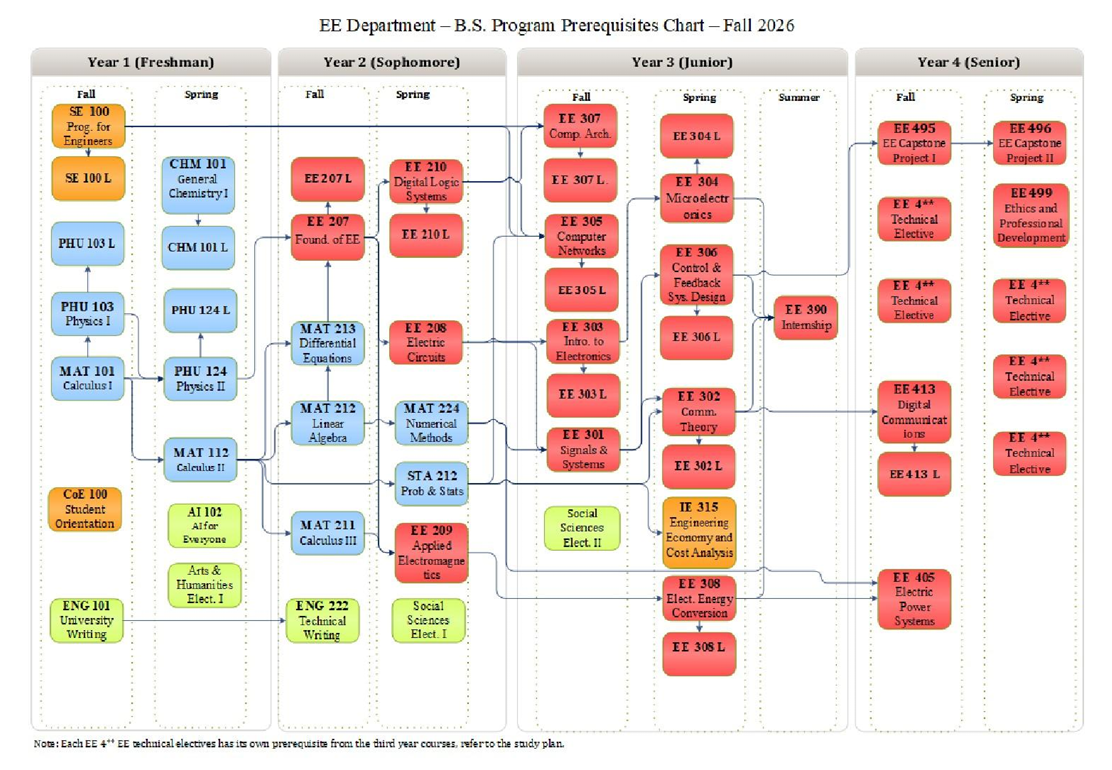
Required Courses (30 CRHs)
Required Courses (15 CRHs).
- Optional Courses: Select any two courses (6 CRHs) from the following list:
- Required Courses: (9 CRHs) with Prerequisites
Electrical Engineering Tracks:
All EE students can select their electives in the fourth year according to their desired academic objective in consultation with their academic advisor and available offerings within the department.
Students can select the non-track option or the Renewable Energy Track. Both options have the same required courses, and the track will only determine the choice of electives in the fourth (senior) year. The total of credit hours for the electives is 15 CRHs for all four tracks.
Bachelor of Electrical Engineering – Renewable Energy Track
The Renewable Energy track at Alfaisal University is a specialization within electrical engineering focused on generating electrical power from various renewable sources. The track covers key topics such as power plant planning, the theory and practical design of renewable and non-renewable energy sources, grid integration, and engineering economy factors involved in design and deployment. Renewable energy resources include a wide range of established and experimental plants, such as solar, wind, hydro, tidal, wave, biomass, and geothermal energy. It also covers energy storage technologies like fuel cells and pumped hydro. Emphasis is placed on integrating these energy sources into the power grid using power electronics theory and practice.
Graduates will develop multiple technical and transferable skills, including strong analytical abilities and leadership in complex design projects. Electrical renewable energy engineers have diverse employment opportunities across power generation, conversion, distribution, and management sectors—including power utilities, factories, consultancy firms, and domestic markets—where renewable energy systems are increasingly in demand.
Track Course Requirements:
In addition to completing the core course: EE 308 + L – Electrical Energy Conversion and EE 405 Electric Power Systems, students should complete the following four courses as technical electives:
• EE 410 Cyber-Physical Systems
• EE 420 Power Electronics
• EE 426 Renewable Energy
Equivalents to EE 410 may be sought in technical elective courses in control and robotics. Advisor’s and Chair’s prior approval are required.
The student will need to further complete the program’s elective requirements, and have a capstone project themed according to the track.