Bachelor of Industrial Engineering

Degree Type
Bachelor,
Major,
Minor,
Track

Program Overview

The Bachelor of Industrial Engineering program at Alfaisal University provides students with a broad and rigorous education that integrates engineering, technology, and management. The program focuses on the design, analysis, improvement, and optimization of complex systems involving people, materials, information, equipment, energy, and financial resources.

Industrial engineers improve the efficiency, productivity, quality, safety, and sustainability of organizations. Their work extends beyond manufacturing to a wide range of sectors, including supply chain and logistics, healthcare, transportation, banking and financial services, information technology, government, and emerging industries.

The curriculum develops strong analytical, technical, and decision-making skills through coursework in operations research, production and service systems, quality engineering, simulation, engineering economy, human factors, supply chain management, and data-driven optimization. Students apply their knowledge through practical learning experiences, including an internship and a year-long capstone design project.

Students may broaden their academic experience through technical electives, minors, or a double major. They may also pursue the Digital Design and Manufacturing track, which provides focused preparation in Industry 4.0 technologies and modern product design and manufacturing systems.

Graduates are prepared for careers in areas such as industrial engineering, manufacturing, quality, process improvement, supply chain and logistics, operations management, human factors, and systems analysis. They are also well prepared to pursue advanced study in industrial engineering, engineering management, and related disciplines.

The Bachelor of Industrial Engineering program is accredited by the Engineering Accreditation Commission of ABET, reflecting its alignment with internationally recognized standards for engineering education.

Study Plan

The Bachelor of Industrial Engineering curriculum is composed of 132 Credit Hours divided as follows:

University General Education Requirements (18 CRHs)

  1. Arts & Humanities (9 CRHs)

  1. Social Sciences (6 CRHs)

  1. Sciences (3 CRHs)


College Requirements (66 CRHs)

  1. Mathematics and Statistics (21 CRHs)

  1. Basic Sciences (12 CRHs)

  1. Engineering requirements (33 CRHs)


Major Requirements (48 CRHs)

  1. Core Major Requirements (39 CRHs)

  1. Technical Electives (9 CRHs)

  1. Internship (0 CRHs)


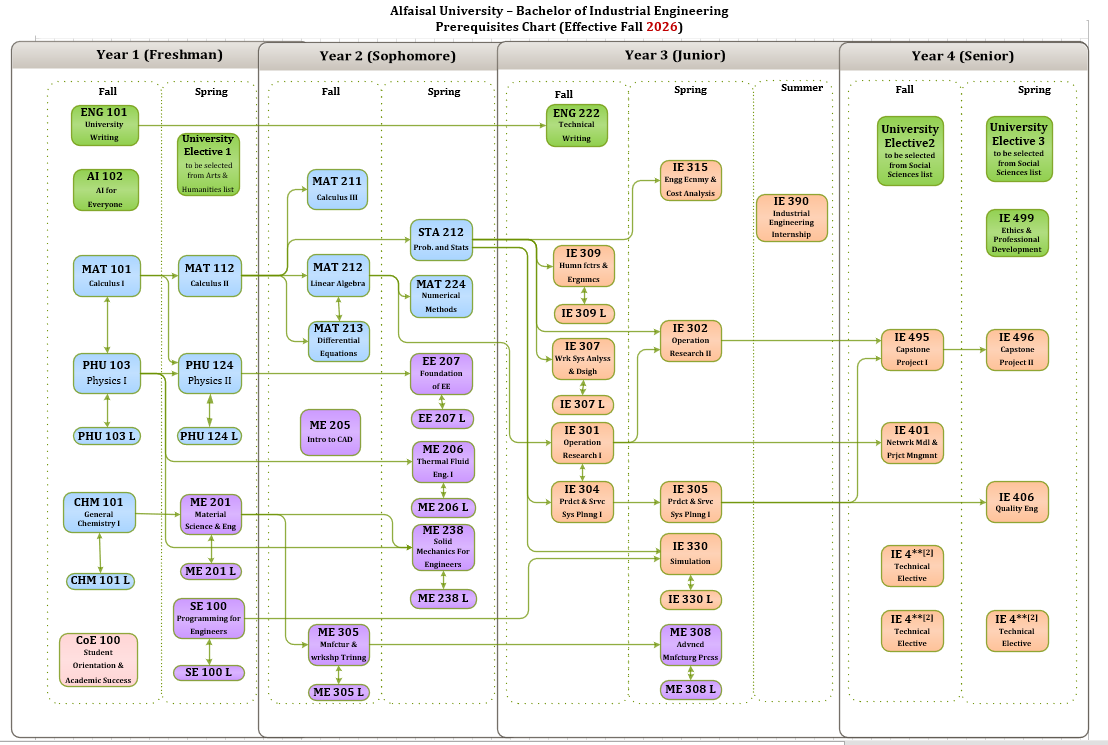
    Prerequisite Flowchart

Item #
Title
Credits
CHM 101Chemistry ICreditsDepartments3.00

CHM 101 is the first semester course of a two semesters General Chemistry sequence for students majoring in science, or preparing for entry into health professional programs such as medicine, dentistry, pharmacy and veterinary science. CHM 101 provides a comprehensive introduction to the basic principles of chemistry including atomic and molecular structure, properties of gases, liquids and solids, and chemical thermodynamics.

CHM 101 LChemistry I labCreditsDepartments1.00General Chemistry I Lab provides an introduction to the fundamentals of laboratory techniques in chemistry. Students will carry out measurements, prepare solutions, and perform qualitative and quantitative experiments.
MAT 101Calculus ICreditsDepartments3.00This course introduces the basic concepts of mathematical analysis used in science and engineering. The course teaches an introduction to differential and integral calculus. Topics include limits; the derivative; rates; Newton's method; the mean-value theorem; max-min problems; the integral and the fundamental theorem of integral calculus; areas, volumes, and average values.
PHU 103Physics ICreditsDepartments3.00

PHU 103 – Physics I is an introductory physics course designed for students in the College of Engineering at Alfaisal University. It is a required course that fulfills part of their science requirements. The course material requires knowledge of differential and integral calculus. Topics covered include the fundamentals of Newtonian mechanics, harmonic motion, mechanical waves, and sound. The course is supported by a mandatory laboratory component, which consists of approximately 11 experiments conducted alongside the theoretical material covered in class.

PHU 103 LPhysics I LabCreditsDepartments1.00This material constitutes the laboratory related to the course PHU 103.
AI 102AI for Everyone: Foundation and Applications CreditsDepartments3.00

This course introduces students from all disciplines to the foundations of Artificial Intelligence (AI),
combining conceptual understanding with practical application in everyday life, education, business, and
society. It provides a non-technical overview of key AI concepts, techniques, and tools, including how
machines learn (machine learning), how generative systems create content (generative AI), how
machines understand human language (natural language processing), and how machines interpret
images (computer vision). In addition, the course addresses ethical principles, regulations, and
responsible AI use, with particular attention to bias, chatbots, and large language models in educational
contexts. Learners examine AI’s impact on daily life, social media, data-driven decision-making, and the
creative arts. Hands-on components introduce AI programming through visual coding, enabling students
to develop foundational technical skills alongside critical and societal awareness.
 

Sub-Total Credits
18
Item #
Title
Credits
SE 100Programming for EngineersCreditsDepartments3.00

SE 100: Programming for Engineers 3 (3-0-0) The course introduces the students to basic notions of computers and computing and then introduces them to programming starting from abstract ways like flowcharts and pseudocode and finally using a typical programming language. The students will be introduced to the basic concepts of data types and structures, operators, and the different ways of data storage, manipulation, and representation. Emphasis is on problem-solving and structured program design methodologies.

SE 100 LProgramming for Engineers LabCreditsDepartments1.00

This course constitutes the lab component of the Programming for Engineer course (SE 100). The purpose of this lab is to provide hands-on training on programming concepts, technologies and techniques, introduced during lectures.

PHU 124Physics IICreditsDepartments3.00

The material of this course requires knowledge of differential and integral calculus. The covered material includes the basics of electricity and magnetism, electromagnetic radiation, and optics.


Prerequisite Courses: ( MAT 101 AND PHU 103 ) OR ( MAT 105 AND PHU 205 )

PHU 124 LPhysics II LabCreditsDepartments1.00This material constitutes the laboratory related to the course PHU 124.
3
Sub-Total Credits
18
Item #
Title
Credits
STA 212Probability and StatisticsCreditsDepartments3.00

This course introduces the basic concepts of descrip2ve and inferen2al sta2s2cs used in science and
engineering. The course teaches (1) how to use data to make numerical conjectures about biological,
medical and agricultural problems; (2) how to summarize and analyze data and interpret the results.
Topics include histograms, average, standard devia2on, the normal curve, linear regression,
es2ma2on, correla2on, confidence intervals, hypothesis tes2ng, measurement error and tests of
sta2s2cal significance.

Prerequisite Courses: MAT 112 OR MAT 116

Sub-Total Credits
18
Item #
Title
Credits
ENG 222Technical WritingCreditsDepartments3.00

Technical Writing develops students’ advanced reading, listening, speaking, and research skills for effective communication in technical and professional contexts. The course emphasizes the language and discourse conventions of students’ chosen fields, enabling them to engage with technical information, conduct field-specific research, and communicate complex ideas clearly and effectively in advanced written and spoken forms.

Prerequisite Courses :ENG 101 OR ENG 102

Sub-Total Credits
17
Item #
Title
Credits
3
3
3
Sub-Total Credits
15
Item #
Title
Credits
3
3
Sub-Total Credits
13
Item #
Title
Credits
3
3
3
Sub-Total Credits
9

Additional 15 Credit Hours 

Required Courses (6 CRHs)

ME 308 Advanced Manufacturing Processes

IE 315 Engineering Economy and Cost Analysis


Select ANY 3 courses from the list:

Optional Courses (select 9 CRHs)

In addition, students will need to complete three courses (9 CRH) from the list below:

• ME 419 Product Design and Development

• ME 420 Advanced Visualization and Simulation

• IE 455 Data Mining and Application in Engineering

• IE 460 Industrial IoT

Item #
Title
Credits
ME 419Product Design and DevelopmentCreditsDepartments3.00This course will introduce students to thought frameworks, tools and methods for product design and development. The course will teach students a set of product development procedures that can be practiced in multidisciplinary teams. Topics include opportunity identification, product planning, identifying customer needs and specification, concept generation, selection and testing as well as designing of environment and manufacturing. The course will include projects-based assignments.
ME 420Advanced Visualization and SimulationCreditsDepartments3.00This course will introduce students to use computer-aided packages in the product design and manufacturing process. Students will be exposed to CAD/CAE/CAM packages which are used in the industry to perform analysis and evaluate performance of engineering products and to optimize manufacturing processes. The course will be hands-on and will involve ample project-based activities along with lecture-based instructions.
IE 445Cognitive ErgonomicsCreditsDepartments3.00

 This course provides basic knowledge about cognitive ergonomics and Human Computer Interaction and to provide insights about those peculiar aspects that link design to ergonomics. Special attention will be given to the “communicative” aspects of user-centered design, both in reference to usability and aesthetic pleasantness, and to the methods developed to evaluate the User Experience. 

IE 460Industrial IoTCreditsDepartments3.00

The course teaches basics of Industrial Internet of Things (IIoT). Investigation of data modeling, storage, acquisition and utilization in Industrial and service settings via computerized methods. It develops an understanding on the data generated by IIoT and how it is collected; recognizes the problems involved with gathering data and some approaches for addressing these problems; provides an overview of data storage; appreciate programming languages such as Python as time-saving tools for manipulating data, understand the process of data acquisition; analyze where to process data using Edge, Fog or Cloud; understand how, when and where to bundle and store IIoT data, appreciate the costs and benefits of live data versus stored data, learn how Python can be used to assist with analysis of large datasets, and understand some methods for cleaning, summarizing and visualizing large datasets.

Sub-Total Credits
15

Additional 15 Credit Hours

Required Courses (6 CRHs) 

  • IE 301 Operations Research I (3 CRHs). 

  • IE 304 Production and Service Systems Planning I (3 CRHs)


Optional Courses (select 9 CRHs) 

  • IE 302 Operations Research II (3 CRHs). 

  • IE 305 Production and Service Systems Planning II (3 CRHs).   

  • IE 307 Work System Analysis & Design (3 CRHs).

  • IE 307 L Work System Analysis & Design Lab (1 CRHs). 

  • IE 315 Engineering Economy and Cost Analysis (3 CRHs).

  • IE 330 Simulation (3 CRHs). 

  • IE 330 L Simulation Lab (1 CHR). 

  • IE 401 Network Models and Project Management (3 CRHs).      

  • IE 406 Quality Engineering (3 CRHs)

Item #
Title
Credits
Sub-Total Credits
15

Students from other colleges must also complete the following pre-requisite courses or their equivalent where needed.

  • STA 212 Probability and Statistics

  • MAT 212 Linear Algebra

Additional 15 Credit Hours 

Required Courses (6 CRHs)

  • IE 315 Engineering Economy and Cost (3 CRHs)

  • EE 481 Innovations and Entrepreneurship in Engineering (3 CRHs)

  • OR BME 422 Medical Device Innovation and Entrepreneurship (3 CRHs) 

  • OR ME 419 Product Design and Development

Optional Courses (select 9 CRHs)

  • IE 401 Network Models and Project Management (3 CRHs).

  • IE 404 Quantitative Methods for Engineering Decision Making (3 CRHs).

  • IE 406 Quality Engineering (3 CRHs).

  • IE 450 Management for Engineers (3 CRHs).

  • IE 460 Industrial Internet of Things (3 CRHs).

  • EE 410 Cyber Physical Systems (3 CRHs)

  • MGT 375: Introduction to Entrepreneurship Analysis (3 CRHs).

Item #
Title
Credits
ME 419Product Design and DevelopmentCreditsDepartments3.00This course will introduce students to thought frameworks, tools and methods for product design and development. The course will teach students a set of product development procedures that can be practiced in multidisciplinary teams. Topics include opportunity identification, product planning, identifying customer needs and specification, concept generation, selection and testing as well as designing of environment and manufacturing. The course will include projects-based assignments.
IE 460Industrial IoTCreditsDepartments3.00

The course teaches basics of Industrial Internet of Things (IIoT). Investigation of data modeling, storage, acquisition and utilization in Industrial and service settings via computerized methods. It develops an understanding on the data generated by IIoT and how it is collected; recognizes the problems involved with gathering data and some approaches for addressing these problems; provides an overview of data storage; appreciate programming languages such as Python as time-saving tools for manipulating data, understand the process of data acquisition; analyze where to process data using Edge, Fog or Cloud; understand how, when and where to bundle and store IIoT data, appreciate the costs and benefits of live data versus stored data, learn how Python can be used to assist with analysis of large datasets, and understand some methods for cleaning, summarizing and visualizing large datasets.

Sub-Total Credits
15

Additional 24 Credit Hours 


Required Courses (9 CRHs) 

  • IE 301 Operations Research I (3 CRHs). 

  • IE 304 Production and Service Systems Planning I (3 CRHs). 

  • IE 401 Network Models and Project Management (3 CRHs).

Optional Courses (select 15 CRHs) 

  • IE 302 Operations Research II (3 CRHs).
  • IE 305 Production and Service Systems Planning II (3 CRHs).
  • IE 307 Work System Analysis &Design (3 CRHs).
  • IE 307 L Work System Analysis & Design Lab (1 CRH).

  • IE 315 Engineering Economy and Cost Analysis (3 CRHs).

  • IE 330 Simulation (3 CRHs).

  • IE 330 L Simulation Lab (1 CRH).

  • IE 406 Quality Engineering (3 CRHs).


Item #
Title
Credits
Sub-Total Credits
24

Students from other colleges must also complete the following pre-requisite courses or their equivalent where needed.

  • STA 212 Probability and Statistics

  • MAT 212 Linear Algebra

  • The double major, minor, or track must be an approved academic specialization offered by Alfaisal University.
  •  Enrollment in a double major, minor, or track is optional and may only take place after admission to the student's primary major.
  • Academic advising is required before enrolling in any additional academic pathway to ensure proper academic planning and timely degree completion.
  •  Students may register for courses in both their primary major and their secondary major, minor, or track concurrently, subject to university regulations governing academic load and prerequisite requirements.
  • Graduation from the University requires the successful completion of all requirements of the primary major. Completion of a double major, minor, or track is optional, and withdrawal from an additional academic pathway will not affect eligibility for graduation from the primary major.
  • A student may discontinue a double major, minor, or track with the approval of the relevant academic department(s), provided that all University policies and procedures are followed.
 

Academic Pathway Eligibility and Requirements

  • Students may select a combination of academic pathways from the University's approved list of double majors, minors, and tracks.
  • Academic advising is required prior to applying for any additional academic pathway.
  • Students must have completed a minimum of 60 credit hours in their primary major before applying.
  • A minimum cumulative GPA of 3.50/4.00 is required for a Double Major, while a minimum cumulative GPA of 3.00/4.00 is required for a Minor or Track.
  • Careful academic planning is essential, as course sequencing and the completion of all prerequisite requirements must be observed.
  • Students pursuing a Double Major may require up to two additional semesters beyond the normal study duration, while students pursuing a Minor may require up to one additional semester, depending on their academic plan and course scheduling.